
When I found out I was pregnant with twins, I couldn’t imagine how completely my life was about to turn upside down. Not just because those two little hearts beating on the ultrasound would soon become two babies crying at exactly the same time, but because of the whirlwind my life was about to become. Two more babies would follow, all in four years.
Very quickly, our home in Barcelona became a noisy, messy children’s playground. Luckily, before the twins arrived, I had still had enough time to read tons of parenting books that promised to teach me how to do everything right.
Most of that parenting literature quickly went out the window. What remained was survival.
I took parenting very seriously
At the beginning, I was determined to help my twins discover the world in the best possible way. I followed the latest baby-led feeding trends, bought almost everything you could imagine to encourage their development, and watched them constantly. I took parenting very seriously.
Then two little girls arrived, one after the other, and family life became even harder to control. At times, I felt — and still do — like a juggler who had already dropped all the balls but was somehow still trying to keep the show going.
Courtesy of the author
I tried hard to watch everything that all four of them did and step in before anyone became frustrated. Spoiler: It was physically and mentally impossible.
No plan ever worked perfectly. Whenever we decided to take a lovely family walk, one of the kids would suddenly have a meltdown or have a massive diaper blowout. If I solved one disagreement, another would start somewhere else.
Once, we even managed to go out for a coffee while one of the boys was in the middle of a tantrum. In all the chaos, we left the keys inside the house and had to break a window to get back in. At that point, tired of fighting against the elements, I gave up on perfectionism and control and decided — or perhaps was forced — to let life flow a little more. A little more Mediterranean.
Surprisingly, that was what worked for me.
Children in Spain are part of public life
I’ve loosened my grip, helped by the fact that I’m raising my children in Spain, where parenting can feel less closely supervised than what I often see described in the US. Children here are also very much part of public life. They don’t disappear from restaurants when the sun goes down, and family life doesn’t necessarily end when adult social life begins.
Courtesy of the author
Even when I’m alone with my four kids, other adults talk to them naturally. People ask their names, their ages, what year they’re in at school, and sometimes even about their friends. Waiters joke with them. Neighbors stop to talk to them. Other parents intervene casually if someone needs a hand. When my children feel comfortable, they answer for themselves.
That social life has changed the way I parent more than I expected.
We spend a lot of time outside, especially in summer, when evenings in Spain seem designed to stretch on forever. We eat at restaurants, walk along seafront promenades, and go to the fiestas mayores that fill towns and villages with music, food, rides, and people of every generation. It is completely normal to see children still outside late at night, running through a plaza while their parents or grandparents sit nearby talking.
My children play freely in busy squares while I stay close enough to see them. They build sandcastles on the beach while I watch from our chairs. They splash around in the shallow children’s pool while I’m beside it. At puppet shows, they choose where they want to sit while I stay a few meters away on the promenade.
Restaurants have become another small training ground for independence. In bars and restaurants we know well, I sometimes let the older ones go to the counter, order something and pay themselves with my card. They know I’m there, and so do I. I supervise, but I try not to intervene unless they need me.
The first few times, I wanted to follow them and make sure they said everything correctly. Now I watch them work it out. Those tiny responsibilities seem to make them feel more confident and give them a small taste of freedom. And we all seem happier than when I was trying to keep them permanently within arm’s reach.
My kids have more freedom in Spain
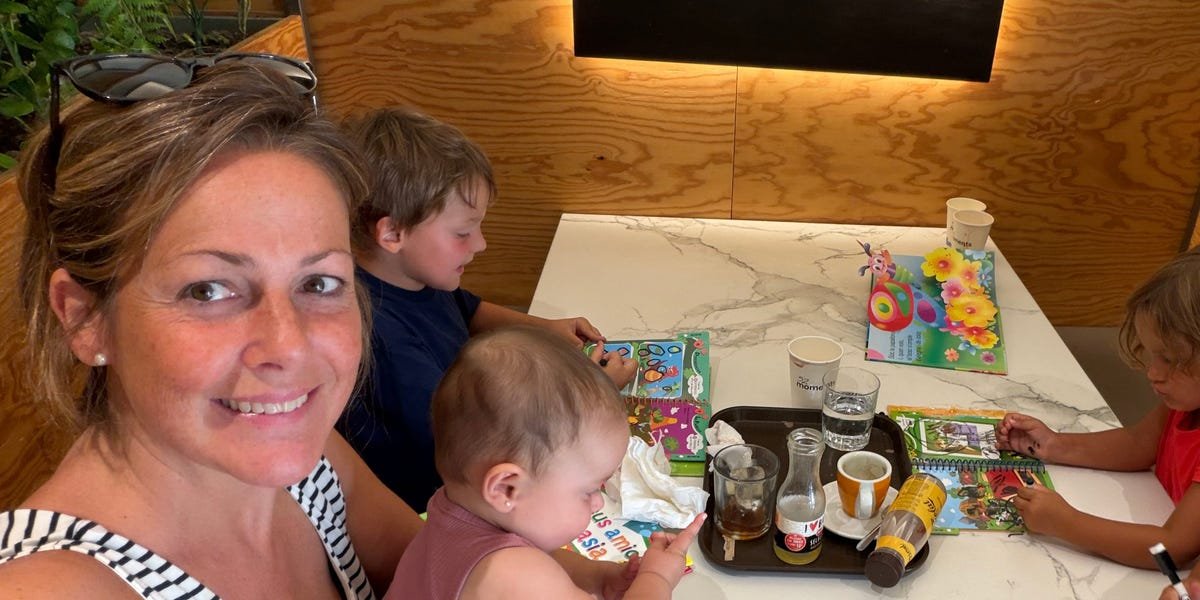
Spanish social life allows me to give them some of that freedom, and, unexpectedly, it has also made the logistics of having four very young children easier. When we’re out, life doesn’t have to stop because one child needs something. Someone can be eating while another is playing. A tired child can sleep while the rest of us finish dinner.
At home, something similar has happened. Because I can’t immediately respond to four children at once — especially when I’m breastfeeding the baby or have her in my arms — they’ve had to learn to cooperate with one another.
And children, unsurprisingly, don’t particularly enjoy waiting. So they’ve started finding their own solutions. The older ones help their younger sisters climb onto a ride at the park. If someone can’t reach something, another child will sometimes get it. If one of them doesn’t know how to do something, a sibling may step in before I do. Not always, of course. Sometimes the proposed solution is considerably worse than the original problem. But increasingly, I see them turning to one another instead of automatically turning to me.
Courtesy of the author
I’ve also started letting them face their own everyday challenges, and I’ve found it’s better for the entire family. Struggling with their shoes? I wait and give them time to work out how to put them on. Sometimes a sibling appears and helps. Fighting over a pencil? I watch from a little distance and see whether they can reach an agreement. Can’t manage something at the playground? I wait to see whether a brother or sister will offer a hand.
If one of the baby’s pacifiers falls on the floor, one of the older children will pick it up and wash it for her. If she crawls off her play mat, they know how to gently guide her back. If someone is too tired to finish dinner at a restaurant, we’ve pushed two chairs together and let a child fall asleep there while everyone else finishes eating.
Their little world is full of problems, but I’m learning that it’s also full of solutions they can find without me.
After those years of raising children this way, I feel they’re becoming increasingly independent and confident. I can see how much they enjoy those ordinary moments when they’re allowed to decide something for themselves: ordering a drink, helping a sibling, choosing where to sit, or figuring out how to solve a small problem without an adult immediately taking over.
And I’ve realized something I never expected when I was pregnant with those twins and reading all those parenting books: sometimes being a good parent isn’t about doing more for your children.
Sometimes it’s knowing when to stand a few meters away and let them try.
