
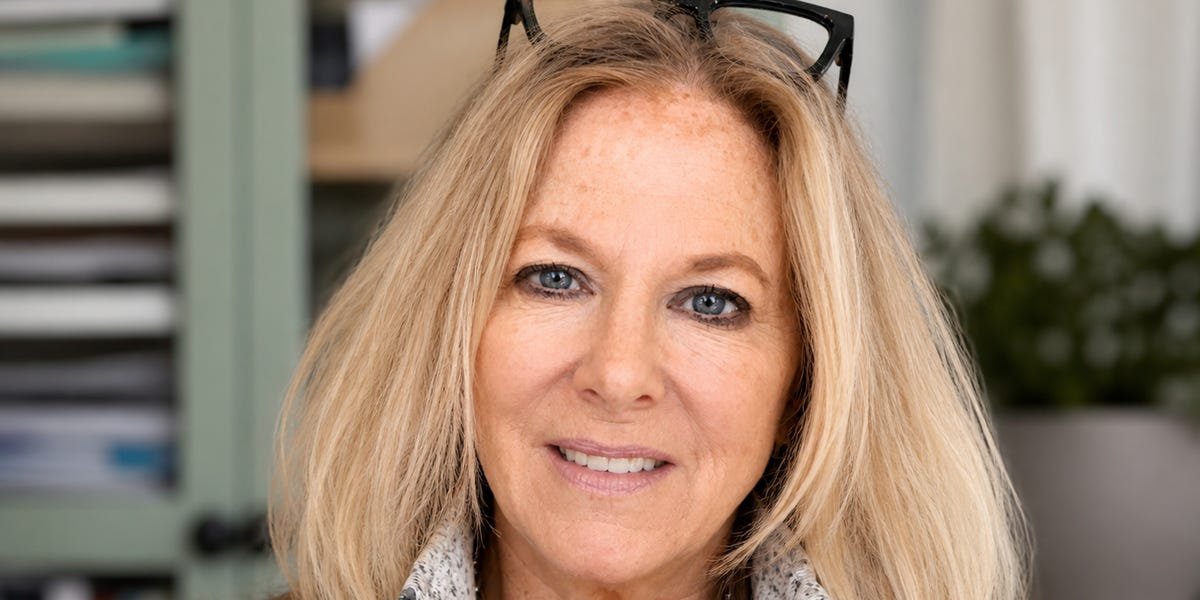
This as-told-to essay is based on a conversation with small-business-owner Kristina Martinelli, a 56-year-old AI consultant who formerly worked a corporate job. The following has been edited for length and clarity.
Getting displaced at 55 years old caught me completely off guard.
I had just spent two years at a Midwest bank as a portfolio manager executive and had decades of experience in corporate technology when I was let go from my job. I grappled with whether I should return to corporate America, asking myself, “Do I stay in an industry that refuses to value my worth as an older worker with institutional knowledge?”
Twenty-four hours after I lost that job, I started my own company, coaigence (spelled with all lowercase letters), an AI consultancy.
When I moved on, I felt nervous, but I leaned into my Fortune 500 and Fortune 100 industry background and used AI from day one.
Starting a business is really about establishing the need
By the end of coaigence’s first day, I had created a name for my new company, a framework, and a direction.
Obviously, the paperwork that goes along with establishing an LLC, an EIN, getting legal and tax representation, bank accounts for clients, and operating costs all take time. To start a business, it’s not about mulling it over; it’s about following a dream and taking the first step.
I knew my AI services would attract corporate executives because I have decades of experience consulting and strategizing for them.
I learned quickly how to build custom GPTs and created a sidekick
I had also been using AI before I was displaced, but I had only scratched the surface.
Once I decided to launch my company, I became a prompt engineer before anything else. I learned how to talk to AI in a way that got me back something actually useful and immediately started building custom GPTs.
I poured everything into a PDF — my thoughts, my vision, and my goals. Then I uploaded it to ChatGPT and named my GPT sidekick Raivyn. I wanted Raivyn to speak and think like me. I don’t want emails and communications that sound robotic.
I created an 80/20 rule for AI adoption: 80% should be a human-driven approach complemented by 20% of AI augmentation. The human intellect must never fall by the wayside.
Tools that are helping me build my AI company
The base AI tools are ChatGPT, Claude, Copilot for when I use Microsoft, Gemini for when I’m using Google, and Grok if I want to completely go out there with no guardrails and create silly images.
After I built Raivyn, I started uploading the ideas I had scribbled in a notebook into it. I also use colored pens. If I color-code my notes and tell Raivyn what each color means, I can take a photo, upload it, and she will organize it for me. Anything urgent is written in red.
I’m a big fan of Claude. It’s really good for putting things into a very organized, succinct, and formatted manner. I also use Perplexity, which is an amazing tool for research because it cites its examples.
The best thing someone can do is try a little bit of all of them and see which one best meets their needs.
Read more from our Tiny Teams series
I made a costly mistake subscribing to AI tools at first
In order to get the best memory out of any of these tools, you have to subscribe, but I don’t recommend subscribing to any AI tool for a year.
It’s very easy to get pulled into subscriptions. I’ve gotten burned so many times thinking I’d get some dollars off. In a month, that tool could be third on the list.
Also, you can run out of tokens pretty quickly when creating audio or visual-intensive items. If you’re not careful, you can spend a lot on buying more instead of waiting for the next day. I’m looking at my spending and putting it back into AI to see where I can save.
AI isn’t going anywhere, so learn to use it
I use this mantra all the time: “feel the fear and do it anyway.” We’re living in that, and people are fearful of AI, but it’s just another tool.
AI is like anything else. You have to learn how to use it effectively.
Most people quit right before they would have turned that corner. They never get to see what’s next. Don’t be that person.
Do you have a similar story to share? Contact this editor, Manseen Logan, at mlogan@businessinsider.com.
