Close Menu
    What's Hot

    America’s K-Shaped Economy Is Breaking Fast Food’s Old Playbook

    February 2, 2026

    Why Is Crypto Down Today? – February 2, 2026

    February 2, 2026

    Kylie Kelce Says There’s One Habit She Tries to Model for Her Kids

    February 2, 2026
    Facebook X (Twitter) Instagram
    Hot Paths
    • Home
    • News
    • Politics
    • Money
    • Personal Finance
    • Business
    • Economy
    • Investing
    • Markets
      • Stocks
      • Futures & Commodities
      • Crypto
      • Forex
    • Technology
    Facebook X (Twitter) Instagram
    Hot Paths
    Home»Money»I Spent 7 Hours With a Vibe Coding Team at Google’s Gemini Hackathon
    Money

    I Spent 7 Hours With a Vibe Coding Team at Google’s Gemini Hackathon

    Press RoomBy Press RoomFebruary 2, 2026No Comments7 Mins Read
    Facebook Twitter Pinterest LinkedIn Tumblr Email
    Share
    Facebook Twitter LinkedIn Pinterest Email


    2026-02-02T05:07:11.748Z


    Copy link


    Email


    Facebook


    WhatsApp


    X


    LinkedIn


    Bluesky


    Threads

    lighning bolt icon An icon in the shape of a lightning bolt.


    Impact Link


    Save
    Saved


    Read in app

    This story is available exclusively to Business Insider
    subscribers. Become an Insider
    and start reading now.

    Have an account? .
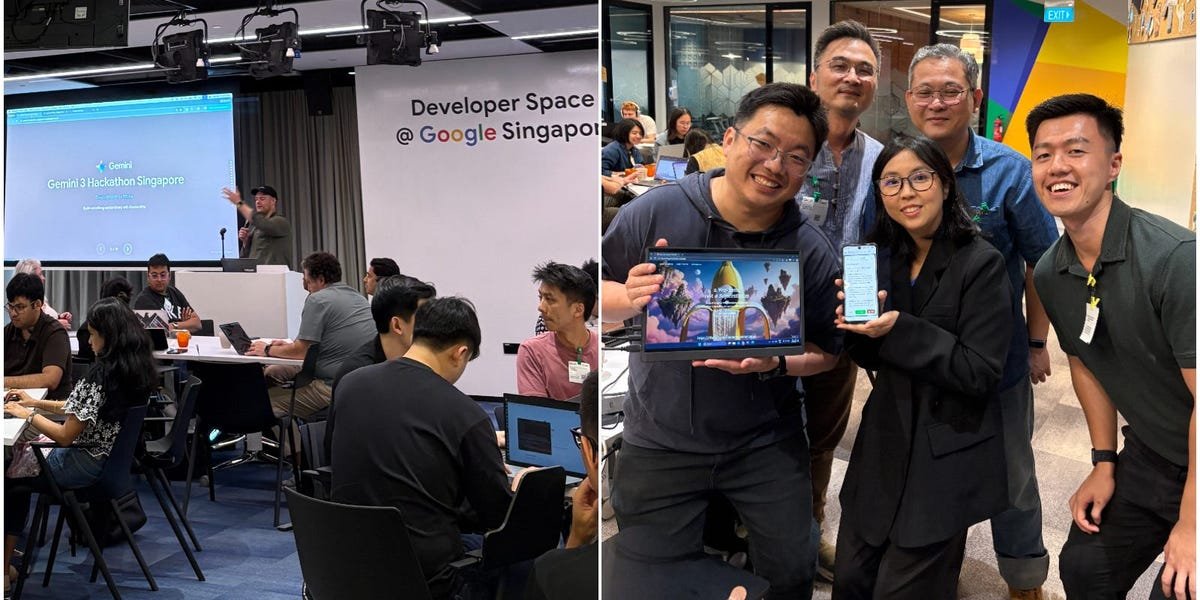
    • I spent seven hours with a vibe coding team at Google’s Gemini 3 hackathon in Singapore.
    • Watching from the sidelines was intense.
    • From prompting and debugging to filming the demo — here’s how it all unfolded.

    Just after sunrise, four vibe coding enthusiasts from Malaysia crossed into Singapore with a loose idea — and a bet that AI could build most of their app.

    Hours later, they were racing to prototype it at Google’s Gemini 3 Hackathon in Singapore.

    The four friends, all in their late 30s to 40s, came from different professional backgrounds. Chan Wei Khjan is an accountant. Chan Ler-Kuan lectures on AI at a private university. Loh Wah Kiang works in IT. Lee How Siem, who goes by Benny, is the chief technology officer of a Malaysian startup.

    Their initial idea was a “feng shui” app to analyze properties in Singapore — a potentially lucrative use case in a market obsessed with housing and wealth accumulation. Feng shui is a traditional Chinese practice that evaluates how a person’s surroundings, along with birth factors, influence luck and well-being.

    I embedded with the team at Google’s developer space in Singapore in January to observe how a vibe-coding project comes together — or nearly falls apart — in seven hours.

    9:30 a.m.: The brief


    Gemini 3 hackathon brief

    Thorsten Schaeff from Google DeepMind welcomed the participants.

    Lee Chong Ming/Business Insider

    The assignment: Teams of up to four people had to build a working demo, publish a public repository with code, and submit a short video explaining their project by 5:30 p.m.

    Each project had to fit into one of six tracks, including generative media, deep research, and enterprise orchestration.

    Organized by Google DeepMind and 65labs, Singapore’s AI builder collective, the hackathon featured a 100,000-credit Gemini API prize pool, with first place getting 30,000 credits.

    By the end of the day, 189 participants had built 76 projects.

    10:30 a.m.: Getting started


    Hackathon team getting started

    The team discusses how to prototype their idea.

    Lee Chong Ming/Business Insider

    The team had pivoted to a new idea due to time constraints: a feng shui app that could analyse a user’s outfit and workspace through the phone camera in real time and assess how “lucky” they were.

    Wei Khjan took the lead on prompting. He typed the first instructions into Claude, asking it to generate the workflow and code. Ler-Kuan focused on whether the AI’s output aligned with feng shui concepts. Wah Kiang and Benny hovered over the codebase, refining ideas and flagging issues.

    “For people who don’t know how to read code, it’s helpful to have people who do,” Wei Khjan said.

    While waiting for the code to be generated, Ler-Kuan opened Google’s AI Studio to design the app’s logo. They called their app “Feng Shui Banana.”

    11:40 a.m.: The bugs arrive


    computer screen with code

    The implementation plan was generated by AI.

    Lee Chong Ming/Business Insider

    After about an hour, Claude generated the initial codebase for the app. It was designed to work with the Gemini Live API, enabling real-time image and text analysis. It ran but was riddled with bugs.

    An error message flashed when they tested the camera feature, so Wei Khjan copied the error back into the AI and asked for it to be fixed. Minutes later, the feature worked.

    It wasn’t right. The feng shui logic was off, especially where colour analysis intersected with the user’s birth timings. Ler-Kuan manually corrected the underlying dictionary and its mappings.

    The team kept prompting to tighten the features: shorter explanations, clearer output, and more streamlined user interfaces.

    By 12 p.m., the app was rough, but it existed.

    12:20 p.m.: Lunch can wait


    Testing the feng shui app

    Ler-Kuan tests the camera feature on the app.

    Lee Chong Ming/Business Insider

    Lunch arrived. The team stayed glued to their screens.

    The app didn’t respond instantly when a user changed their outfit, nor did it update its feng shui analysis in real time.

    Wei Khjan explained how one prompt matters. Instead of issuing commands, he asked the AI to “discuss it with me.” The shift changed how the model reasoned, and it worked more like a collaborator.

    After some prompting, the app updated with a real-time camera analysis. It was striking to watch a feature emerging from a short back-and-forth with AI.

    1 p.m.: Putting the app to the test


    Screenshot of me testing the app

    A screenshot of the feng shui app on my phone as I test its camera feature.

    Lee Chong Ming/Business Insider

    I helped the team test the app.

    The camera correctly identified what I was wearing: a dark green polo, a yellow participant tag, and a white name card hanging from my neck. According to the app, I was already wearing colours aligned with my luck for the day.

    The app suggested small tweaks, such as additional accessories, that could enhance the feng shui of my outfit.

    1:20 p.m.: Pizza break


    Pizza break

    The team munched down their pizzas in about 20 minutes.

    Lee Chong Ming/Business Insider

    They finally had lunch and joked around to ease the tension. Four hours remained before they had to submit their project.

    1:40 p.m.: Back to work


    Feng shui banana landing page

    The landing page for their app.

    Lee Chong Ming/Business Insider

    Ler-Kuan shifted focus to workspace feng shui, feeding knowledge into the model and refining how the app would evaluate desks and work setups. Wah Kiang and Benny worked on the video demo.

    By 2 p.m., they had a landing page that looked animated and 3D. When I asked Wei Khjan how he felt, he smiled.

    The team also revisited the app’s tagline. After cycling through suggestions from multiple AI models, they settled on a line that didn’t come from an AI at all: “A wisdom, not a superstition.”

    3 p.m.: Filming the demo


    Filming the demo

    Wah Kiang and Benny are filming Ler-Kuan as they reenact scenes for their demo video.

    Lee Chong Ming/Business Insider

    By late afternoon, the restlessness was showing. The team snacked and paced, then decided to film the video explaining their project.

    They used Gemini to generate a storyboard for the demo video. The model laid out several scenes and drafted the script. The team followed along, filming clips and stitching everything together as they went.

    Their workspace feature was also up and running.

    4 p.m.: Final touches


    Hackathon team scrambling

    The team is hard at work as the deadline approaches.

    Lee Chong Ming/Business Insider

    The app had come together nicely. With some time to spare, they decided to add audio output for users who prefer listening to reading on a screen.

    The first attempt to generate a voice using AI fell flat. It sounded robotic.

    After debugging and several iterations, they landed on a voice they liked, similar to how a Chinese feng shui master might speak.

    5:30 p.m.: Deadline


    Finishing the hackathon

    Taking a group photo as they submit the project.

    Lee Chong Ming/Business Insider

    As the deadline approached, the team was still stitching clips for their video and nitpicking the AI-generated presenter voice.

    The organizers had urged teams to submit early. With about 15 minutes to spare, they made the call to lock the final cut and hit submit.

    Then it was over. The hunger hit immediately, and everyone got in line for some well-deserved food.

    Even as an observer, watching from the sidelines was tiring. Seven hours of vibe coding turned out to be anything but effortless.

    The team didn’t win a prize, but agreed that the hackathon had been worth it.

    “Sometimes, the best experiences come from saying ‘yes’ without overthinking,” said Ler Kuan. “Innovation starts with curiosity and a little bit of spontaneity.”

    Do you have a story to share about vibe coding? Contact this reporter at cmlee@businessinsider.com.

    Share. Facebook Twitter Pinterest LinkedIn Tumblr Email
    Press Room

    Related Posts

    America’s K-Shaped Economy Is Breaking Fast Food’s Old Playbook

    February 2, 2026

    Kylie Kelce Says There’s One Habit She Tries to Model for Her Kids

    February 2, 2026

    Clawdbot’s Creator Says Vibe Coding Became a Rabbit Hole

    February 2, 2026
    Leave A Reply Cancel Reply

    LATEST NEWS

    America’s K-Shaped Economy Is Breaking Fast Food’s Old Playbook

    February 2, 2026

    Why Is Crypto Down Today? – February 2, 2026

    February 2, 2026

    Kylie Kelce Says There’s One Habit She Tries to Model for Her Kids

    February 2, 2026

    Polymarket Hit With Two-Week Nevada Ban

    February 2, 2026
    POPULAR
    Business

    The Business of Formula One

    May 27, 2023
    Business

    Weddings and divorce: the scourge of investment returns

    May 27, 2023
    Business

    How F1 found a secret fuel to accelerate media rights growth

    May 27, 2023
    Advertisement
    Load WordPress Sites in as fast as 37ms!

    Archives

    • February 2026
    • January 2026
    • December 2025
    • November 2025
    • October 2025
    • September 2025
    • August 2025
    • July 2025
    • June 2025
    • May 2025
    • April 2025
    • March 2025
    • February 2025
    • January 2025
    • December 2024
    • November 2024
    • April 2024
    • March 2024
    • February 2024
    • January 2024
    • December 2023
    • November 2023
    • October 2023
    • September 2023
    • May 2023

    Categories

    • Business
    • Crypto
    • Economy
    • Forex
    • Futures & Commodities
    • Investing
    • Market Data
    • Money
    • News
    • Personal Finance
    • Politics
    • Stocks
    • Technology

    Your source for the serious news. This demo is crafted specifically to exhibit the use of the theme as a news site. Visit our main page for more demos.

    We're social. Connect with us:

    Facebook X (Twitter) Instagram Pinterest YouTube

    Subscribe to Updates

    Get the latest creative news from FooBar about art, design and business.

    Facebook X (Twitter) Instagram Pinterest
    • Home
    • Buy Now
    © 2026 ThemeSphere. Designed by ThemeSphere.

    Type above and press Enter to search. Press Esc to cancel.