Close Menu
    What's Hot

    Amaroq GAAP EPS of -$0.04, revenue of $26.98M; gives FY26 outlook

    March 26, 2026

    $25K Book Trilogy Publisher Files for Bankruptcy, Owes Bob Dylan $450K

    March 26, 2026

    SOL Foundation Bets on AI Agents

    March 26, 2026
    Facebook X (Twitter) Instagram
    Hot Paths
    • Home
    • News
    • Politics
    • Money
    • Personal Finance
    • Business
    • Economy
    • Investing
    • Markets
      • Stocks
      • Futures & Commodities
      • Crypto
      • Forex
    • Technology
    Facebook X (Twitter) Instagram
    Hot Paths
    Home»Economy»How Today’s Egg Prices Scrambled Traditional Economic Theories
    Economy

    How Today’s Egg Prices Scrambled Traditional Economic Theories

    Press RoomBy Press RoomMarch 5, 2025No Comments7 Mins Read
    Facebook Twitter Pinterest LinkedIn Tumblr Email
    Share
    Facebook Twitter LinkedIn Pinterest Email


    Late one night in 1989, economist Jeffrey Sachs found himself in a smoke-filled room of government officials in Warsaw, Poland. The country had  just declared independence from the Soviet Union, which had exerted central control over prices of tens of thousands of items, leading to frequent shortages.

    Sachs argued to the economists and politicians that Poland needed “shock therapy” with an immediate transition to a free market economy with floating prices.

    For millions of Poles,  that was a frightening proposition. Prices posted by the command-style government had been easy for ordinary people to see and understand, but the principles of the free market were an abstract theory. It required faith to leap into the unknown world of supply and demand where an unseen force called “the invisible hand” would now regulate prices.

    Sachs’ plan was put in motion the next day, and newly unregulated prices of ordinary grocery items immediately spiked, causing anxiety across the country. The Polish finance minister, Leszek Balcerowicz, paced the streets, looking for a glimmer of hope. He decided to concentrate on one thing: the price of eggs.

    If the market was working, the higher price of eggs would create incentives for farmers to bring more eggs to market, leading to a fall in prices. Sure enough, in a few days, egg prices began to drop. “That was an important day,” Balcerowicz recounted, a signal that the new free market was working its magic in allocating goods and services in the most cost effective manner.

        *                                             *                                          *                             

    It’s not just the Polish people who watch egg prices. Here in the United States, spiking egg prices since late 2024 are dominating news reports. Eggs, like gasoline, are bought frequently, and so tracking these prices is highly relatable to consumers.  As if they were gold coins, 100,000 eggs were stolen from a trailer in early February. Waffle House’s decision to charge a 50 cent surcharge per egg order even made the national news.
    The cost of one dozen Grade A eggs jumped 53 percent higher than the same time last year. What’s more, there has been more price volatility, because of sudden shocks from bird flu that has killed over 120  million chickens since 2020.

    But here’s the strange thing: the egg market is not acting in a way that economic textbooks would predict, and certainly in a different direction than Sachs’ confident prediction to the Polish people.

    There are two egg puzzles that go well beyond Econ 101 textbooks’ standard explanations of how firms and consumers work together. The answers ultimately give us a richer understanding of the complexities of humans’ selling and buying behavior.

    The first Econ 101 puzzle:  even with rising egg prices, grocery stores are not letting prices rise high enough to bring demand in line with supply. Customers are swamping stores, buying far more eggs than they need on a weekly basis, leading to empty shelves. To combat potentially angry customers,  grocery stores such as Kroger, Walmart, Trader Joe’s and Costco are now limiting sales of eggs to one dozen per person. In other words, they are rationing eggs, seemingly resembling more of a command economy than a fully functioning free market.
    The second Econ 101 puzzle is that despite the rise in retail egg prices, grocery stores are actually losing money on each dozen eggs sold, as reported in The New York Times.  According to the latest February 14th, 2025  USDA report, national wholesale prices average $7.74 a dozen while national retail prices average $4.95 a dozen.

    What’s going on here?  In puzzle #1, the shortage of retail eggs and self-imposed store quotas indicate excess demand. In puzzle #2, the elevated wholesale egg prices mean a higher input cost for supplying retail eggs. Textbook economics predicts that in both cases, retail prices should be driven higher.

    That means we should be paying at least $8 a dozen, not $5, on average nationwide.

    Some might explain that this is happening because eggs are a “loss leader,” that encourages customers to buy other profitable items while they make their way to the back of the store, where eggs and milk are typically sold.

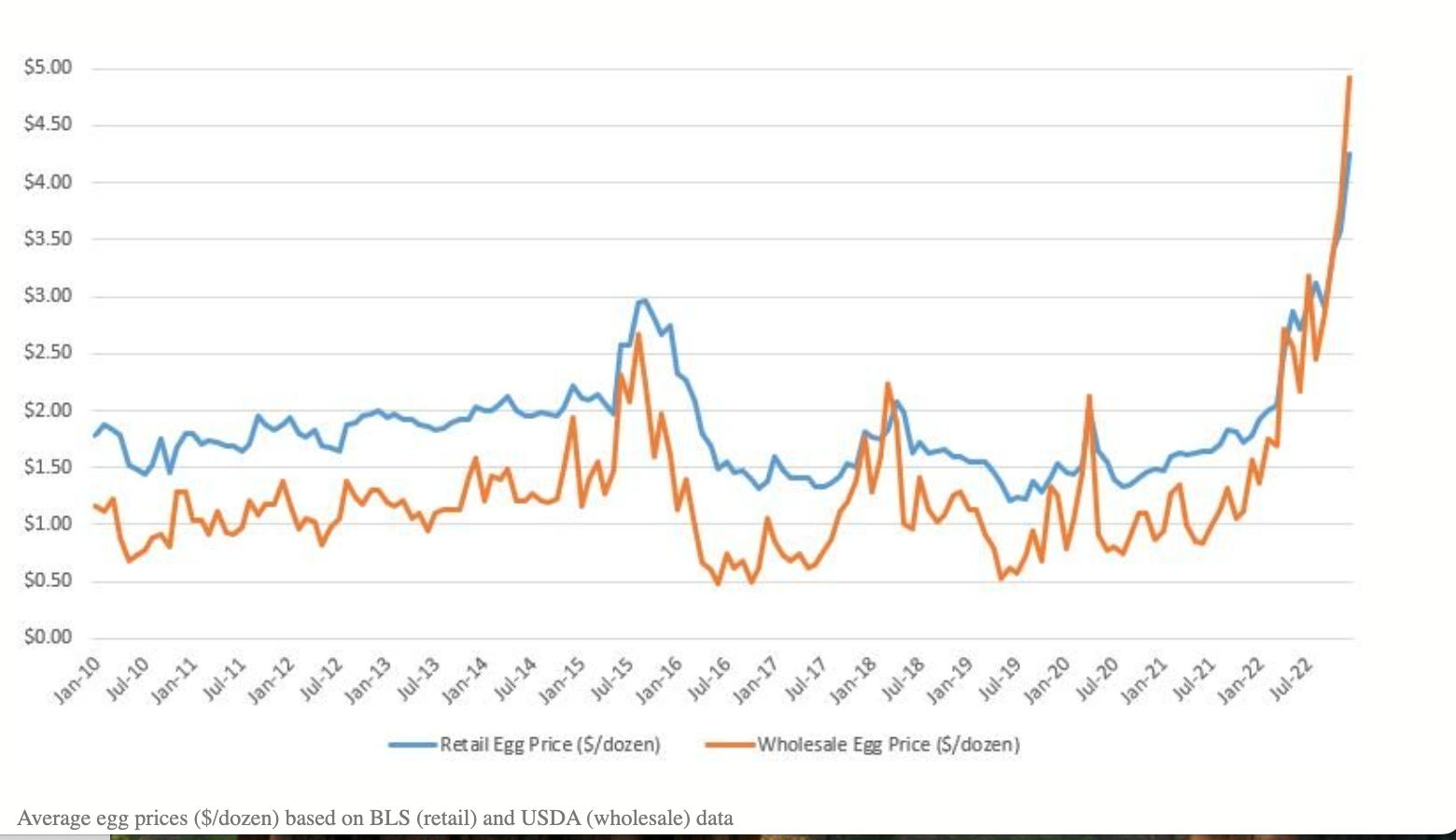
    There is little evidence this explanation is true for any length of time. The below figure charts the past history of retail vs. wholesale egg prices. The orange line representing wholesale prices is almost always below the retail prices in blue.

    In fact, we see an interesting phenomenon: grocery stores only lose money on eggs when the wholesale prices spike up very quickly, as they briefly did in 2015, 2018, 2020 and 2023 as well. Otherwise they are making around a reasonable 20-75 cents profit per dozen, depending on the type of eggs sold.

    Figure 1. U.S. Egg Retail and Wholesale Prices, 2010-2023.
    Whenever we see markets not following standard economic theory, we should investigate two alternative explanations: either there is a government regulation that is leading to some unintended consequences, or there is some aspect of customers’ high emotions that override a firm’s typical profit maximization process.

    Since there has been no price control on retail eggs a la the former Soviet Union, we turn to the  other explanation. A humble pack of a dozen eggs is likely an emotional purchase, at least when the prices go high. We are in touch with the prices of eggs as intimately as the Polish finance minister who wandered the streets, seeing them as a bellwether of the economy as a whole.

    Grocery stores have a tough decision to make: they need to weigh the cost of their retail losses from egg sales versus the loss to their reputation if they are seen as “villainous price gougers”  in a time of rapidly rising prices. It appears in this case at least, grocery stores will take the short-term losses on the chin, because they have thousands of other items where the profits can offset these losses.

    Ironically, consumers may complain about sky-high egg prices in 2025, but they are largely kept in the dark about how protected they are from the reality of far higher wholesale prices.

    The quotas instituted by the grocery stores now make sense: the nearly $3 loss per dozen eggs sold is like a store’s investment in retaining customer’s goodwill, serving to limit the damage from even higher priced eggs.

    So it’s rational on the part of the grocery store to distribute their eggs among the largest possible customer base by disallowing bulk purchases by individual customers.  That way, they enhance their reputation as a business who cares for customers and keep their eggs out of just one customer’s grocery basket.

    The lesson: even in something as simple as an egg market, a delicate dance of emotion and reputation can intertwine with prices finding equilibrium.  In all cases, the more competition the better, especially under long time frames. Consumers stand a far better chance of being protected by firms in these situations than command economies or regulations that create barriers to entry for other competitors, such as health insurance markets.

    That is eggsactly what we should wish for. (I had to get a bad pun somewhere).


    Craig Richardson is the BB&T Distinguished Professor of Economics and Finance at Winston-Salem State University.


    Source link

    Share. Facebook Twitter Pinterest LinkedIn Tumblr Email
    Press Room

    Related Posts

    Wall Street slides as valuation concerns, rate-cut jitters linger

    November 18, 2025

    Wall St opens lower as valuation concerns, rate-cut jitters linger

    November 18, 2025

    They solved for the Kansas City Chiefs enforcement equilibrium

    September 5, 2025
    Leave A Reply Cancel Reply

    LATEST NEWS

    Amaroq GAAP EPS of -$0.04, revenue of $26.98M; gives FY26 outlook

    March 26, 2026

    $25K Book Trilogy Publisher Files for Bankruptcy, Owes Bob Dylan $450K

    March 26, 2026

    SOL Foundation Bets on AI Agents

    March 26, 2026

    Iran said to draft bill to impose fees for transit through Strait of Hormuz

    March 26, 2026
    POPULAR
    Business

    The Business of Formula One

    May 27, 2023
    Business

    Weddings and divorce: the scourge of investment returns

    May 27, 2023
    Business

    How F1 found a secret fuel to accelerate media rights growth

    May 27, 2023
    Advertisement
    Load WordPress Sites in as fast as 37ms!

    Archives

    • March 2026
    • February 2026
    • January 2026
    • December 2025
    • November 2025
    • October 2025
    • September 2025
    • August 2025
    • July 2025
    • June 2025
    • May 2025
    • April 2025
    • March 2025
    • February 2025
    • January 2025
    • December 2024
    • November 2024
    • April 2024
    • March 2024
    • February 2024
    • January 2024
    • December 2023
    • November 2023
    • October 2023
    • September 2023
    • May 2023

    Categories

    • Business
    • Crypto
    • Economy
    • Forex
    • Futures & Commodities
    • Investing
    • Market Data
    • Money
    • News
    • Personal Finance
    • Politics
    • Stocks
    • Technology

    Your source for the serious news. This demo is crafted specifically to exhibit the use of the theme as a news site. Visit our main page for more demos.

    We're social. Connect with us:

    Facebook X (Twitter) Instagram Pinterest YouTube

    Subscribe to Updates

    Get the latest creative news from FooBar about art, design and business.

    Facebook X (Twitter) Instagram Pinterest
    • Home
    • Buy Now
    © 2026 ThemeSphere. Designed by ThemeSphere.

    Type above and press Enter to search. Press Esc to cancel.