
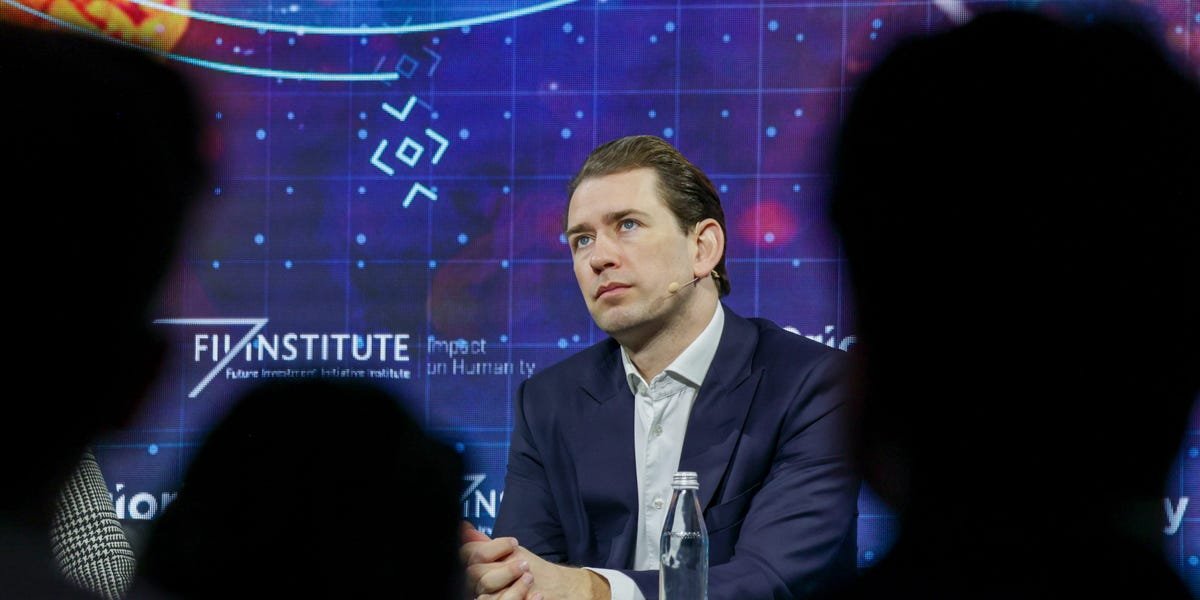
Sebastian Kurz once worked out of Austria’s chancellery on Vienna’s Ballhausplatz, an imposing government building that resembles a Baroque palace. Today, he welcomes visitors to a sleek glass office tower that blends seamlessly into Tel Aviv’s skyline.
The contrast between the two workplaces couldn’t be greater. What hasn’t changed is Kurz’s relentless ambition — or the remarkable speed with which he continues to rack up achievements.
At 27, Kurz became Austria’s foreign minister. At 31, he became the country’s youngest-ever chancellor. Now, at 39, he has emerged as one of Europe’s and Israel’s most prominent startup founders.
His company, DREAM, announced on Thursday a new $260 million funding round, bringing its valuation to $3 billion. The Series C financing marks a major milestone for the startup, which was founded three and a half years ago. The round was led by Bicycle Capital and Group 11, with participation from Bain Capital, Tru Arrow Partners, alongside investor James Rothschild, Norway’s Antler, and several other global investors.
Many founders would be floating through the hallways after securing investors of that caliber and a $3 billion valuation. But neither Kurz nor his Israeli cofounder, Shalev Hulio, shows much interest in celebrating.
The two move briskly through DREAM’s stylish Tel Aviv headquarters before sitting down in Hulio’s office. Their tone is almost understated.
“When we started this company from scratch three and a half years ago, we had no way of knowing whether it would work,” Kurz says. “Now we’re incredibly happy that we get to keep building it.”
Then, for a brief moment, the entrepreneur sounds a bit like the politician he once was.
“More important than our personal success is the value we can create for entire nations.”
Kurz is convinced that artificial intelligence will fundamentally reshape the future of cyber warfare.
“The next cyber war will be fought by AI against AI.”
To help governments, militaries, intelligence agencies, healthcare systems, and critical infrastructure defend themselves against increasingly sophisticated cyberattacks, Kurz and Hulio set out to combine two worlds that had largely remained separate: the expertise of elite hackers and the capabilities of artificial intelligence.
GEORG HOCHMUTH/APA/AFP via Getty Images
The result is an AI model purpose-built for cybersecurity and trained by internationally recognized experts. That technology powers a platform designed to detect and stop state-sponsored cyberattacks before they can compromise government systems or critical infrastructure.
“Most of the attacks we’ve been able to prevent originated from China, Russia, Iran, and North Korea,” says Hulio, who oversees technology at DREAM.
Hulio brings decades of cybersecurity experience. Before founding DREAM, he cofounded and later led NSO Group, the Israeli technology company behind the controversial Pegasus spyware.
“Russia relies on large-scale phishing campaigns,” Hulio says. “China is building AI-powered attack capabilities.”
According to Hulio, DREAM’s biggest competitive advantage is that it enables governments to become more independent in cybersecurity.
“Countries shouldn’t have to depend on either the US or China,” he says. “We build solutions that governments own, operate, and control themselves. Their data never has to be uploaded to the cloud, and it’s never shared with anyone.”
The company’s customer base is expanding rapidly across Europe, the Middle East, and Southeast Asia. DREAM has generated roughly $300 million in revenue to date, and Kurz says the company became profitable this year with a workforce of around 350 employees.
Given the company’s rapid growth, are the founders already thinking about an IPO?
“It’s certainly an option — a very realistic option for a fast-growing company like ours,” Kurz says.
FII
For now, however, the focus is on expansion. The company is preparing to grow its operations in Abu Dhabi and has decided to establish a research and development center in Germany.
The only question still unresolved is where.
“For us, a direct flight to Tel Aviv is important,” Hulio says.
The combination of Israeli and Western European business cultures appears to be one of DREAM’s competitive strengths.
The founders even look the part.
Kurz is clean-shaven and wears a crisp white dress shirt. Hulio sports a beard, a black T-shirt, and an easygoing smile.
Early on, Hulio says, their cultural differences occasionally became apparent.
“Sebastian can fit 20 meetings into an hour,” he says, laughing. “He’s incredibly disciplined. I’ve never seen anything like it. In Sebastian’s world, if you’re one minute late, you’re already late. As an Israeli, I had to get used to that.”
Hulio says he has worked with many talented people throughout his career, but none compares to Kurz.
“What he accomplished in politics in such a short period of time, he’s now accomplishing in tech,” Hulio says. “Sebastian is a brilliant mind. If he had chosen entrepreneurship at a young age instead of politics, I think he’d already be in the same league as Elon Musk.”
Kurz is equally generous in his assessment of his cofounder, who had long been regarded as one of Israel’s leading technology entrepreneurs before DREAM.
“Shalev is a genius,” Kurz says. “If someone tells him there’s no technical solution to a problem, it only motivates him. He pushes the team to its limits. Throughout his career, he’s repeatedly achieved technological breakthroughs that many people thought were impossible.”
In some ways, the same could be said of Kurz himself.
While many former political leaders struggle to reinvent themselves in business — or, like former German Chancellor Gerhard Schröder, become lobbyists for authoritarian regimes — Kurz has pulled off an unlikely second act: transforming himself from one of Europe’s youngest heads of government into the cofounder of one of the world’s fastest-growing AI cybersecurity companies.
This story is courtesy of the Axel Springer Global Reporters Network, which harnesses the resources of the company’s newsrooms to publish ambitious scoops, investigations, interviews, opinion pieces and analysis. It allows journalists — including those from POLITICO, Business Insider, WELT, BILD, Onet and Fakt — to collaborate on major stories for an international audience of hundreds of millions across platforms: online, print, TV and audio.
