
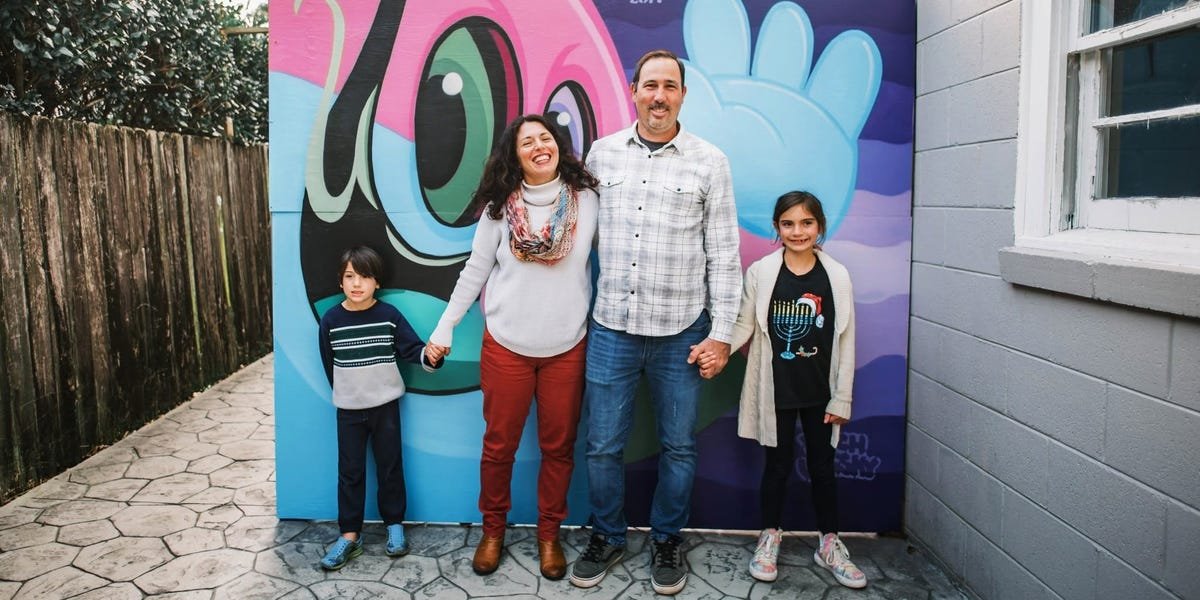
Mike Savage didn’t let a modest salary or limited savings keep him from buying real estate.
He cycled through sales roles in his 20s before becoming a firefighter and EMT. His wife worked as a teacher. There was “not a whole lot of money between us,” he told Business Insider.
Still, the couple managed to buy their first home in Massachusetts in 2010 using a USDA rural housing loan, which allowed for a 0% down payment, and an $8,000 first-time homebuyer credit available at the time amid the housing crisis.
When work brought them to the South about three years later, they converted that home into a rental and bought another primary residence in Mount Pleasant, South Carolina.
As their family grew, Savage said, the couple began to question whether their combined incomes would be enough to cover education costs, save for retirement, and build the life they wanted. After buying a few primary residences, they began looking to rental real estate as a way to build wealth beyond their day jobs.
Buying an investment property with a $10,000 truck loan
Savage’s first investment property was a $49,000, three-bedroom house in Charleston, South Carolina, which he bought in 2015.
He and his wife had already tapped retirement funds to help pay for their move to Charleston and had “nothing in the bank,” he said. But Savage owned his truck outright, so he took out a loan against it to cover the roughly $10,000 down payment.
Courtesy of Mike Savage
Borrowing against an asset, such as a paid-off vehicle, allows an owner to use it as collateral for a loan. It can unlock cash quickly, but it also puts the vehicle at risk if the borrower can’t make payments.
For Savage, the loan offered a way into the market without waiting years to save up a cash down payment.
His mindset at the time, he said, was: “What is there to lose? This is what I want to do. I just have to figure out how to make it happen.”
He used HELOCs to keep buying
Savage later tapped the equity in his primary residence to continue growing his real-estate holdings.
He and his wife took out a roughly $30,000 home equity line of credit, or HELOC, against their Mount Pleasant home and used it to help buy a $250,000 townhouse in downtown Charleston. They bought the townhouse as a primary residence, kept the Mount Pleasant home, and converted it into a short-term rental.
A HELOC lets homeowners borrow against their home equity, offering a revolving line of credit they can tap as needed during a set draw period.
“With our incomes and what we were making, it was always going to be difficult to qualify for big loans and get people to give us money,” Savage said. The HELOC gave the couple another source of capital.
They then repeated the process, taking out a HELOC against the downtown property to buy the home where they now live. They converted the downtown home into a short-term rental, too. It performed well, he said, until Charleston changed its short-term rental rules about a year later, forcing them to switch to a long-term rental.
Around 2018, looking to take his portfolio to the next level, Savage began attending local real-estate groups and investor meetups. He learned that investors don’t always need a 20% down payment for every deal. With a broader understanding of financing options, including hard-money lending and the BRRRR method, his acquisitions accelerated: He bought three long-term rentals in 2020 and six more in 2021.
Business Insider reviewed property-tax records confirming Savage’s ownership of several properties.
A ‘less is more’ mindset
Savage hadn’t originally planned to quit his job, but when the fire department changed its pay structure and reduced some of his compensation, he began to question how much control he really had over his family’s financial future.
“I remember feeling very helpless,” he said. “I can’t rely on these employers to provide for myself and my family.”
Courtesy of Mike Savage
Until then, Savage had viewed real estate mainly as a way to supplement his retirement savings. The pay change pushed him to consider it as a career — and to cofound SynergyStays, a short-term rental revenue management business.
The business grew out of his own experience as an Airbnb host. He had worked with several property-management companies, he said, but even the best ones left him feeling that his rentals were being managed “less as a business, and more as, well, a property.”
As SynergyStays has grown, Savage has also shifted his investment strategy from accumulating as many units as possible to maximizing the income from each unit. This year, he sold four long-term rentals, paid down some debt, and said he had about $450,000 in cash from the sales. He plans to put roughly $350,000 toward a single short-term rental that he believes could generate more income than the four properties combined.
“I want to achieve more through less,” he said.
Savage estimates his net worth at about $2 million. In his final full year with the fire department, 2021, he said his take-home pay was about $40,000. The following year, a single rental — an accessory dwelling unit he built in his backyard — generated almost the same amount: $35,000 in gross income.
With income from rentals and SynergyStays — which he said each accounts for roughly half of his total income — Savage felt comfortable leaving the department.
His version of financial independence doesn’t mean he no longer works. “I do have to work a lot right now, and I have to work hard,” he said, but he no longer depends on an employer to decide his pay, schedule, or time off. “I get to decide that. I go out and make decisions, and work harder, or do things smarter to help myself make more money.”
