
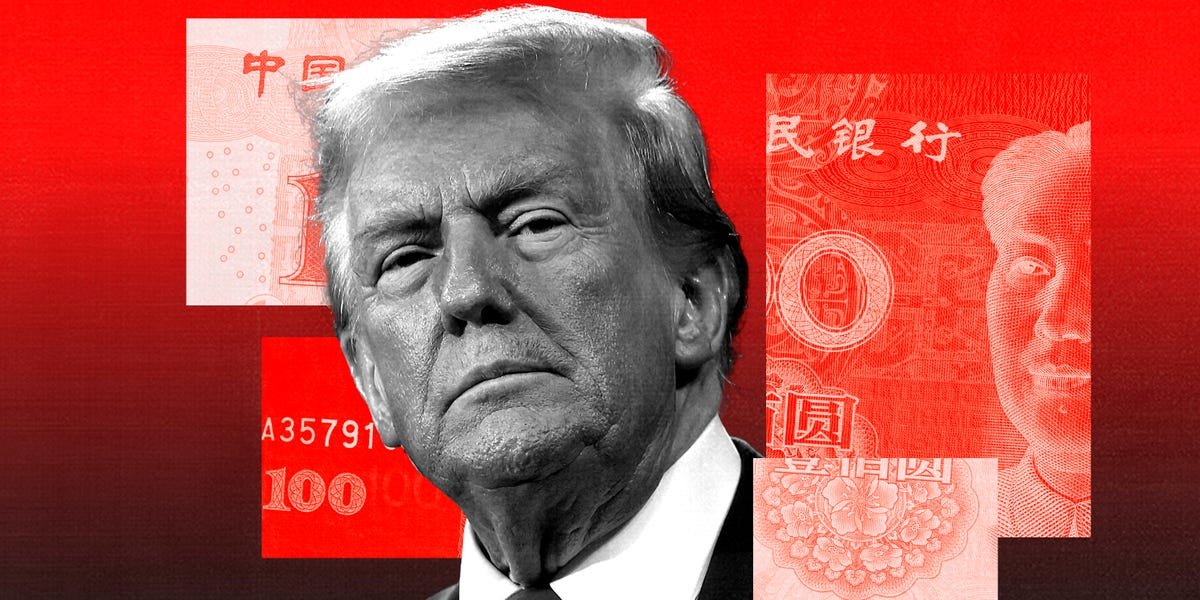
- President Donald Trump is threatening significant tariffs on manufacturers in China.
- China could pull out tools to protect its economy, some developed during the first Trump term.
- Beijing may ratchet up trade restrictions or change its monetary policy.
China is President Donald Trump’s prime target for a trade war — again. But China already put its boxing gloves on.
In his first term, Trump slapped high tariffs on a range of Chinese goods. This time, the President has pledged blanket tariffs of 60% on Chinese imports. On January 21, Trump threatened 10% tariffs on China that could come as soon as February.
But four years of Trump 1.0 has given China plenty of time to formulate its strategy — and countermeasures.
“Depending on the range of such new US tariff measures, China is likely to respond to significant US tariff hikes by imposing retaliatory tariff countermeasures on US imports,” Rajiv Biswas, an international economist and the author of “Asian Megatrends,” told Business Insider.
As Zhu Min, an economist and former Chinese central bank official, said at a at panel session on January 22, “China understands much better now” what a Trump presidency brings.
This is how China could respond:
Limiting raw materials for high-tech products
The US-China rivalry is firmly in its tech phase, with Beijing’s new economic growth areas of electric vehicles, solar cells, and lithium batteries in the spotlight.
The Biden administration had already limited the export of high-tech chips to China. There could be more curbs on the way targeting China’s AI development — especially after US markets were spooked by DeepSeek’s new model.
“I expect a continuation of the strict US prohibition on exporting advanced semiconductors to China,” Olivier Blanchard, the research director for AI devices at tech research firm The Futurum Group, told Business Insider. “The AI race between the US and China doesn’t stop because of a change in US administrations.”
In the battle against the US for global tech supremacy, China has the upper hand in at least one critical area: rare earths, the raw materials in tech products ranging from semiconductors to industrial magnets to some solar panels.
China — which has long dominated the rare earths market — has been tightening its grip for more than a year.
In December, China announced that it was banning the exports of gallium, germanium, and antimony — key minerals used in the making of chips, fiber optic cables, and weapons — to the US, citing national security.
The end game is about tech supremacy. Some analysts are comparing the US-China race to a new Cold War.
“The heart of the issue is concern about how China will use AI chips for military applications and surveillance,” Chris Tang, a UCLA professor and expert in global supply chain management and the impact of regulatory policies, told BI in November. “It’s a different type of Cold War.”
Tried and tested methods
China could also return to tried-and-tested methods of financial policy maneuvers and import controls.
“China could weaken its currency against a strong dollar to support its exports, while carefully managing the pace of depreciation via its daily renminbi fixing rate and a variety of other administrative tools in the currency market,” wrote Betty Wang, a lead economist at Oxford Economics, on November 12 — a week after Trump won the presidential election.
Last month, China shifted its monetary policy approach from “prudent” to “moderately loose” — which would boost liquidity and lending. In September, China launched an aggressive stimulus package to boost the markets.
In trade, Beijing could ramp up countermeasures against US agriculture products. In 2018, China slapped 25% tariffs on US soybeans, beef, pork, wheat, corn, and sorghum imports to retaliate against Trump’s tariffs.
A tariff exclusion mechanism in the January 2020 US-China trade deal has kept American soybeans flowing to China, albeit at lower levels. China’s policies could change if Trump imposes high tariffs on Chinese goods.
The US accounted for 20% of China’s soybean imports in 2024, down from 40% in 2016.
“In a scenario where China imposes retaliatory tariffs on US soybeans in 2025, the impact would again likely be a substantial economic loss for the US soybean industry due to lower US domestic soybean prices and declining US soybean exports to China,” Biswas, the economist, said.
Other agricultural imports from the US could also be subject to more restrictions, said Biswas.
Beyond exports and imports, China is likely to turn inward to strengthen domestic consumption through fiscal stimulus as authorities try to engineer a turnaround for its flagging economy.
The country will also double down on its status as the world factory floor, especially in high-tech manufacturing, to retain its competitiveness, said Zhu, who was a former deputy managing director of the International Monetary Fund.
“We focus on competitiveness regardless of what happens outside China. We’ll be able to survive,” Zhu said at the World Economic Forum.
Trump and Beijing are both weighing a trade war
Trump appears to prefer avoiding tariffs to resolve the US’ trade disputes with China.
“We have one very big power over China, and that’s tariffs, and they don’t want them,” the president told Fox News in an interview that aired Thursday. “And I’d rather not have to use it. But it’s a tremendous power over China.”
On Sunday, the White House walked back its 25% tariff threat against Colombia after making a deal on migrant transportation.
Meanwhile, most analysts expect continued economic challenges in China this year due to flagging consumer confidence — which means Beijing would prefer not to have to engage in a trade war, too.
“Differences and frictions need to be handled through dialogue and consultation,” said Mao Ning, the spokesperson for China’s foreign ministry, on Friday. “Trade and tariff wars have no winners and are in the interest of no one, still less the world.”
Should the two powers still end up in a trade war, China will have more leverage this time around because it’s now less reliant on the US, wrote Lynn Song, the chief economist for Greater China at ING, on Thursday.
The US accounted for 14.6% of China’s exports in 2024 — down from 18.2% in 2017. That opens the possibility for “more aggressive retaliation from China if it is pushed into a corner,” wrote Song, citing expert controls and more targeted tariffs on large American companies.
“The world has changed a lot since the first trade war broke out in 2018,” he added.
