
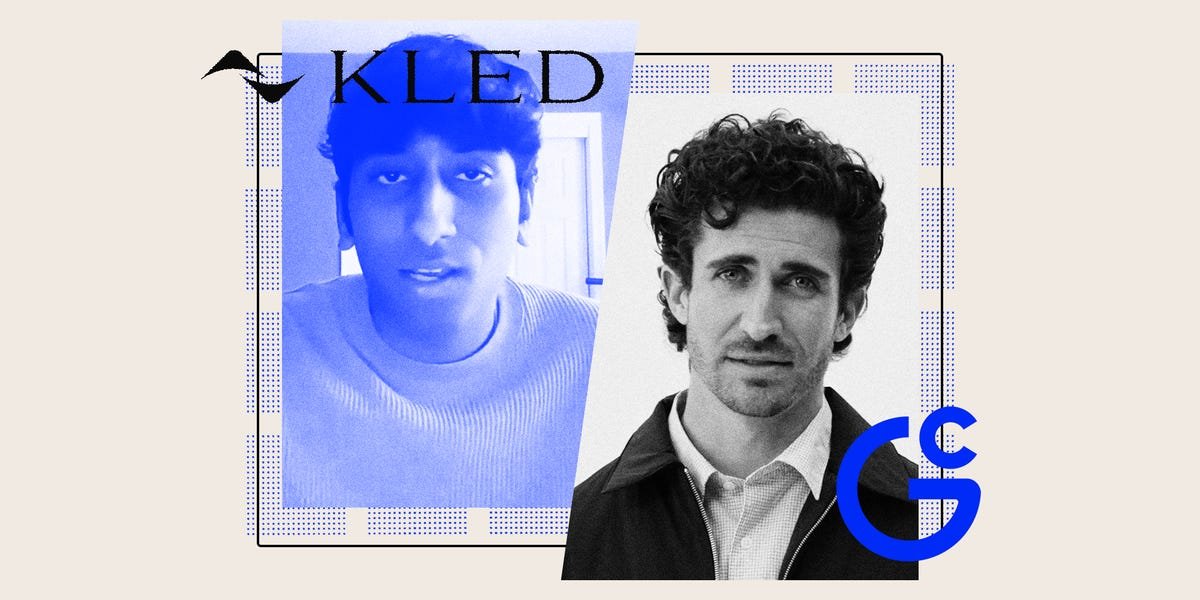
Last Friday morning, Avi Patel was scrolling on X when he saw a post that made him crash out. The post, from General Catalyst investor Yuri Sagalov, announced a $31 million seed round for a startup called Luel, which pays people for AI training data. Patel is the founder of a startup called Kled that also pays people for AI training data. When Patel looked at Luel’s website, it appeared almost identical to Kled’s, right down to the font. Kled had recently raised a $5.5 million seed round, and Patel had taken multiple meetings with General Catalyst. Now, the fund was investing in a copycat. “They gave these guys the same terms I was asking for,” he tells me. “That was my check that they were supposed to give me.”
What followed was an escalation of drama worthy of reality television: Patel called Sagalov and other investors at General Catalyst, demanding answers. When they didn’t pick up, he says, he called his own investors. One of them — Keenan Rice, a general partner at K5 Global — encouraged him to air out his grievances in a post on X. “If you really fundamentally believe that they ripped you off, they fully just copied it blatantly, then let the court of public opinion decide,” Rice says. So Patel turned on his laptop camera, hit record, and “kind of just let it fly.”
Patel’s five-minute response video — which has now been viewed more than 9 million times — is a searing, f-bomb-filled takedown of Luel. Against a backdrop that includes a pull-up bar draped with what appears to be a used towel, Patel laid into the company for ripping off his idea (“unimaginative slop that continues to get rewarded due to nepotism”) and showed a side-by-side of the two websites (“your uncreative fuck-ass of a brain can’t even make your own website”). For good measure, he also insulted General Catalyst, mocking an ad the fund had put out a few days earlier. The video quickly made the rounds on tech Twitter, inspiring rounds of replies, subtweets, and memes. Few people had heard of Kled or Luel before Friday. Now, everyone was talking about it.
Startup turf wars are nothing new. Yet this one, which has animated the online discourse in Silicon Valley, presents something like a Rorschach test. On one side, Patel’s defenders have sympathized with what feels like unfairness, and chided investors for awarding such a large seed round to a company that appears to have done little of its own work. On the other side, Patel’s critics have questioned how defensible his startup could be if a competitor could so easily spin up a replica. Plenty of startups go to market with the exact same idea: Uber and Lyft, DoorDash and Postmates, DraftKings and FanDuel, Kalshi and Polymarket. But in the age of AI, when code is commodity, traditional startup moats are obsolete. As one detractor put it on X: Patel “needs to embrace the competition and just build harder and stop crying. No crying in the casino.”
Patel, who is 22, dropped out of the University of Illinois to start a music licensing company before pivoting to Kled in 2025. William Namgyal and Inigo Lenderking, who are 18, dropped out of Berkeley to start Luel in January 2026. They joined Y Combinator’s winter 2026 batch — a three-month program that comes with a $500,000 investment — before raising more money this month. In its funding announcement, Luel claims its $31 million seed round is one of the largest in Y Combinator history. (Namgyal and Lenderking did not respond to multiple requests for comments. Neither did Sagalov, General Catalyst, Lightspeed, and Y Combinator. Patel showed me a Signal message he received in the midst of the drama from one partner at General Catalyst, who told him that he had been “asked not to communicate.”)
They gave these guys the same terms I was asking for. That was my check that they were supposed to give me.Avi Patel
Both startups serve the demands of a rapidly expanding AI economy. As frontier labs develop more advanced models, they are exhausting the supply of data that is publicly available on the web. Plus, scraping web data without permission has led to massive copyright lawsuits. So AI companies need a way to get more data to feed their models, and they are willing to pay if the data is good and comes from sources that explicitly consent to giving it away. Kled and Luel are marketplaces that broker this exchange. They post “tasks” from AI companies, like taking a video of a street intersection or reading a Hebrew transcript out loud, and then pay users a nominal fee for collecting it. Both startups are targeting users in the developing world.
That tens of millions of dollars have gone to such young founders working in such nascent markets is indicative of the strange, frenzied times in startupland. Seed rounds are getting bigger and bigger, according to a recent analysis from Crunchbase — in 2025, more than half of seed rounds were more than $10 million — even as fewer deals are getting done. And investors are foaming at the mouth for the opportunity to back the types of early-stage companies that could, one day, become essential for the new AI economy. Mercor, yet another AI training platform, was founded three years ago and has already achieved a valuation of $10 billion. Its three founders also happen to be 22-year-olds who each dropped out of college to start the company.
In a world where everyone is racing to build and fund the same ideas, how does a founder stand out? Today’s seed-stage founders can take a master class from the likes of Elon Musk, Sam Altman, and Dario Amodei, who have proven that it’s not about who has the most money, but who can most successfully shape the public narrative. It’s not enough for founders to simply “build in public.” They also have to win over the public, acting as influencers and ambassadors for their own brands. If you’re all over the X feed, you can steer the conversation. And starting some drama, as Musk did in his recent lawsuit against Altman, turns out to be a pretty good way to get people talking.
“In the era of AI, anyone can build anything. There’s a lot less defensibility,” says Rice, the partner at K5 Global. But getting attention at a large scale? That’s a differentiator. “Capital is the cheapest thing out there right now. The ones who know how to garner attention and use it effectively are the ones that have an outsized advantage.”
Bryan Kim, an early-stage AI investor at Andreessen Horowitz, made a similar point in a blog post last year: “How do you build a moat in consumer AI? Right now, sorry to say, there is none,” he wrote. “In this dynamic environment, what matters is velocity: how fast you can launch, gain traction, and seize mindshare.”
Mindshare, of course, is different from market share. That’s part of why today’s startup founders are encouraged to “go direct,” bypassing the traditional channels and doing their own messaging. Patel is following that playbook to a tee. On Saturday, he posted a follow-up video further accusing Luel of “misrepresenting their compliance practices” and “fabricating their website user numbers.” Following that video, he appeared on the Andreessen Horowitz-backed news show MTS, and was a guest on Jason Calacanis’s podcast “This Week In Startups.” The Luel founders, by contrast, have remained quiet.
The upshot? While Luel now has $31 million, Kled has gained something almost as lucrative in today’s economy: attention. After Patel’s video went viral, multiple people reached out to him, offering their encouragement or offering to write him a check. The investor Sahill Bloom: “This is incredible content. I want to invest in Kled now.” Bastian Lehmann, the cofounder of Postmates: “Take my money.” Austin Rief, the cofounder of Morning Brew: “Don’t even know what Kled does but I’m a fan now.”
Patel, who tells me he will likely take another million dollars in angel investments before raising a Series A, may have learned a valuable lesson: For a founder today, attention is still the greatest currency.
Arielle Pardes is a reporter in San Francisco covering the business and culture of technology.
Business Insider’s Discourse stories provide perspectives on the day’s most pressing issues, informed by analysis, reporting, and expertise.
