
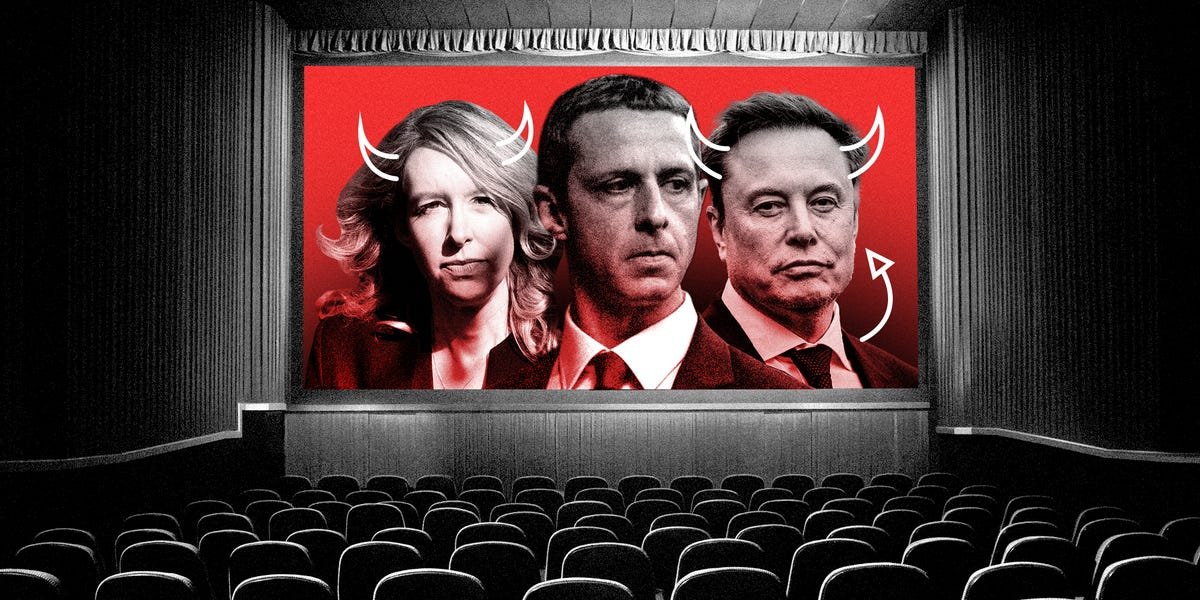
Writing villains is supposed to be hard. No grand, world-dominating plan ever really makes sense in a story. Soon after “The Dark Knight” came out, David Goyer, its writer, told me the Joker had been a real relief. “Blessedly, because of who the Joker is, we just said, ‘fuck the plan. We don’t have to do it. He’s the Joker. He’s the anti-plan,'” Goyer said. “Trying to take over the world is such an impossible, stupid idea — as if anyone could do it with a single act, you know?”
Yet now very real people seem to try just that, on the regular. Except if you believe Hollywood, they’re not insane clowns. They’re billionaire tech bros. It’s starting to seem like every movie and TV bad guy is a douchebag who got rich making stuff that works on your phone. Mark Zuckerberg in “The Social Reckoning,” Elon Musk in “Musk,” Elizabeth Holmes in “You Can See Everything,” Sam Altman in the upcoming “Artificial,” Sam Bankman-Fried in “The Altruists.” In these stories, at varying levels of fictionality, the evil villains’ megalomaniacal plans mostly make sense. Some of them even got away with it. America is eagerly consuming stories about them. “You Can See Everything” grossed $15 million on opening in just 855 theaters, twice what its producers expected.
The more interesting question is why these founders are our demons, all of a sudden. Chalk it up to the reality of the “techlash,” the society-wide revulsion to Big Tech’s ubiquity and power. But if you really want to understand the extent to which everyone thinks Silicon Valley is so uncanny these days, you should be watching a CBS legal procedural called “Cupertino.” It’s a sharp look at tech and its discontents — but more than that, it clarifies how widely the techlash is spreading.
“Cupertino” comes from the TV-making couple Michelle and Robert King, best known for the “The Good Wife” and “The Good Fight.” In their new show, a slick lawyer played by Mike Colter gets iced out of the tech company he cofounded at the same time as a more junior attorney also gets ousted. The two join their wrongful-termination lawsuits against the company, eke out a big settlement, and start a firm to represent “little guys” against Silicon Valley giants. In one plotline, a drone maker tries to blame a mid-level coder for one of its bots falling out of formation during a show and killing a man — it turns out the company had changed batteries to accommodate a prospective military contract. In another, a mysterious whistleblower client asks for help to force an Anthropic-like company to put guardrails around its most powerful AI. Then the whistleblower claims to in fact be the AI.
It’s all in good fun. The actors are beautiful. They banter well. Colter wears the hell out of a suit. Busy Philipps plays a Mackenzie Scott-like benefactor of the new law firm — if Scott used her incredible wealth to become a hardcore partier.
A CBS show like “Cupertino” picks bad guys that millions of people can easily recognize as deserving of comeuppance. It picked the overlords of Silicon Valley.
But thematically, there’s depth. That Colter is the only Black person for miles does not go unremarked. His new partner Olivia Siffre (pronounced “cypher”), played by Rachel Keller, is a devout, cross-wearing conservative from the Midwest, an alumna of Liberty University. Their closest allies don’t come from the ranks of coders, marketing, or venture capital but are instead service workers, tradespeople, and the waitstaff from a nearby TGI Fridays. (Alas, a fiction — there are no TGI Fridayses in the Valley.)
So see that class rage for what it is. The fantasy here is that the middle-American proletariat gets to stick it to bespoke-suited, arrogant C-level types and unkempt, geniuser-than-thou sex pests. Because for the last few years, those people have had all the power. “They always have a friendly audience, an accommodating interviewer who won’t ask them anything controversial. And then they get into territory where the price is much higher,” Robert King said in a recent interview. “They reveal who they really are: robotic, inhuman nerds who never got laid in high school and are now kind of crazy with power, self-importance, and a sense of entitlement.”
The point is, the “little guys” fighting this good fight seem like they’re supposed to be proxies for the viewer. “Cupertino” is a CBS procedural, the genre of shows like “NCIS” and its offspring — things that no one watches, except for 10 million people every week. That’s a lot. CBS typically has the largest primetime viewership of any network, and the oldest — like, people in their 70s. It’s all well and good for young coastal sophisticates to post about Elizabeth Holmes’ inability to grasp the Who’s-on-First routine, but “Cupertino” is aimed at America’s parents and grandparents. And apparently they are excited to see the people who make their phones portrayed as the wealthy engines of every inconvenience — sources of half a billion dollars to Republicans only, builders of data centers, creators of chatbots that drive kids to death by suicide, purveyors of screens that watch you back. “Cupertino” debuted to rapturous reviews and more than 3 million viewers, beating “Grey’s Anatomy” in its time slot.
A show like “Cupertino” is meant to have a low barrier to entry; it picks bad guys that millions of people can easily recognize as deserving of comeuppance. It picked the overlords of Silicon Valley.
Not so long ago it would’ve seemed preposterous to give a scrawny, socially awkward, brainy little guy the job of Big Bad. They’re the assistant, or the butt of a particular kind of joke, like the spectrum-y heroes of the wildly popular “Big Bang Theory” — Klingon-speaking, physics-doing, Green Lantern oath-knowing clods. Still, I can think of examples of “bad guy, subtype: tech nerd” going back to the early days of science fiction. Mad scientists like Dr. Frankenstein or Dr. Jekyll, or various HP Lovecraft antiheroes, probably count. So too might the arrogant cyberneticist in Robert Heinlein’s “Waldo.”
A rough analog in the mid 20th century might be the rogue industrialist. After all, James Bond villains have often been tech-bro adjacent. Karl Stromberg in “The Spy Who Loved Me” wants to build independent ocean settlements; he’s basically a seasteader. Hugo Drax in “Moonraker” is a eugenics-obsessed CEO who wants to build space stations, which sounds familiar. Max Zorin, played by Christopher Walken in “A View to a Kill,” is an “industrialist” and the product of Nazi genetic experiments. But his megalomaniacal plan is to use a California natural disaster to gain a monopoly on silicon computer chips. That’s just Jensen Huang on any given Tuesday.
The weirdest new phenomenon here is how personal it all is. Evil technology oligopolies have been representatives of oppressive capitalism in Hollywood for decades — but they were faceless. The anonymity was part of the terror. Think of the company that orders Bruce Dern to destroy the last forest in his spaceship biodome in “Silent Running,” the Umbrella Corporation in “Resident Evil,” or Cyberdyne Systems, creator of Skynet in the Terminator movies.
More recently, film and television have started identifying not just faceless corporations but specific tech-coded people as their worst-of-the-worst. And not just any people, but people geofenced into Silicon Valley: “Glass Onion,” “Don’t Look Up,” “Ex Machina,” “Devs,” “Super Pumped” (fictionalized Uber), “WeCrashed” (fictionalized WeWork), “The Playlist” (fictionalized Spotify), and “The Dropout” (fictionalized Theranos), “Mythic Quest” — the list goes on.
Actually, Cyberdyne’s a good example of one important way these depictions have changed; in 1984’s “The Terminator,” Cyberdyne is a Los Angeles-area heavy-industry firm. In 2015, “Terminator Genisys“ moved Cyberdyne to a gleaming tech campus explicitly modeled on the headquarters of Oracle. It’s an inside joke, though not the ha-ha kind. The movie’s producers included Megan and David Ellison, children of Oracle CEO Larry Ellison. David now owns the merged studios of Warner Bros. and Paramount, and he just got a billion-dollar investment from Elon Musk. The new company, Skydance, includes in its holdings … CBS.
Christopher Walken’s Bond villain has a megalomaniacal plan is to use a California natural disaster to gain a monopoly on silicon computer chips. That’s just Jensen Huang on any given Tuesday.
“A sequence of Hollywood contemporary science-fiction movies identifies Silicon Valley capitalists as a new type of villain,” write Northumbria University film studies scholars Joe Street and Russ Hunter in a 2024 paper. These new movies critique tech, they say, using an approach “in the grand tradition of cinematic science fiction touchstones such as the Cold War alien invasion films that allegorized fears of Communism in 1950s America.”
In other words, movies about time-travelling killer robots and dead-eyed billionaires aren’t so different, after all. Horror is about shared anxieties. Old-school mad scientists posed a threat because they dared to do experiments that contravened the laws of nature; they were evil for love of the game. The Silicon Valley bad guys are worse, because they do it for profit. “When presented with an innovation,” Street and Hunter write, “the prime movers in these corporations think not of moral or ethical concerns and crucially not of the material impact of what they are doing — but only of the innovation’s potential for financial gain.”
Is Hollywood’s techlash actually on the rise? The schlemiels of “Silicon Valley” premiered in 2014. I have tech-bro-villain articles in my files going back to 2022 at least. And the business world has always been fodder for stories filtered through the anxieties of the time—what was Ebenezer Scrooge if not a capitalist oppressor?
Mapping the full arc of technology-associated villains would be, in the words of Ted Underwood, “hard to code.” Underwood’s an English and information science professor at the University of Illinois at Urbana-Champaign, researching ways to identify literary trends across time, in big canons. “In addition to tracing the history of villains, you’d have to think how often these social types appear as heroes,” he says. For every Max Zorin there’s a Tony Stark. Ethan Hunt’s nobody without tech aces Luther and Benji. “Star Trek” doesn’t trek without Scotty, or Chief O’Brien. Every movie heist is basically a hack. And let me just say unto you: “MacGyver.” “One hypothesis would be that what we’re feeling right now with evil tech bro villains is just that the counterbalancing examples have dropped out,” Underwood says.
Clearly, though, tech billionaires and their hangers on have actively tried to make themselves into main characters. Some of them seem to think they’re the only real consciousnesses in a simulation, a virtual world populated with non-player characters like you and me. At minimum they evince a belief that they possess a greater depth of perception and knowledge. As the architect and tech historian Fred Scharmen once wrote, “for this particular kind of person, wealthy and powerful or not, intelligence comes paired with a certain kind of malignance. The Evil Nerd is sharp, and also mean, their big brains are oriented towards anger and destructiveness.” The Thiels, Altmans, Musks, and Karps of the world turn what had been nerdy weakness into nerdy strength. They go on friendly podcasts and show up in pictures taken with presidents. We don’t have to imagine them delivering what the screenwriter John Rogers, creator of the anticapitalist TV show “Leverage,” calls the Evil Speech of Evil. They monologue at tech conferences! These guys embody their ideologies; l’enterprise, c’est moi.
And what happens if that kind of behavior gets depicted, week in and week out, on a popular legal procedural TV show? Even if that show airs on a network owned by one of those “evil nerds”? Hard to say. Maybe it’ll be enough to turn some people into the Joker.
Business Insider’s Discourse stories provide perspectives on the day’s most pressing issues, informed by analysis, reporting, and expertise.
