

German companies in the Fortune 500 Europe have announced over 60,000 layoffs this year, in a sign of the country’s ongoing economic malaise that has left manufacturers reeling.
Major German employers, including Bosch, Thyssenkrupp, Deutsche Bahn, and Siemens, have this year announced plans to lay off thousands of workers in a bid to combat falling profits following a rocky post-COVID economic landscape.
The companies that make up the backbone of Europe’s biggest economy, Germany, have struggled to combat oppressive macroeconomic headwinds tied to rising energy prices and falling external demand, a particular issue in Germany’s export-dependent economy. The country is set for its second consecutive year of negative economic growth in 2024.
Germany’s production PMI, a survey of manufacturing bosses, indicates the sector has been in recession since the start of 2022. That was when inflationary pressures from rising energy prices began to hit producers’ bottom lines. Manufacturing’s share of GDP in Germany is much larger than that of other European countries like the U.K. and France, exacerbating the impact.
“In a world where China has become the “new Germany” – at least in manufacturing – Germany’s old macro business model of cheap energy and easily accessible large export markets is no longer working,” Carsten Brzeski, head of global macro for ING, wrote in a note.
German companies suffer the consequences
Fortune’s analysis found that German companies in the Fortune 500 Europe have announced plans to lay off over 60,000 workers, the majority of whom come from the country’s manufacturing sector. The figures rely on reported announcements this year and could be higher.
Earlier in November, German industrialist and autos supplier Bosch said it planned to lay off 7,000 employees as the company warned of a “difficult economic situation.” This followed an October announcement that the group would trim its workforce by 5,500 after Bosch’s chairman Stefan Hartung warned it wouldn’t hit its financial targets for 2024.
Thousands more workers saw their weekly working hours reduced from 38-40 hours to 35 hours for less pay, effectively giving them an unwanted four-day week. The company is one of Germany’s largest employers.
Later that month, the engineering and steel-producing group Thyssenkrupp said it would lay off 11,000 steel workers, representing 40% of workers in that division. The company cited the familiar foe of cheap Chinese imports as motivation for the headcount reduction.
Truck maker Daimler said in August that it would introduce a job freeze and reduce employees’ working hours, mainly affecting its German plants.
The pain hasn’t been confined to Germany’s manufacturing sector. In November, tech conglomerate Siemens said it could cut up to 5,000 jobs in its automation business after profits nearly halved in its flagship digital industries business.
Deutsche Bank, meanwhile, said in February that it would lay off 3,500 workers in a bid to boost profitability. The bank also announced plans in November to axe 111 senior managers in its retail and private banking unit.
Is Volkswagen next?
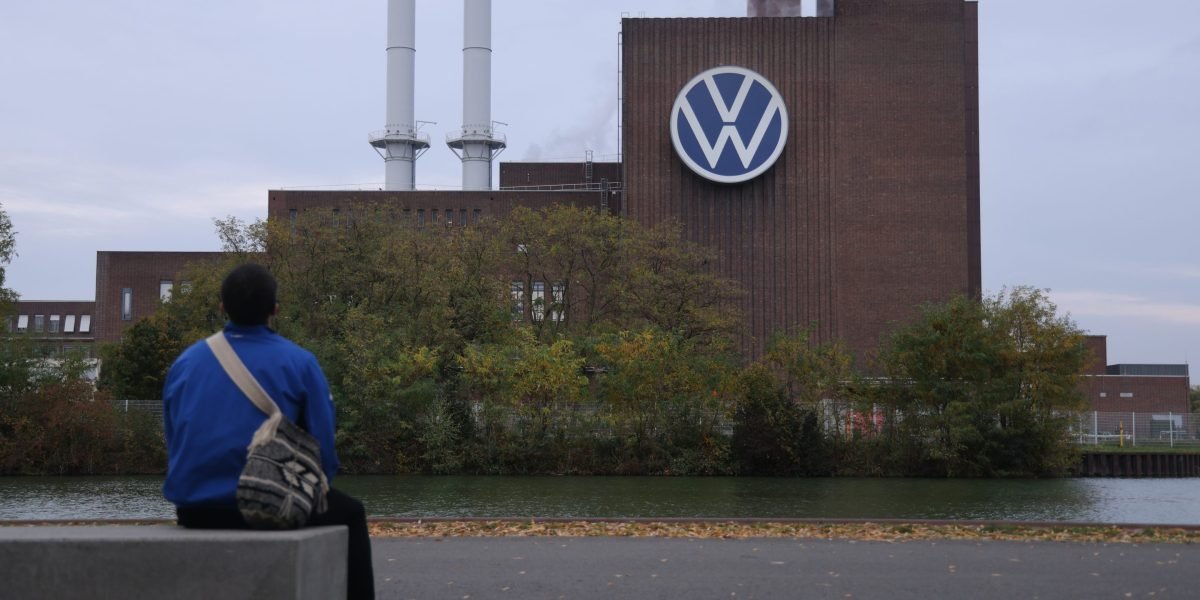
Yet to feature in the layoff data is Germany’s largest company and perhaps its most imperiled: Volkswagen. The €330 billion carmaker is on a daunting path to cut €10 billion in costs as part of an efficiency drive amid flatlining sales.
Volkswagen, Germany’s biggest private employer, has been laying the foundations to include ramped-up workforce reductions as part of these cost cuts.
To date, Volkswagen has made use of the demographic curve to reduce headcount by lowering its retirement age and offering older employees generous voluntary redundancy packages.
However, the company has acted more decisively in recent months, canceling a 30-year labor agreement that ensured job security for its employees while confirming plans for its first German factory closure in its 87-year history.
In September, Jefferies analysts predicted Volkswagen could lay off 15,000 employees during its cost-cutting drive, which would represent the largest round of layoffs in Germany yet. However, layoffs have been held up by negotiations with Volkswagen’s powerful works council.
Other German carmakers have also largely relented on layoffs so far. In November, Mercedes-Benz said it planned to cut annual costs by several billion euros in the coming years and refused to rule out workforce reductions as part of this strategy.
