
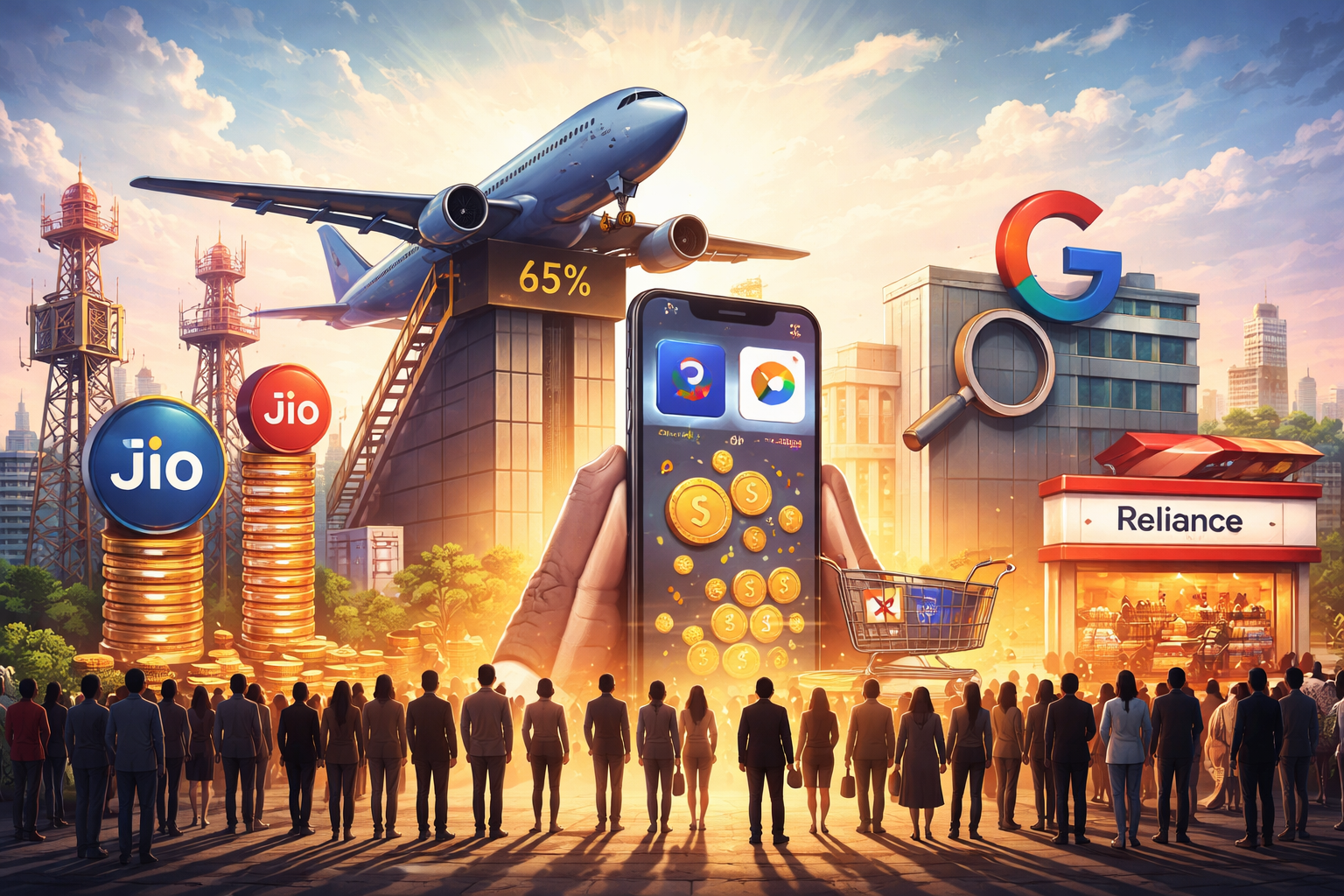

When one airline flies nearly two-thirds of India’s domestic passengers and just two apps handle over 80% of UPI payments, market power stops being a policy debate — it becomes a charge on your monthly bill.
India’s economy hasn’t just grown. It has quietly narrowed, concentrating essential services into a handful of dominant players.
IndiGo’s December 2025 operational breakdown, relentless telecom tariff hikes and the rise of a payments duopoly point to a deeper shift: consolidation is reshaping prices, amplifying systemic risk and hollowing out the promise of post-liberalisation competition.
Using regulator data, company filings and stakeholder interviews, this report asks the uncomfortable question: when competition fades, who really wins — and who pays the price?
Market concentration across India’s essential sectors shows extreme dominance by single or dual players, with Google commanding 97% of search, PhonePe-Google Pay controlling 83% of UPI, and IndiGo holding 65% of domestic aviation.
Market power by the numbers: Mapping India’s concentration problem
The scale of consolidation across sectors is striking.
IndiGo holds 65% of the domestic aviation market as of May 2025, with Air India commanding 27.3% and no other carrier exceeding single digits.
In telecom, Jio and Airtel together control around 70% of wireless subscribers as of October 2025, with the top five operators accounting for 98% of users.
PhonePe and Google Pay jointly control 83.3% of UPI transactions.
Google claims 97.17% of India’s search market. Reliance Retail, with 19,340 stores across 7,000 towns, anchors organised retail, whilst the duopoly of Zomato and Swiggy commands food delivery.
This concentration has directly translated into consumer bills.
Telecom ARPU, what subscribers actually pay per month, jumped 16.89% in FY25, from ₹149.25 to ₹174.46, driven not by innovation but by tariff hikes from operators facing minimal competitive pressure.
Industry projections show ARPU climbing to ₹200+ by FY26, another 14.68% jump.
When Jio and Airtel set prices, competition ceases to discipline rates; pricing becomes a function of market share, not supply and demand.
Telecom ARPU in India surged 16.89% in FY25 due to operator tariff hikes.
Industry projections show further growth to ₹200+ in FY26, reflecting consolidated market dynamics where fewer operators exercise stronger pricing power.
The 2024-25 tariff increases exemplify this dynamic.
After the July 2024 price hike, the Supreme Court dismissed a petition seeking price regulation, advising consumers to switch to public telcos like BSNL or lodge complaints with the Competition Commission of India if they suspected cartelisation.
Yet BSNL trails with only 36.92 million broadband connections versus Jio’s 476.58 million, rendering the “competitive choice” hollow for most users.
The regulator, operating under a forbearance policy since 2004, permits telecom operators to set tariffs freely provided they file them with TRAI within seven working days.
As long as charges don’t breach formal non-predation thresholds, increases pass scrutiny — regardless of whether competition exists to restrain them.
When dominance breaks: IndiGo, disruption and consumer fallout
IndiGo’s December 2025 operational crisis crystallised the dangers of extreme market concentration.
The airline faced an unprecedented cascade of cancellations when new DGCA crew duty norms, tightening pilot rest requirements from 36 to 48 hours per week and limiting consecutive night landings to two, fundamentally altered crew scheduling mathematics in November 2025.
IndiGo’s high-frequency, lean-staffing operational model had no buffer for regulatory tightening.
Between December 2-11, the airline cancelled approximately 1,600 flights on peak days alone, stranding tens of thousands of passengers and accumulating compensation obligations exceeding ₹500 crore.
Invezz reached out to India’s aviation regulator Directorate General of Civil Aviation (DGCA), but most officials remain tight-lipped about how things around IngiGo became so chaotic.
“Our oversight team repeatedly flagged operational weaknesses to the airline, but the execution gaps in complying with new crew duty norms and stabilising schedules exposed systemic vulnerabilities that we expected IndiGo to have mitigated,” said a senior DGCA official familiar with the ongoing review, speaking on condition of anonymity.
With IndiGo carrying two-thirds of the market, its operational failure became an economy-wide bottleneck.
Moody’s flagged the airline’s “lean operations,” efficient in stable times but fragile under stress, highlighting governance risks intrinsic to dominance without resilience.
Passengers couldn’t simply switch to competitors; competing airlines had limited spare capacity, fares spiked, and the Government of India activated a 24×7 crisis hotline.
By December 11, the DGCA imposed a 10% mandatory schedule reduction on IndiGo, focusing cuts on routes with competing carriers.
The crisis exposed a hard truth: when a single airline controls two-thirds of supply, its failure isn’t an airline problem; it becomes a national crisis.
Corporate perspective: M&A as consolidation strategy
From the corner office, consolidation is strategic.
India’s M&A landscape has matured into deliberate, value-focused consolidation rather than opportunistic dealmaking.
Mid-market M&A transactions in the ₹200–2,000 crore range now account for nearly 50% of India’s M&A activity, with companies acquiring rivals to build industry leadership positions.
Reliance Industries exemplifies this strategy.
Through Jio’s disruptive pricing in 2016, Mukesh Ambani’s conglomerate captured over 500 million telecom subscribers and triggered industry consolidation, whilst simultaneously building organised retail scale through acquisitions of Raskik, V Retail, and Eda-Mamma.
In August 2025, Reliance spun off its consumer products business into a separate subsidiary to focus on India’s “$2 trillion high-growth” consumer opportunity, itself a consolidation play targeting market share across FMCG categories.
“Scale, regulation, and capital constraints are pushing firms to acquire rather than build,” notes research on India’s consolidation trends.
Executives frame M&A as essential to survival.
As sectors mature and regulatory compliance rises, especially post-GST formalisation, smaller, unorganised players lose ground whilst dominant firms acquire cost-efficiently and achieve “razor-thin” margins that smaller competitors cannot sustain.
This creates a self-reinforcing cycle: consolidation reduces costs, enables price hikes when competitive constraints fade, and generates capital for further acquisitions.
Yet this corporate logic masks an asymmetry. Consolidation lowers costs and increases efficiency, gains that shareholders and deal architects prize.
But those efficiency gains don’t automatically filter to consumers when competition weakens.
Instead, dominant firms weaponise scale: dictating supplier terms, bundling services to create lock-in, and capturing data and monetisation avenues unavailable to smaller rivals.
From prices to profits: How scale converts into pricing power
Dominance compounds across verticals.
In telecom, bundling services, voice, data, broadband, and OTT subscriptions, creates switching costs and lock-in.
Jio’s bundled strategy, offering free voice and reduced data rates initially, achieved market dominance, then tightened pricing as competition weakened.
In payments, PhonePe and Google Pay use UPI dominance to cross-sell financial products, insurance, and credit lines, monetising discovery and transaction flow.
Reliance Retail’s scale, 19,340 stores across 7,000 towns, allows it to dictate supplier terms and monetise shelf space via “retail media” networks, creating new revenue streams unavailable to smaller chains.
Digital platforms exemplify algorithmic dominance.
Google’s 97.17% search market share means advertisers and sellers must pay for visibility.
Meta and WhatsApp, dominant in messaging and social discovery, face CCI scrutiny for leveraging platform data to compete unfairly across adjacent markets.
These aren’t competitive outcomes; they are rents extracted from scale and network effects.
Regulators react: But can they restrain market power?
Regulatory capacity to address consolidation remains structurally limited.
The Competition Commission of India operates within an evidentiary framework designed for stable markets, not fast-moving digital platforms.
In 2024, the CCI initiated only 8 new investigations and found violations in just 2 cases, whilst clearing 107 merger combinations, many in concentrated markets.
The CCI’s Digital Markets Division, established in 2024, promises stronger scrutiny of tech platforms, but enforcement remains slow.
TRAI’s forbearance policy on telecom tariffs delegates pricing to operators, with regulatory review limited to formal non-predation checks.
DGCA’s reactive measures: suspension of crew norms, operational audits, schedule cuts, stabilise IndiGo, but don’t address the underlying structural risk of dominance without resilience.
The result: reactive regulation rather than structural intervention.
Show-cause notices, refund mandates, and advisory circulars substitute for proactive competition enforcement.
Meanwhile, India’s lapsed MRTP (Monopolies and Restrictive Trade Practices) framework, which historically constrained monopoly practices, sits dormant, replaced by a CCI mandate that operates under higher evidentiary burdens and slower timelines.
‘Always harmful to consumers’: The case for reviving anti-monopoly tools
Consumer advocacy groups are raising alarms.
“Monopoly or duopoly structures are always harmful to consumer interest. A genuinely free market has repeatedly shown that competition leads to outcomes that favour consumers, in pricing, quality and choice,” argues the Voluntary Organisation in Interest of Consumer Education (VOICE).
The organisation contends it was for this reason that the MRTP framework was created when India opened up its markets, bringing “significant relief across sectors by curbing monopolistic practices.”
“Ensuring a level playing field is fundamentally the government’s responsibility. Essential sectors such as telecom, railways and airlines cannot be allowed to dictate terms to consumers. The MRTP framework must be revitalised and given an active role again in checking monopoly power in essential markets,” VOICE says.
This argument is gaining traction among policymakers.
The CCI’s 2025 outlook anticipates a “Competition Regime 2.0,” with strengthened enforcement capabilities, streamlined merger review timelines, and expanded deal-value thresholds capturing digital transactions previously outside regulatory scope.
The Competition (Amendment) Act, 2023, introduced provisions for hub-and-spoke cartels and “lesser penalty plus” mechanisms to incentivise cartel disclosures.
Yet these reforms remain incremental; without structural interventions, mandatory divestitures, interoperability mandates, or sector-specific caps on market concentration, dominance will likely deepen.
From competition promise to consolidation reality
India’s post-liberalisation economy promised that competition would discipline prices, improve services, and protect consumers.
Three decades later, that promise has inverted.
From IndiGo’s operational meltdown to telecom tariff spirals to payments duopoly, consolidation has quietly reshaped essential services into oligopolies where market power translates directly into consumer bills.
The regulatory vacuum: forbearance policies, slow CCI enforcement, reactive measures, permits dominance to compound unchecked.
Until India’s competition framework is revitalised with stronger structural tools and faster enforcement in essential sectors, consolidation will continue.
Your seat on IndiGo, your mobile bill, and your payment app are all sold by single-source suppliers. They know it. And they’re pricing accordingly.
The post From IndiGo seats to your phone bill: who is profiting as Indian markets concentrate appeared first on Invezz
