
Stay informed with free updates
Simply sign up to the European companies myFT Digest — delivered directly to your inbox.
If Charles Dickens were to rewrite A Tale of Two Cities today, he might well switch locations. To illustrate the best and worst of times in contemporary Europe, the novelist could perhaps have picked Helsinki and Venice, both of which I visited this month.
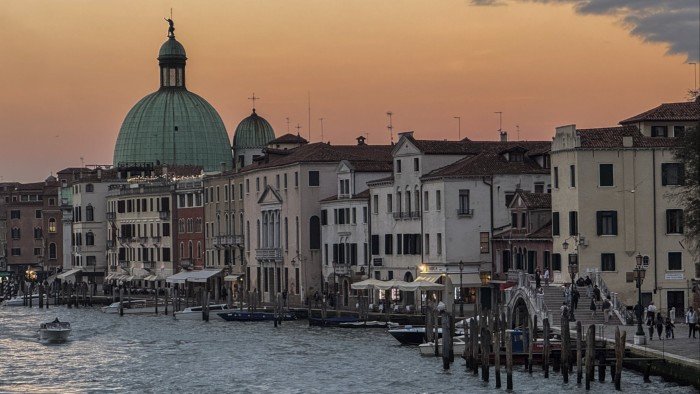
For centuries, Venice was one of the world’s most vibrant trading and financial centres and a fearsome naval power. But the city now makes its living as a glorious museum and tourist magnet. Venice remains ridiculously beautiful and culturally rich, even if environmentally threatened. It is also an example of how even enduring empires can end up as political backwaters.
By contrast, Helsinki boasts little of the beauty or artistic heritage of Venice. But it is a far better model for how Europe can reinvigorate itself and reassert its technological relevance. The Slush tech conference, which attracted 13,000 attendees to the city this week, highlights Finland’s attractions as an entrepreneurial hotspot. For a shot of positive adrenaline, there are few better places to visit in Europe. Just this week, Oura, the Finnish smart ring maker, raised funding at a $5.2bn valuation.
Finland’s canny balance between capitalism and welfarism ensures it consistently ranks as the happiest country in the world. But it believes in hard power as well as soft and is determined to defend its sovereignty. Alarmed by Russia’s full-scale invasion of Ukraine, Finland last year joined the Nato defence alliance. It currently spends 2.4 per cent of GDP on defence, among the highest in Europe.
The country is also a star performer in Atomico’s latest annual State of European Tech report, released this week, which highlights how the region’s tech ecosystem has blossomed over the past decade. Between 2015 and 2024, European start-ups raised $426bn, 10 times more than in the previous decade. With 35,000 early stage start-ups across the region, Europe jostles with the US in terms of company creation.
But even in Europe’s upbeat north, the mood of European founders is downbeat. Northvolt, the Swedish battery maker once seen as one of the region’s most promising companies, is fighting for survival. The country’s fintech company Klarna has just announced it intends to float in the US, not Europe. And there was gnawing concern among attendees at Slush that Europe is falling behind in the latest artificial intelligence revolution given the torrent of money being invested by US tech giants.
Europe’s entrepreneurs do not expect much from their political leaders, with France and Germany, in particular, wracked by uncertainty. But there are two relatively uncontroversial ways in which politicians could help boost Europe’s new economy. First, they could accelerate their efforts to mobilise growth capital. Second, they could create a common European corporate structure to help start-ups operate across the EU.
Europe undoubtedly boasts impressive research depth in many critical technologies — AI, climate tech, quantum, biotech and nuclear fission and fusion — and thousands of ambitious start-ups ready to exploit them. But Europe’s glaring lack of growth capital acts as a serious constraint in an increasingly winner-takes-all world. Atomico estimates that European pension funds devote less than 0.01 per cent of their €9.6tn of assets to venture capital.
“We have magic in our hands,” says Juha Vartiainen, co-founder of IQM, a Finnish start-up that employs 120 PhDs to explore the frontiers of quantum computing. But even though the company has received strong state backing and raised €200mn in funding, IQM fears the industry may yet migrate across the Atlantic once investment ratchets up. “Europe needs to find its own identity in tech otherwise it will become a museum,” Vartiainen tells me.
To that end, 13,000 signatories from the tech sector have signed a petition calling on the incoming EU commission to create an “EU Inc” corporate structure, cutting red tape and giving easier access to a market of 450mn consumers. “The mindset has to be that you do not set up as a Finnish or French company but as a European one,” says Peter Sarlin, co-founder of Silo AI, the Finnish AI start-up. In July, Silo sold itself to the US chipmaker AMD for $665mn to accelerate its own expansion.
The chatter at Slush was that the comeback US of president-elect Donald Trump and the threat of a more nationalistic US may prove a salutary shock to Europe, forcing its political leaders and fund managers to invest more in the technologies of the future. If not, even Helsinki risks becoming the new Venice.
john.thornhill@ft.com
