
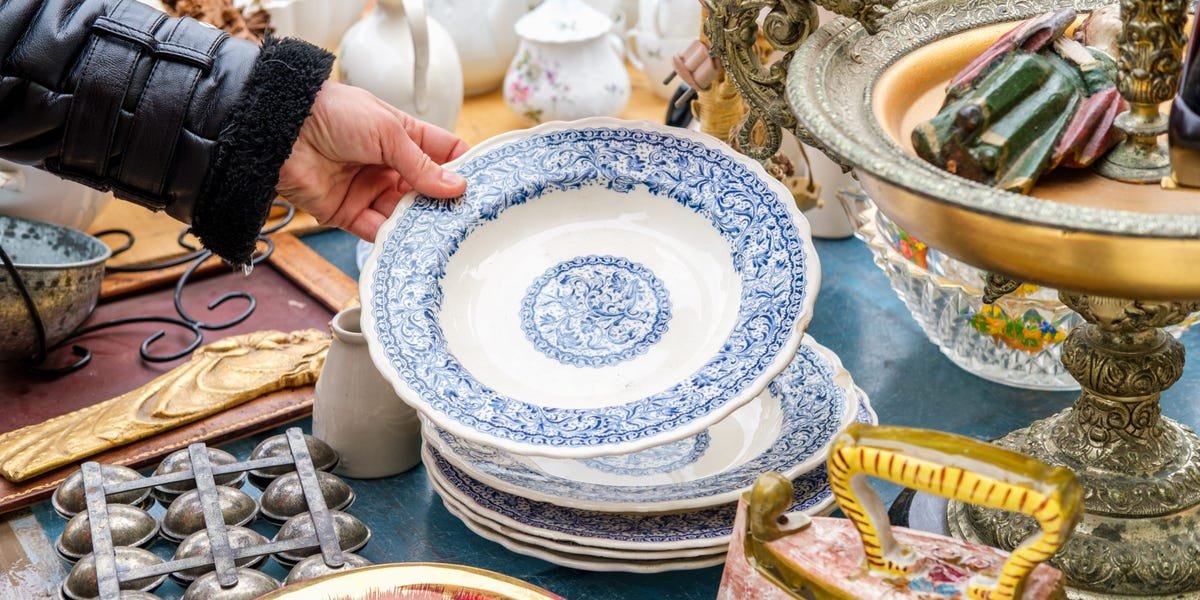
People love to complain about baby boomers, including that they have a lot of stuff. They’re hoarding all the houses, they’re keeping all the money, they’re materialists who have accumulated an exorbitant amount of possessions. There are a couple of problems with these gripes: For one, no generation is a monolith, and everybody amasses things over the course of their lives, so back off. But more importantly, youths and slightly-beyond-youths, the stuff pileup is actually to your benefit.
The golden age of boomer estate sales is upon us, and while you probably don’t want all the wedding china that’s about to flood the market, there’s a lot of other neat stuff you can pick up. Think knickknacks for Gen Z maximalists, midcentury modern decor, and so much silver that one estate seller says the weighing it all makes her team “feel like drug dealers.” Over the next couple of decades, baby boomers’ stuff has to go somewhere, and that rehoming process is increasingly taking place at estate sales.
“I call it the tsunami of stuff,” says Julie Hall, the director of the American Society of Estate Liquidators. “It’s cresting.”
There are … a lot of baby boomers. America’s over-65 population reached 55.8 million in 2020, and an additional 42.4 million are in the 55-64 age group (which, yes, catches some Gen Xers). This adds up to nearly 100 million people who have amassed a large amount of possessions — stuff they bought, stuff they got from their own parents, stuff their kids stuck them with.
“They kept everything,” says Sarah Hersh, one of the owners of Ben Hersh Estate Sales in New Jersey. Boomers were the first American generation to come up in an era of mass production and blatant consumerism, and many of the things they bought were built to last. “When we go into these houses of the boomer generation, they’re packed to the rafters with stuff from the mid-century to current.”
You can’t take it with you, and there are plenty of people willing to scoop up the stuff you’ve left behind.
Many elders would prefer to keep all of this stuff in the family, but their kids, grandkids, nieces, and nephews don’t want to inherit much, or simply don’t have the space. Enter the estate sale — pop-up limited-time museums of a person’s life, where everything on the premises is for sale.
“Boomers were an era of collectors. They believed in entertaining, and they believed their possessions had value, so they were proud to amass large collections of things to display to the world,” Hersh says. “We don’t really live like that anymore, but those things make for excellent inventory for resellers and the new younger generation of consumers who are into that vibe.”
Gen Z likes the appeal of sustainability, plus they’re into “cottagecore” and “grandmacore” aesthetics. Millennials and Gen X want midcentury modern and utilitarian pieces.
I recognize estate sales can sound a bit morbid at first, but not all offloadings come after a funeral. There are actually four Ds to estate sales: downsizing, divorce, decorating, and, yes, death. That latter one may give you the heebie jeebies, but as the saying goes, you can’t take it with you, and there are plenty of people willing to scoop up the stuff you’ve left behind.
Janelle Stone, a high-end estate liquidator, operates out of what she calls the “mecca of estate sales” — Dallas — and sees her line of work as a goldmine. After decades of minimalism in fashion and design, maximalism is back. She’s started buying plate hangers to put dishes on display again and marvels at 20-something shoppers grabbing various tchotchkes. Furs have gone “insane,” she says, and the same goes for vintage fashion. Customers will wait in line for two hours for a Herend porcelain starfish they’ve scoped out online prior to the sale. “You’re never going to completely clear a house, but it’s pretty amazing,” she says. “People know what they want, and they come and buy.”
It’s a huge moment for sterling, given the increase in the price of silver, which hit an all-time high of over $120 per ounce at the start of the year. (It’s since come back down but is still in the $85 range.) Stone tells me it’s affected how they price it — they can’t be as aggressive, because nobody can afford to pay $16,000 for an eight-piece silverware set, and the smelters are so inundated they might not even take it. Hence the drug dealer analogy: “We have to weigh it out. I mean, we look like drug dealers with our gram scales and baggies everywhere,” she says.
Hersh, in New Jersey, concurs on the popularity of sterling silver and vintage clothes, and adds that vintage collectibles, jewelry, toys, and electronics are also a big draw.
Not everything is flying off the estate sale shelves. Hersh says midcentury modern furniture still sells, but “it’s not as strong as it was.” Few buyers are into china, etched crystal, and glass. The big brown furniture that’s long sat in baby boomers’ and the silent generation’s homes often goes unwanted.
“A general rule of thumb is the bigger and heavier and darker a piece is, the more likely it’s going to remain there and not be sold,” Hall says. Younger generations tend to prefer smaller, portable pieces. Hersh tells me clear glass isn’t a popular seller “no matter what you do.”
A lot of baby boomers have china. Sadly, no one wants it.
Emily Stewart/Business Insider
The same goes for glassware. There’s just not a lot of demand.
Emily Stewart/Business Insider
I recently witnessed this for myself at an estate sale in Long Island, New York. It was a lazy Sunday, so I showed up during the last hour of a five-hour sale. The first thing I noticed when I walked into the kitchen was two sets of china, one of which looked very similar to the set my mother has. Around the corner was a big brown hutch filled with stacks of crystal and clear glassware, and there was more in the basement. My main thought was we should shut down Ikea immediately and never buy new dishes or glasses again.
The internet has changed and accelerated the scale of the estate industry, just as it has every other part of the economy. Everyone can look up what everything costs, so sellers have to do their research and can’t simply guesstimate a fair price anymore. Sellers often post what’s available online ahead of time, so buyers can pinpoint exactly what they want before they show up in person.
And then there are the resellers — technology has given birth to a plethora of resale platforms, from eBay to Depop to Whatnot, and droves of people eager to turn flipping used stuff into a side hustle or even a full-time gig. Most of the estate sellers and aficionados I spoke to for this story had tales about this development. Hersh tells me resellers are “vicious,” and on certain sales, flipped me up the first 50 people in line. “They are like elbowing each other out of spaces to get to stuff,” she says.
Hall points out that the resellers are generally a positive for estate sales — after all, the goal is to get rid of everything in the house, and who cares if someone plans to put it on eBay for triple the price. But they can be pushy, asking for deals. “Resellers sometimes want more of a bargain, and a lot of times we cannot give it to them on the first day,” she says. “It’s not for the faint of heart.”
Emily Stewart/Business insider
Maddy Brannon, an estate sale influencer based in Washington, DC, says she prefers to hit up estate sales later in the day so she doesn’t have to duke it out with the pros. She stumbled into the market when she and her husband were looking to furnish their home, and now she uses her experience to pass along useful tips to the noobs.
“You don’t need to be the first person at the estate sale unless you saw something on the listing you absolutely have to have,” she says. She’s not sure if it’s the “Disney World effect” or what, but people worry about long lines and feel like they must be first in at all costs. Plus, later in the day, you’re more likely to get a discount.
Brannon’s other pieces of advice included going during the week to avoid crowds and making sure you understand the rules of getting in — for some sales, waiting in line isn’t enough. Instead, the executor will call you in by name or number. And don’t shop off the “hold” table, where shoppers place items they want to buy. “People get really upset about that,” she says.
There’s genuinely something quite nice to all of this, albeit awkward. We spend our lives accumulating things and, over time, getting attached to them. Getting rid of them can be emotionally fraught, especially if we’d hoped our loved ones would want them or believed they’d hold more value than they do. For many people, it’s a hard pill to swallow that their kids don’t want their prized tea set, but acknowledging that is also permission to let it go.
There’s a peculiar sense of intimacy to estate sales — you walk through someone’s home, touch their things, look through their drawers, and get to make up stories about them based on their possessions. The golden age of estate sales isn’t just about the “goldmine” of inventory or the “vicious” hustle of the resale market, it’s about the way we experience life through tangible items — and how those things can live multiple lives, even ones we’re not involved in.
So next time you see an estate sale nearby because your boomer neighbors are finally selling their family home and moving to a condo in Florida, instead of begrudging that it took so long, pop over to see if you can pick up a vintage Le Creuset.
Emily Stewart is a senior correspondent at Business Insider, writing about business and the economy.
Business Insider’s Discourse stories provide perspectives on the day’s most pressing issues, informed by analysis, reporting, and expertise.
