
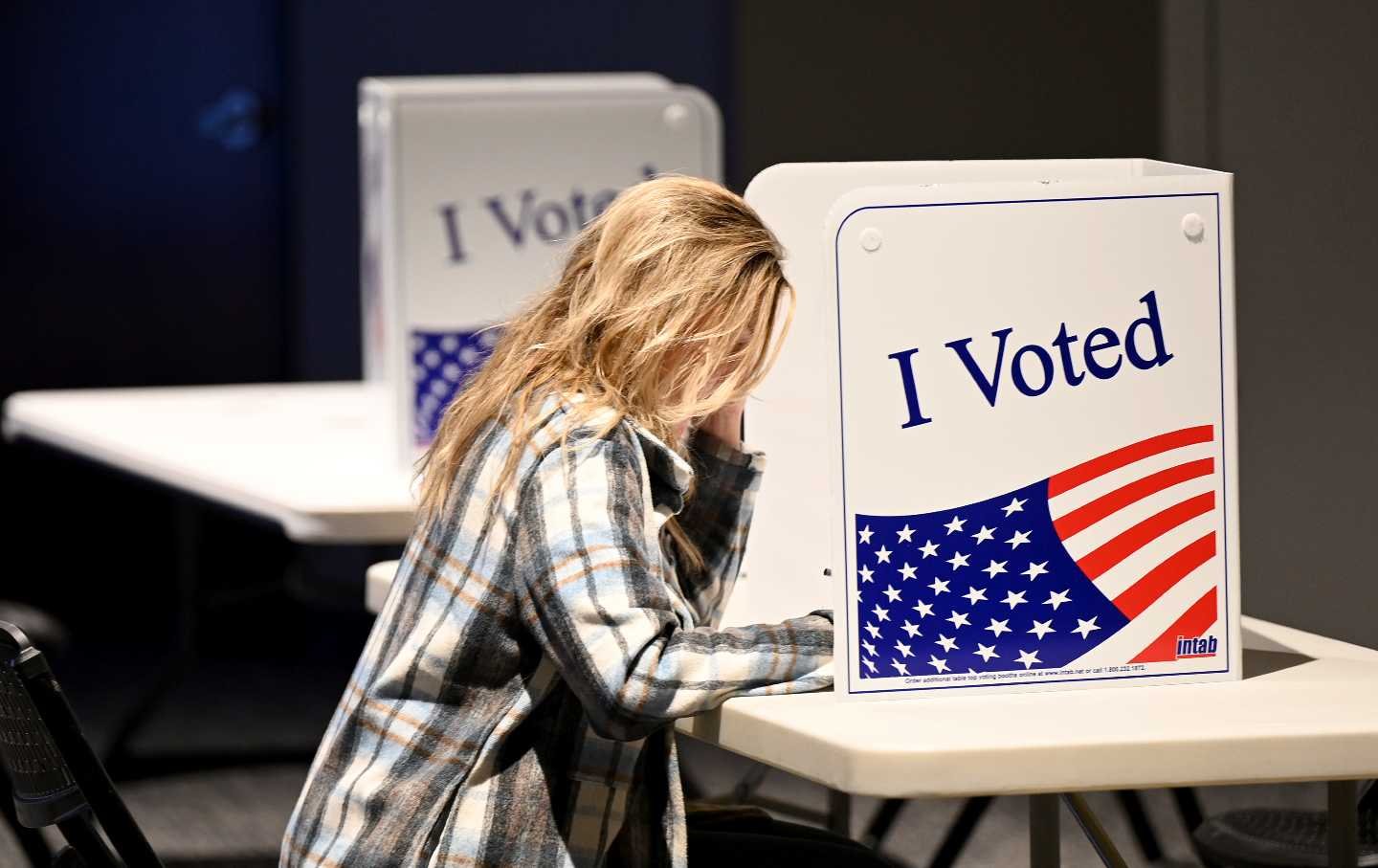
To properly diagnose what went wrong, we need to look at the actual number of votes cast.
Why did Democratic turnout contract?
(Will Newton / Getty)
The road to recovery and healing must begin with a proper diagnosis. Just as a good doctor conducts tests and rigorously reviews the results before prescribing a course of treatment, those seeking to revive the Democratic Party need an accurate assessment of what actually happened in the 2024 election. Unfortunately, recent weeks have seen an avalanche of dubious interpretations of the election results.
As bruised and battered party leaders search for solutions and explanations, they have had to contend with politically shallow, culturally ignorant, and mathematically incorrect interpretations of electoral data. These bad takes have come from myriad sources, most recently and alarmingly from The New York Times and its chief political analyst, Nate Cohn, who occupies one of the most prestigious and prominent spots in the political media universe because of his paper’s outsize influence on public opinion.
In his December 3 newsletter, Cohn argued that it would be a mistake “to conclude…that Harris might have won if [Democrats] had voted in the numbers they did four years ago.” Cohn based his contention on the belief that “millions of Democrats soured on their party and stayed home, reluctantly backed Harris or even made the leap to Trump.” Then he sought to buttress that position by pointing to the election results in Clark County, Nevada, where the Democratic margin shrank from 9.3 percent in 2020 to 2.6 percent this year. Citing statistics that Democratic voter turnout fell, Cohn posited that “two-thirds of the shift toward Trump was because voters flipped his way.”
Cohn’s conclusions are not only mathematically incorrect; they are, in fact, absurd. For some inexplicable reason, far too few people in politics pay attention to the single most important data set there is: actual votes cast. Looking, as Cohn does, at shifting statistical margins and percentage turnout rates by party misses the more obvious point of who actually voted. Cohn completely misses the fact that Kamala Harris got almost the exact same number of votes in Clarke County as Joe Biden did in 2020.
If the Democrats lost a lot of voters to Donald Trump in Clarke County, then how did Harris get nearly the exact same number of votes there as Biden did four years earlier? (Vote tallies are not yet final, but Harris is just 1,665 votes shy of the 2020 number, in a county with more than 1 million voters.) At a minimum, she would have had to backfill those allegedly lost voters with new Democratic voters, but this inconvenient fact is completely overlooked.
The underlying reality that many in the media and politics are missing is that in four of the battleground states—Georgia, North Carolina, Nevada, and Wisconsin—Harris exceeded Joe Biden’s performance four years earlier. The biggest story of the election is not that Trump succeeded in flipping the allegiances of previously Democratic voters; it is that Republicans did a better job of mobilizing their previously infrequent voters, while Democrats squandered far too much money on television and digital ads trying to appeal to Republicans.
Current Issue

To properly understand why Republican turnout expanded while Democratic turnout ultimately contracted, it helps to look at the now centuries-long role that white racial resentment and fear have played in US politics. New York Times reporter Astead Herndon’s podcast The RunUp touched on this reality when he conducted a focus group after the election. One of the participants broke it down clearly when she said, “People just came out of the rural areas and came out of everywhere to make sure that that Black woman would not win.”
A similar wave of racial resentment surfaced in Georgia in 2018 when Stacey Abrams came within 55,000 votes of winning the gubernatorial election. Abrams boosted Democratic turnout by 68 percent over the 2014 numbers, but fell just short because of a combination of massive voter suppression (e.g., purging hundreds of thousands of people from the voter rolls) and a historic increase in white voter turnout that occurred at the same time that Georgia was as close as it had ever been to having a Black female governor.
One of the reasons that it is essential that those attempting to analyze election results have deep cultural competence is that the electoral power of white racial grievance has long been a staple of American politics. In 1948, Southerner leaders outraged by President Harry Truman’s support for civil rights banded together to form the Dixiecrat Party whose platform unapologetically stated, “We stand for the segregation of the races.” Twenty years later, staunch segregationist George Wallace, governor of Alabama, used his defiant call for “segregation now…segregation forever” as a springboard to his 1968 presidential campaign. In 1980, Ronald Reagan launched his presidential campaign by traveling to the county in Mississippi that was nationally famous as the place where three civil rights workers were murdered in 1964. The same Southern states that anchored the Confederacy made up the cornerstone of Wallace’s, Reagan’s, and now Trump’s electoral support.
Understanding this historical context—the kind of “family history” that a doctor takes—illuminates the proper path forward. Given the abundant evidence of the electoral power and endurance of white racial fear, Democrats must do even more to maximize voter turnout of their supporters than they have in the past. Nearly half of Democratic voters are people of color, and the country’s profound racial wealth gap means it takes even more resources to help those families surmount the myriad financial and logistical hurdles that make it harder to vote. And Democrats must aggressively pursue a policy agenda that will galvanize the proponents of equality in commensurate numbers as the enemies of racial and gender justice.
If this election proved anything, it is that no amount of money or television ads are going to change the minds of voters susceptible to the fear-based and divisive politics of the Republicans. The good news is that there are still tens of millions of supporters of justice and equality among the ranks of those who did not vote this year. And despite what you may have read in The New York Times, prioritizing policies and politics that engage, inspire, and mobilize those potential voters is the correct course of treatment and path back to power for the Democratic Party.
