
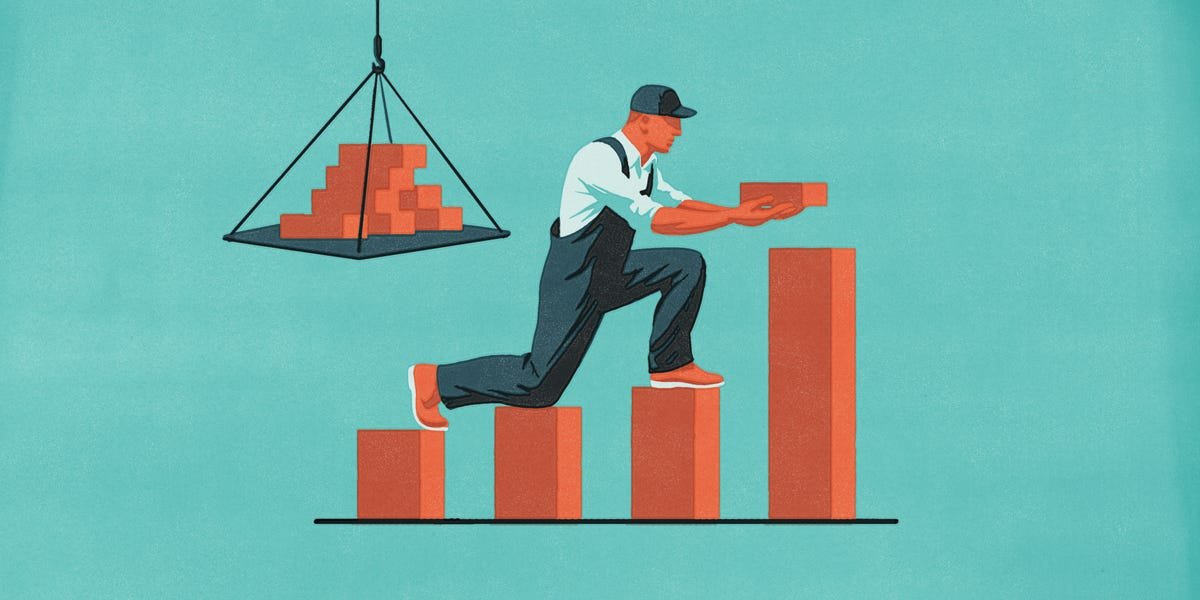
A new gospel is coming out of Silicon Valley, major business conferences, and seemingly every corporate call with investors: Artificial intelligence is about to make workers way more productive.
Free from the shackles of mundane tasks, employees will be able to churn out high-quality work in half the time. In fact, the argument goes, the data shows that labor productivity — the wonkish measure of how much a worker can get done in a given hour — is already on the rise.
While another technology-driven efficiency miracle might be coming soon, the recent uptick in productivity is almost certainly more quotidian than the AI evangelists suggest. Strong economic growth is inspiring businesses to invest more in basic equipment that helps people work faster, and the more stable labor market is leading to more experienced workers with a firmer grasp of their jobs.
This may not be the earth-shattering news that technophiles believe it is, but higher productivity is still great news for the US economy. In a time when everyone has inflation on the brain, better productivity helps lift the economy’s potential output, allowing for higher growth without triggering a rapid run-up in prices. I’ve written before that stronger, noninflationary growth is an “economic nirvana” where businesses can build, workers can increase their incomes, and households can watch nest eggs grow. And with increasing productivity, there’s a better chance that America can get there.
What we talk about when we talk about productivity
First, it’s important to get a handle on what exactly productivity means. At the simplest level, labor productivity is how much output (widgets, meals, spreadsheet computation) one person can complete in an hour. But measuring just how productive workers are can be tricky. Indeed, productivity is calculated from what we know: output and hours worked. Work from the Federal Reserve Bank of San Francisco, however, helps break down labor productivity into several component parts to give us a sense of the whole:
-
Labor quality: The more skilled or educated the workers, the more likely they are to be productive. If employees take a course on how to better perform a critical task, or if they simply stay in their jobs and learn the ropes better, overall labor quality and productivity go up.
-
Capital deepening: Businesses can invest in new equipment or facilities that make workers more productive — for instance, a machine that can quickly assemble parts that a worker used to have to assemble by hand.
-
Utilization of labor and capital resources: This refers to how intensely and efficiently existing resources are being used. Businesses can buy all the new equipment they want, but they also have to learn to deploy it optimally.
-
Total factor productivity: This is basically everything else not included in the factors above, such as technological advancements.
Over time, labor productivity has been driven by different elements. In the 1990s and 2000s, rising productivity was mostly from capital deepening and new innovations. In the years following the global financial crisis, businesses didn’t spend much on capital, which weighed on productivity.
Since the start of the pandemic, productivity has been somewhat erratic. It fell by 1.09% on average per quarter from 2021 through 2022, the worst two-year stretch in four decades. But over the past year, labor productivity has advanced by 1.62% on average per quarter, a significant reversal and even better than the pre-pandemic period of 2015 to 2019. There are signs, however, that the US could be on the verge of an even bigger productivity boom.
The case for a productivity boom
Last year, though supply-chain snarls and other COVID-era knots had been disentangled, plenty of firms still expected the economy to go into recession, and so they curtailed their investments in new equipment and big capital projects. Conditions so far in 2024 are much improved — recession risks have receded, and corporate confidence has recovered. There are signs that this is, in turn, inspiring companies to invest more in productivity-enhancing capital projects:
-
The S&P Global US Manufacturing Purchasing Managers’ Index points to strengthening durable goods orders. The new-orders component — which measures how much new product managers expect to be ordered in the months ahead — has climbed to 53.5, the highest since May 2022. Globally, conditions appear to be perking up as well.
-
The US is importing more capital goods. January’s trade data indicates imports of real capital goods rose by 3.8% month over month. Over the past six months they’ve increased by 9.6% at an annual rate. Ultimately, imported capital goods will be used for domestic production.
-
Stocks are up. A rising stock price means stronger balance sheets and more collateral against which to borrow. So during a boom, there’s a positive feedback loop: Rising stock prices and easier lending standards accelerate the impact on investment.
Capital spending also benefits from an accelerator effect. If companies perceive the economy as getting better, they’re more likely to spend more on capital goods to meet the expected increase in demand. So when GDP growth accelerates, investment tends to rise even faster, which should push up productivity down the line.
A steadying of the labor market is also a strong sign of a coming productivity boom. In the early days of the pandemic, labor markets were red hot, driving up the rate of quitting and hiring. Employers were running around with fishnets trying to find people, and workers used their leverage. A little heat in the job market is good, but you can have too much of a good thing. It’s hard to establish productivity if folks aren’t actually staying in their positions for that long. Today, labor-market conditions have settled: Job openings have declined, unemployment has increased somewhat, and workers are less willing to quit their jobs. This means people are staying in their jobs longer. As workers gain experience in their roles, productivity should follow.
Total factor productivity has been particularly weak since the start of the pandemic — perhaps innovation has slowed down or employees are still getting used to new in-person or hybrid work arrangements in the remote-work era. But those hurdles should fall into the rearview mirror as the economy settles. At the same time, there has recently been a burst of new business formation. That’s important since the slowing pace of business dynamism and lack of new business formation in the 2000s was said to be a reason behind the sluggish growth in productivity, particularly after 2005. The rise in business formation suggests people are willing to take on additional risk, and that should aid in productivity growth. More broadly, increased business formation ought to help allocate resources from less-productive firms to more-productive ones. Competition is a good thing!
Rising productivity lifts all boats
If productivity is indeed turning up, economists and market experts haven’t fully processed the news yet. Looking at a chart of Blue Chip Consensus estimates for GDP growth back to the early 1990s, a few trends become clear. First, the consensus tends to underestimate the severity of recessions, so economists have to quickly revise down their estimates during downturns. Second, the consensus tends to be too pessimistic as the economy recovers from the recession, which is why we see upward revisions to growth immediately after a recession. And finally, there are long periods when surprises tend to flow in the same direction — a string of years when economists are consistently underestimating or overestimating growth. This tends to happen when the growth trend changes and economists are mismeasuring the change in productivity.
Productivity shocks tend to come in waves. The 2010s, when productivity consistently fell short of expectations, was a period of chronically overestimated growth: The consensus would start the year at about 3% but end up at 1.5% or 2%. By contrast, the late 1990s were a period of higher productivity growth and underestimated growth, starting the year at 2% but ending closer to 4%.
These historical examples are worth thinking about today because growth expectations are climbing. Blue Chip consensus expectations for 2024 real GDP have jumped, tripling since last summer, to 2.1% from 0.7% in June. Unsurprisingly, recession fears have collapsed. Professional forecasters now see just a 23.9% chance of a drop in real GDP in the next quarter, down from nearly 50% this time last year. If we’re seeing a genuine increase in productivity, the takeaway is that it’s unlikely to be fleeting. If the past is prologue, the consensus will consistently be revising up growth estimates.
The AI boom isn’t here — yet
The media is littered with discussions about how AI is going to send productivity into hyperspeed. But it’s probably too soon to be thinking about these factors as the main driver of recent productivity growth. That’s an important part of the productivity paradox. Productivity miracles don’t necessarily follow a technological breakthrough right away. It takes time for the technology to make its way through the economy and time for workers to gain the skills needed to make the most of it.
The good news is that the normalization of the economy — improvement in supply chains, balanced labor markets — is likely to result in continued improvement in business-sector productivity growth. I think “normal” is about 1.5% to 2%. There’s likely some improvement on the horizon as capital spending outpaces hours worked; as a result, we’ll get a bit more capital deepening this year.
The investment implications of this are clear: Stronger productivity growth implies a higher speed limit for the economy. Wages can grow somewhat faster without pressuring firms to raise prices — a positive development for the Fed, at least in the short run. On the flip side, neutral rates might be somewhat higher as a result. For stocks, stronger productivity should be welcomed, implying more growth with stronger profit margins.
Neil Dutta is head of economics at Renaissance Macro Research.
