
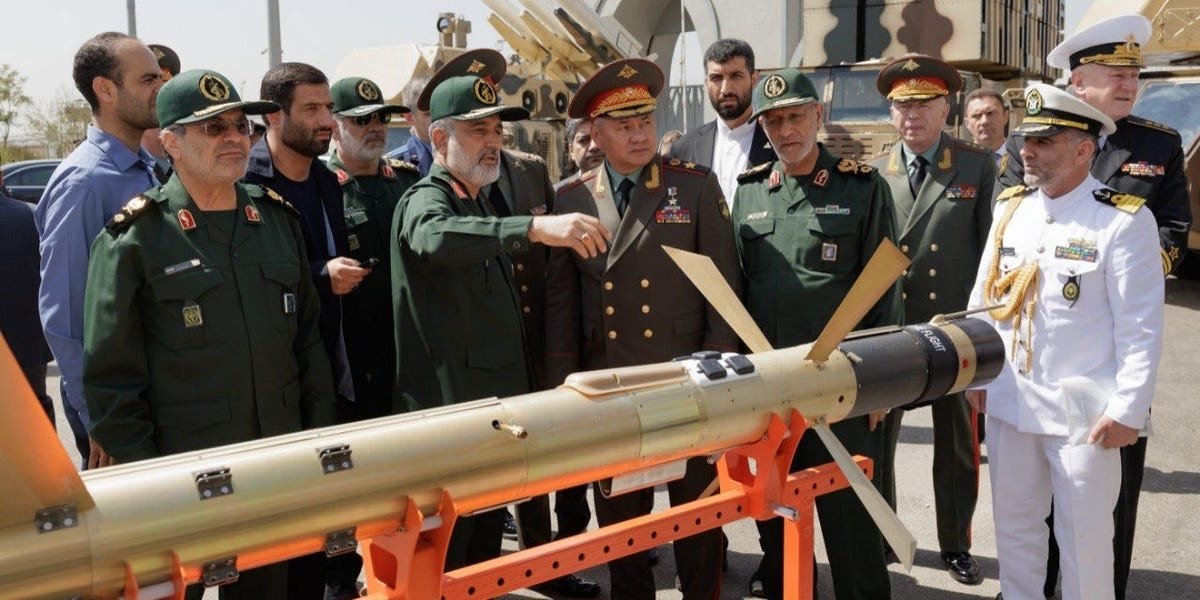
Several Iran-backed militias have acquired loitering surface-to-air missiles — essentially explosive drones that loop in search of aerial targets — in recent years, giving them the means to knock out the more advanced drones flown by their adversaries.
The Iranian-made 358 is undoubtedly the most ubiquitous. Since the US Navy seized a shipment of these air-breathing loitering missiles en route to the Houthis in Yemen in 2019, they have appeared in the arsenals of Iran-backed Iraqi militias and Hezbollah in Lebanon.
The 358 resembles an air-to-air missile. According to a report in Iran’s state-run media, the 358 is a nearly 9-foot-long cylinder, with body and tail fins and a 22-pound warhead. The report claimed it can reach an altitude of 28,000 feet but noted it’s primarily designed to intercept low-flying drones.
“The Iranian 358, surface-to-air system, has become a staple of groups allied to Iran,” James Patton Rogers, the executive director of the Cornell Brooks Tech Policy Institute at Cornell University and author of Precision: A History of American Warfare, told Business Insider.
“Utilized by the Houthis, as the Saqr/Hawk, the loitering munition proved effective against Saudi drone systems and was even deemed a threat against US aircraft operating in the region by the Pentagon,” Rogers said. “Reports of the 358 being used against Israeli drones by Hezbollah have also surfaced, making the system one of the most widely used, and most effective, across the Middle East.”
The 358 is an unusual weapon. It can be fired from a crude launcher like those militants often use, and after its initial ascent on a rocket motor, it is most likely propelled by some kind of jet engine like those found in cruise missiles. The 358 missiles confiscated by the US Navy were powered by small gas turbine engines made by a Dutch company.
The missile then “flies in a figure-eight pattern” in a designated area awaiting enemies to lock onto using the optic sensor in its seeker head. It also has infrared proximity fuses that can detonate the warhead once the missile is near its target. It’s apparently designed to loiter in a specific area until it either finds something to attack or runs out of fuel.
The missiles are much slower than traditional surface-to-air missiles and are, therefore, not likely to endanger airborne fighter jets. However, the steady proliferation of these systems among militants may provide an entirely new capability for groups long hunted by advanced drones like Turkey’s Bayraktar TB2.
“Medium-altitude long-endurance drones, like those adopted by Turkey, are especially vulnerable as they have been designed for use in regions where command of the air is maintained,” Rogers said. “In addition, any low-flying aviation, such as helicopters or aircraft coming in to land at remote bases, might be under increased threat.”
“Yet this is just the start of an offensive-defensive cycle, with states adapting their drones with defense systems and groups seeking ever longer range and more powerful air defense measures,” Rogers added.
Ryan Bohl, a senior Middle East and North Africa analyst at the risk intelligence company RANE, noted that the 358-type missile has had “some notable successes.”
“They offer a certain degree of flexibility for Hezbollah, untying their anti-air defense network from being completely anchored on geography by allowing them to loiter in the skies,” Bohl told BI. “Still, they have not yet demonstrated the capability to close the skies to Western combat aircraft, and so they must be seen as a hindrance to Israeli combat operations rather than a substantial block.”
Rogers anticipated that the 358 and similar loitering missiles will “likely continue to be deployed widely, leading to the worrying potential of escalation as the US and its allies respond to attacks on their military systems.”
“As air defense systems increase in power and effectiveness, it will mark a new challenge to drone systems that have long had command of the air,” Rogers said. “We are seeing a renewed age of offensive/defensive challenges and a new age of contested airspace.”
CENTCOM
‘Drone hunting drones’
A report in March speculates that Turkey’s arch-foe, the Kurdistan Workers’ Party or PKK group, may have acquired Iranian Meraj loitering missiles. These claims coincide with the PKK’s recent claim to have shot down 13 Turkish drones over Iraqi Kurdistan.
“With variants of the Meraj family of ‘drone hunting drones’ documented in Iraq, it is technically possible that the PKK has obtained such systems, either directly from Iran or otherwise,” Rogers said.
He noted that the most advanced Meraj system, the 532, has a maximum altitude of 12,000 feet. Turkish drones like the Bayraktar TB2 and Akinci can fly at 40,000 feet.
“While it remains possible the PKK has found ways to smuggle or illegally obtain Iranian systems, it would be in limited quantity given that Tehran has its own issues with the PKK and little interest in supplying an anti-Turkish faction with such systems for fear of upsetting Turkish-Iranian relations,” Bohl said.
“This seems, at least on the strategic level, to be far-fetched.”
The PKK would require large quantities of Meraj loitering systems if it aims to “overcome” Turkey’s overwhelming “drone and logistical advantages,” Bohl said. But if the group has managed to capture or smuggle a few, the RANE analyst anticipates they “could be of localized, tactical consideration for individual PKK-Turkey encounters.”
“The real constraint for non-state actor use is their supply; they need some kind of firm supply line to a state that manufactures them since few of them can be cobbled together in makeshift factories,” Bohl said.
While the 358 has proven capable of intercepting occasional drones and complicating air operations, they have not shut any airspace to American or allied military operations and are unlikely to do so.
“I think the loitering drones factor in as less of the end of Western air dominance in the region and more of a way for less advanced powers to have at least some layers of air defense against these rivals,” Bohl said. “That could contrast with groups like ISIS, which have virtually no air defenses whatsoever and must endure Western air power in any confrontation.”
“For Iran and its allies, they’ll have networks of air defenses that add deterrence to escalation, but don’t necessarily block air operations, especially covert ones by stealth units.”
