
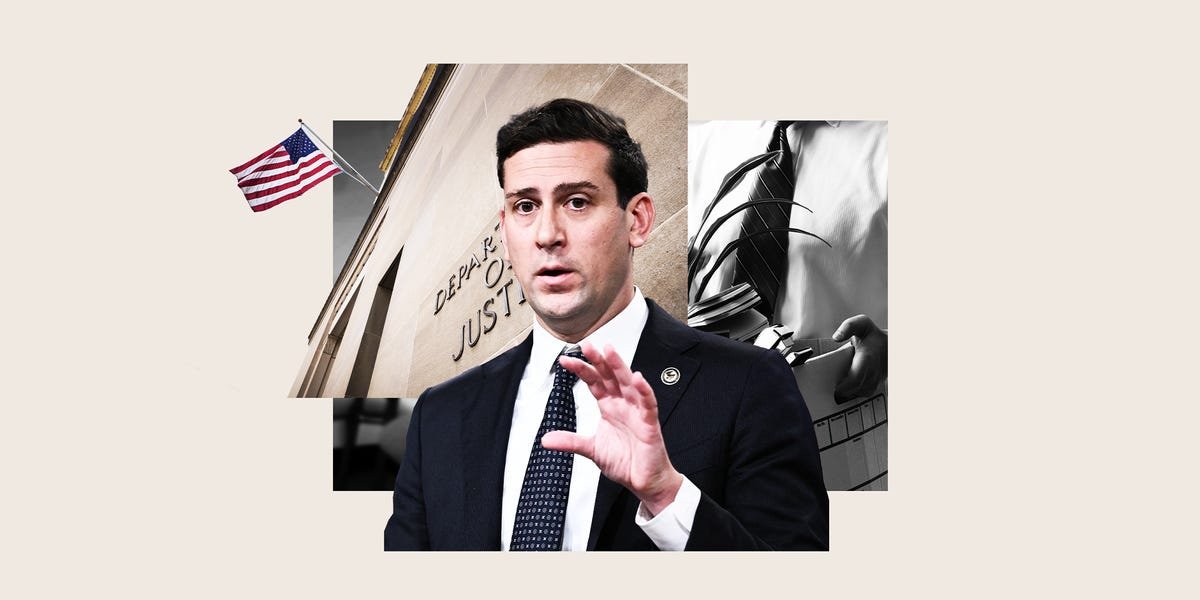
In June, Matthew Galleotti, the head of the Department of Justice’s criminal division, gave a speech outlining the Trump administration’s law enforcement priorities.
About halfway through, Galleotti used a word that ricocheted through the offices of white-collar lawyers around the country: “will.”
The Justice Department was announcing that it would provide declination letters — formal commitments not to prosecute companies — to companies that turn in their employees for potential white collar crimes.
Before the second Trump administration, there was only a “presumption” of a declination. The Justice Department had signaled it was safe for companies to self-report potential crimes or misconduct, but it still retained the discretion to prosecute if it wanted to, according to Lisa Zornberg, an attorney at Morvillo Abramowitz and former federal prosecutor.
That one word — will — replaced years of ambiguity with a guarantee.
Galleotti told BI in a statement that his revisions to the policy maximize the criminal division’s enforcement efforts by encouraging companies to voluntarily self-disclose potential wrongdoing, cooperate with investigations, and “disgorge ill-gotten gains.”
“My revisions in May to our Corporate Enforcement and Voluntary Self-Disclosure Policy (CEP) provide clear incentives for companies to do just that, which allows the Division to identify and prosecute white collar crimes, including those we may never otherwise know about, and hold individual wrongdoers accountable,” Galleotti’s statement said. “This policy also encourages companies to invest in compliance programs, which helps deter misconduct from happening in the first place and detect it when it does occur, all of which benefits the American public.”
The new policy offers the benefit of certainty and closure. If a company blows the whistle on itself, works with federal authorities to investigate employees, and handles the situation internally, then they will receive a declination letter, Galleotti said in his June speech.
“If you self-report and you get a declination, it’s over,” Zornberg told Business Insider. “It’s in the company’s rear view mirror and you don’t have to worry or wonder whether in four years from now a different DOJ administration is going to come back and dig into what happened.”
Self-reporting isn’t always the obvious move
To receive a declination, the companies need to cooperate with the government, which could mean supplying information to pursue criminal charges or civil enforcement action against any employees responsible for the mess.
Related stories

Business Insider tells the innovative stories you want to know
Business Insider tells the innovative stories you want to know
“They’re trying to take a narrower view of when the corporation has to be prosecuted, and instead they’re going to focus on individual wrongdoers,” Zornberg said.
For corporations, recognizing wrongdoing — like fraud, bribery, or skirting regulations — and reporting it to the government isn’t always a black-and-white issue.
If companies conduct an internal investigation into potential criminal activity, they face a sophisticated decision matrix for how to move forward.
Do they reach out to the government when they open the investigation, before all the facts are known? If they suspect a whistleblower, do they want to rush to self-report before the whistleblower goes public? What if they’re unsure if there was a civil or criminal offense, or simply a violation of an internal company policy? And are they sure the Justice Department would even be interested in the misconduct?
“Deciding whether and when to self-report is not off the rack, it’s couture,” Zornberg said.
Turning in your own employees to the government could have downsides. While it’s helpful for agencies, it could be at odds with the interests of shareholders or employees, according to Rod Rosenstein, who served as deputy attorney general in the first Trump administration.
Companies have fiduciary obligations to weigh the pros and cons, Rosenstein said. Instead of telling the government, they could try to fix things in-house and hope government agencies don’t find out about it before the statute of limitations expires, he told Business Insider. Even if the Justice Department chooses not to prosecute a case, there’s always the risk that the disclosures could trigger class action or shareholder lawsuits, or an investigation from a regulator in another country.
“For companies that have engaged in wrongdoing, there’s always a cost-benefit analysis,” said Rosenstein, now an attorney at Baker McKenzie. “As in, ‘If we say nothing, there’s a chance we’ll get away with it. If we cooperate, how harsh a penalty are we going to suffer?”
The second Trump administration has taken a light touch on white collar crime, as Business Insider previously reported.
By increasing incentives for self-reporting, the Justice Department can enforce the laws with fewer resources, Rosenstein said.
“The perception of reduced enforcement does create a risk that companies will be more willing to roll the dice,” Rosenstein said. “And so this policy is really intended to offset that to some extent by creating a greater, a bigger carrot to incentivize companies to come forward and cooperate.”
The DOJ is upping the incentives
For companies that report their own misconduct and cooperate with the government, the Justice Department also created incentives for companies that exist in a gray area.
In May, it announced that companies won’t necessarily face a full-scale criminal investigation if they don’t do everything they need to do to get a declination letter. If a company self-reports but doesn’t do so quickly enough, or if there are aggravating factors that could still warrant a criminal prosecution, the Justice Department says it’ll offer a non-prosecution agreement and reduced fines.
According to Rosenstein, the incentives continue a decadeslong effort by both Democratic and Republican administrations to make it easier for companies to self-report suspected crimes being committed within companies..
“The government has adopted a series of strategies to try to incentivize companies to police themselves and report to the government the details of the wrongdoing,” Rosenstein said.
It also marks a continuation of the Justice Department going after individual bad actors, rather than entire corporations.
Prosecuting an entire company could be a death knell for the corporation, potentially leading to people unaffiliated with the wrongdoing losing their jobs.
“A corporation is in some ways a fiction,” Zornberg said. “If you prosecute a corporation, there’s almost never a trial because there’s no one to sit at the counsel table.”
Zornberg pointed to the 2002 conviction of accounting giant Arthur Andersen, which prosecutors said enabled fraud at Enron.
The Supreme Court overturned the company’s conviction three years later, but Arthur Anderson had already collapsed by then, leading to tens of thousands of job losses.
“From a prosecutor’s standpoint, it just hits in the moral kishkas that, if there are individuals who have been engaged in criminal conduct — flesh and blood people who have done wrong things that have injured investors or the environment or whatever, name your victim — that those individuals should be held accountable for their conduct,” Zornberg said. “That’s the ethos of always prioritizing the accountability of individuals.”
