
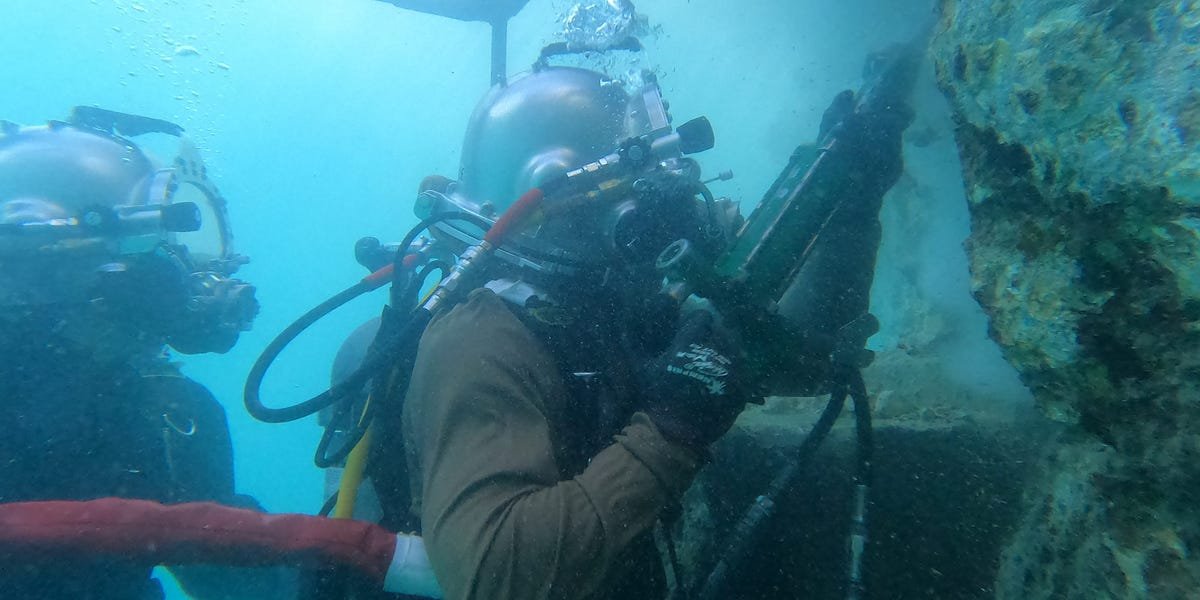
The US military’s research arm wants to find ways to 3D print concrete underwater to fix and build critical port infrastructure using seafloor sand and clay and ocean water.
DARPA, the Defense Advanced Research Projects Agency, is asking civilian industry and academia for help solving what the agency has identified as “critical limitations” in underwater construction methods by using advanced maritime construction equipment and a mix of seawater and ocean sediments to build in shallow, shoreline waters and waters up to 100 meters deep.
The ultimate goal is to “lay the foundation for future development of a fully autonomous, deepwater-capable system,” which could build and repair ports, seawalls, and artificial reefs, provide “blowout protection” for underwater oil and gas pipes, and even protect underwater telecommunications cables, using AI to determine what mix of sediment and water would work best in different locations.
The US military is interested in autonomous systems that could give American forces an advantage in future conflicts, from small aerial and ground drones capable of surveillance and violent attacks to other systems that can evacuate wounded troops. The services have also experimented with 3D printed construction on land.
But autonomous underwater construction using robotic systems could be a new frontier and could prove particularly useful for units that might need to build or repair maritime damaged facilities.
Underwater concrete construction technology already exists, though current methods can be logistically burdensome, requiring specialized equipment and material transportation. Current approaches are too slow, costly, and environmentally intrusive, DARPA says, making them “unsuitable for expeditionary or military operations.”
Maritime infrastructure faces a host of structural challenges. Saltwater, humidity, storms, and corrosion take a harsh toll on ports, piers, seawalls, and other facilities. Those sites are crucial for the US military in both peace and war, serving as key logistics hubs and naval bases.
Many maritime military facilities are already in poor condition. A government watchdog report over a decade ago raised concerns about the condition of strategic military seaport infrastructure. A more recent report released last year noted numerous problems with Coast Guard maritime infrastructure — around 45% of facilities, including piers and moorings, were past their expected service life.
Another DARPA program, also in its earliest stages, seeks to find better ways to predict how concrete infrastructure, including land-based infrastructure like aircraft runways, will hold up over decades and how it could fail before it ever begins to crack. Current tests can assess the strength of concrete, but DARPA says they do a poor job reproducing the combined real-world damage from elements like humidity and heat and predicting long-term wear and tear.
DARPA has been interested in assessing how concrete infrastructure can be quickly repaired for some time. In 2023, the agency gave $10 million to a University of Colorado effort for a nearly five-year research project examining how damaged infrastructure, including airfields, missile silos, and naval piers, could “heal itself” in ways similar to human vascular systems or fungi do.
“The idea is that networks of cracks in concrete can naturally provide a pathway to facilitate internal healing, similar to the veins in human bodies,” read a school press announcement on that effort, called RC-REVIVE. “Creating a biological network within a structure will allow the team to introduce nutrients and organisms for concrete self-repair.”
