
Journalist
Tanzeel Akhtar

Journalist

Share

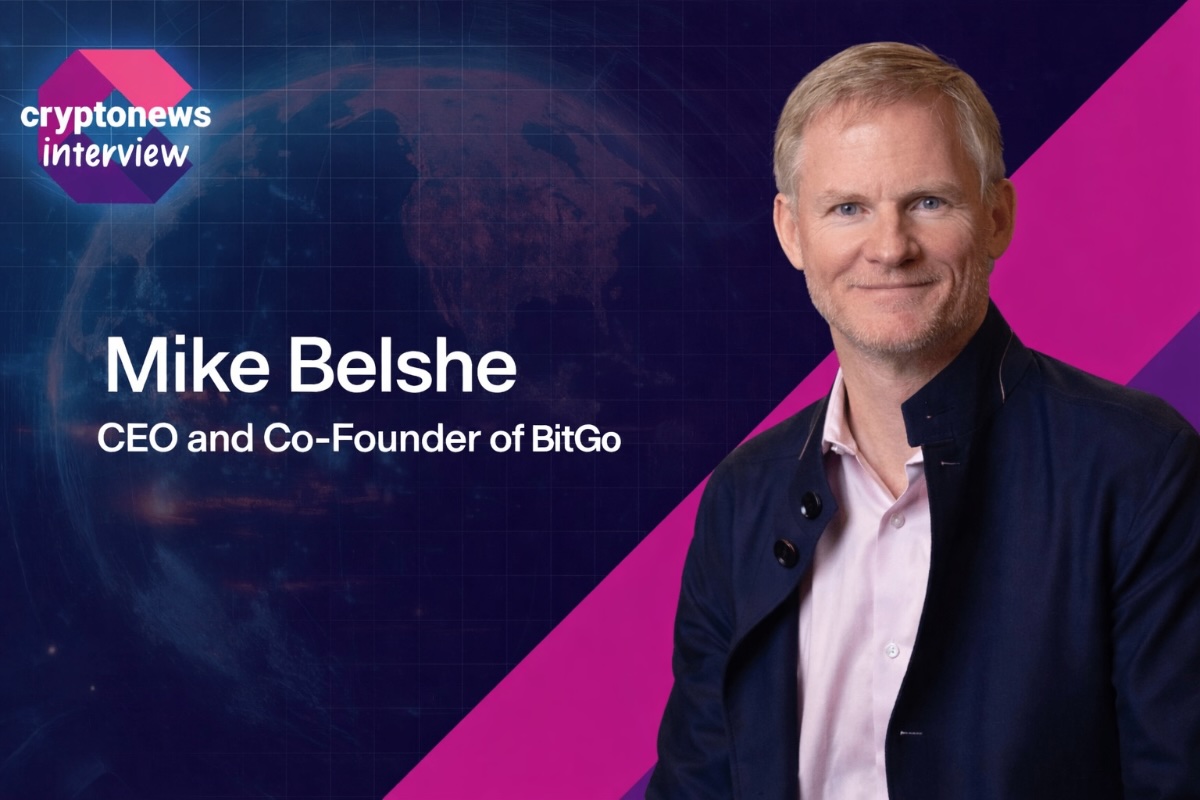
Mike Belshe is not trying to build the loudest company in crypto. He is trying to build the most trusted one. As CEO and co-founder of BitGo, Belshe has spent the last decade positioning the firm as the institutional backbone of digital assets — the custody provider, settlement engine, and compliance infrastructure that large financial players can actually underwrite.
Now, with BitGo becoming the first crypto IPO of 2026, he believes the market is finally catching up to that vision. “We went public because the industry is maturing,” Belshe told CryptoNews in an interview. “Institutions want infrastructure they can diligence, underwrite, and trust over long time horizons.”
In an industry still defined by cycles of hype, collapse, and reinvention, BitGo’s public debut marks something different: a bet that crypto’s future belongs less to speculative trading and more to regulated financial plumbing.
An IPO Built on Maturity, Not Momentum
The timing of BitGo’s listing is striking. Crypto markets remain volatile, and the public markets have not always been kind to digital asset firms. Yet Belshe frames the decision as almost inevitable — not opportunistic but structural. “The strategic rationale is straightforward: more transparency, more access, and a stronger platform for long-term institutional adoption,” he says.
For BitGo, becoming a public company is not simply a capital event. It is a governance statement. Disclosure and accountability, Belshe argues, are features when your business is safeguarding billions of dollars in client assets. “It raises the bar on disclosure and governance,” he says. “That’s a feature, not a bug, when your job is safeguarding client assets.”
Infrastructure Over Speculation
Unlike exchanges built around retail flow, BitGo has never positioned itself as a trading destination. Instead, it has focused on what institutions actually require to participate in crypto markets responsibly: custody, wallet technology, settlement workflows, prime brokerage services, stablecoin rails, and compliance architecture.
“BitGo isn’t a retail exchange,” Belshe explains. “We’re the underlying infrastructure that institutions rely on.” That distinction is more than branding. It is also a response to the industry’s most painful lessons. “A core lesson from past failures is that vertically integrated models can create dangerous single points of failure,” he says.
BitGo’s philosophy is rooted in separation. Custody should not sit inside the same entity as trading, market making, or clearing. That structural division — familiar in traditional finance — is precisely what Belshe believes crypto needs to survive its next phase.
“The long-term health of this market depends on separating roles,” he says. “That’s exactly where BitGo has focused for years.”
Public Scrutiny as Product Discipline
Going public introduces a different kind of pressure: quarterly reporting, shareholder expectations, regulator attention. For some crypto founders, that scrutiny is unwelcome. For Belshe, it is part of the product.
“It makes the roadmap more disciplined and more accountable,” he says. “You don’t get to hand-wave priorities when you’re reporting as a public company.”
BitGo’s mission remains unchanged — to build the most trusted platform for digital asset financial services — but public markets demand sharper execution. “What changes is the rigor: clearer timelines, tighter prioritization, and an even stronger emphasis on resilience, controls, audits, and operational excellence,” he says.
Transparency, in his view, is not a compliance burden. It is a competitive edge.
Profitability and Institutional Compounding
BitGo entered the IPO from a position of profitability — a rarity among crypto-native firms. While Belshe avoids granular financial breakdowns beyond what is disclosed in filings, he attributes the performance to institutional durability rather than cycle chasing.
“Profitability comes from building durable, institutional-grade lines of business and running them with operational discipline,” he says.
Infrastructure companies do not win through hype, he argues, but through compounding trust: retention, long-lived client relationships, and services that scale with real activity rather than speculative mania. “Infrastructure businesses win by compounding trust,” he says.
Control, Governance, and the Long Horizon
BitGo’s IPO also brings attention to its dual-class share structure, which leaves Belshe with significant voting control. Critics often argue that such setups weaken shareholder power. Belshe sees it differently.
“We’re building critical financial infrastructure,” he says. “That requires long-term decisions that won’t always optimize for the next quarter.”
Security and compliance cannot be sacrificed for short-term earnings beats, he argues, because in custody, trust is existential. “The dual-class structure is designed to protect the mission and the time horizon: security, compliance, and trust first,” he says.
Still, he emphasizes that control does not mean insulation. “Public investors get more transparency, more scrutiny, and clear governance obligations,” he says. “We welcome that scrutiny.”
Managing $100 Billion With “Paranoia and Process”
With reported assets under custody exceeding $100 billion, BitGo operates at a scale where risk management becomes the core business. Belshe’s description is blunt. “You do it with paranoia and process,” he says.
Security is not a feature bolted onto the platform — it is the architecture, the culture, the audits, and the elimination of single points of failure. “At scale, risk management is about enforcing segregation, continuously testing assumptions, and making conservative choices even when it’s inconvenient,” he says.
And it extends beyond technology: operational risk, compliance risk, vendor risk, governance risk. In custody, reputational trust is the ultimate product.
Regulation as Unlock, Not Obstacle
Few crypto executives speak as directly about regulation as Belshe, who has testified before U.S. policymakers in the past. His view is that institutions do not fear regulation — they fear uncertainty. “Institutions don’t fear regulation,” he says. “They fear ambiguity.”
The United States, he argues, needs consistent pathways that allow regulated firms to participate onshore, rather than pushing activity offshore into weaker structures.
“The biggest risks often come from exclusion,” he says. “When the regulated system can’t engage, concentration and structural risk build elsewhere.”
BitGo will continue advocating not for lighter rules, but smarter ones: frameworks that match how the technology works while protecting investors and preventing financial crime.
Tokenization, DeFi, and the Next Financial Rails
Looking ahead, Belshe sees tokenization as more than a buzzword. The promise is faster settlement, transparent markets, and programmable finance — but only if the same institutional principles apply.
“It only works at scale if robust custody, identity and compliance controls, audited systems, and clear accountability are in place,” he says.
DeFi, too, will evolve as institutions enter — some activity remaining on public rails, some adapted into regulated forms. Either way, the plumbing matters. “Secure key management, policy controls, and infrastructure that lets firms operate safely,” he says. “That’s where BitGo plays.”
In many ways, BitGo’s IPO is not just a milestone for one company. It is a sign that crypto’s next era may belong less to speculative excess — and more to the quiet, disciplined infrastructure builders determined to make digital assets part of the regulated financial system.
And Mike Belshe intends to be at the center of that shift.
