
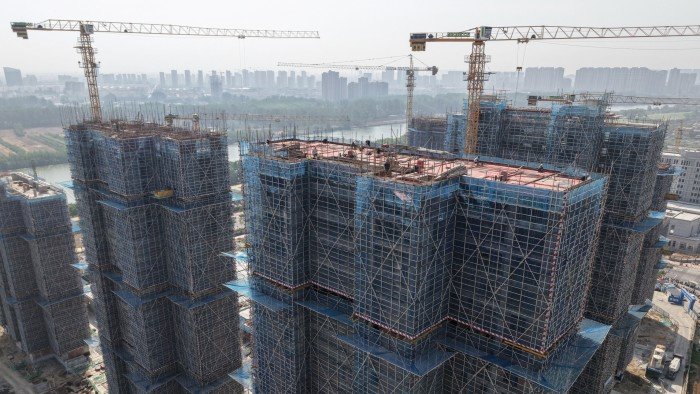
As China grapples with a trade war, a four-year property slowdown and lingering weakness in consumer confidence, one typical gauge of corporate distress has been conspicuous by its absence.
There has been only one first-time default in China’s $4tn onshore corporate bond market so far this year, according to data from S&P Ratings. That compares with 16 in 2024 as a whole, and multiple defaults by this stage in every year since 2013.
Rather than a definitive indication of corporate distress across the economy, the absence of defaults points to a marked change in tone during the recent development of China’s financial markets.
A 21st century move closer towards international norms, for which the US was both a driving force and a blueprint, appears in many areas to have lost momentum.
Instead, amid a bleaker economic outlook and a geopolitical rift with Washington over trade, the domestic focus has shifted to stability.
“There was a trend [of] normalising towards global rates [of default], but that trend started to reverse itself recently, particularly during and after Covid, as systemic risk concerns became more of a worry for the government,” said Charles Chang, Greater China country lead at S&P.
The government had “taken a step back” from a “normally functioning bond market”, he added.

China’s bond market dates back several decades, but it only recorded its first outright corporate default in 2014 as the country pushed ahead with reforms to its financial system, including efforts to adapt international standards in its nascent capital markets.
in March that year, the government cited the default of Shanghai Chaori Solar as an example of the market’s healthy development. A 2021 report from the International Capital Markets Association noted corporate defaults were “relatively unheard of” prior to 2015, amid assumptions of state support. It cited issues including transparency and liquidity, but also pointed to rising default rates and “a less interventionist stance”.
The corporate bond market was worth about Rmb29tn ($4tn) at the start of the year, according to S&P estimates based on data from provider Wind, and has continued to expand.
But foreign participation is extremely limited. Goldman Sachs estimates that last year it fell to its lowest level in more than a decade, ending 2024 at just 0.29 per cent, compared with 2.4 per cent for the overall domestic bond market.
Concerns over financial stability mounted after a prolonged property crunch beginning in 2021, which drove a wave of defaults both within the country and in offshore bond markets.
That prompted tighter government controls. In a report, S&P referenced a “series of directives to prevent outright defaults, focused on state-owned enterprises”, including a State Council press conference in 2023 that said central state-owned enterprises had been directed to “ensure zero outright bond defaults”.
In 2025, the one case of a new default from a company not previously in distress is Xinjie Investment Holding Group Co, a real estate venture that defaulted on a Rmb350mn bond last month.
Ying Wang, a managing director at Fitch Ratings, said in a written comment that China’s bond market was, other than financial institutions, “predominantly composed of state-owned issuers”.
She added that central and provincial governments had emphasised “minimising public bond defaults among state-owned enterprises to mitigate systemic risk, often prioritising bond repayment over private debt obligations”.
Another analyst, who asked to remain anonymous, said that after a lot of “cleaning up of debt”, the bond market was “now more the domain of the state-owned companies”, and that credit quality had improved “as a consequence of that”.
The person added that “implicit government support tends to be highest when the economic picture is more uncertain”, and was currently likely to be “incredibly strong given the economic backdrop”.
S&P data shows only a handful of defaults from state-owned enterprises in recent years, alongside significantly more private-sector defaults.
Many of those failures were driven by China’s property developers, who borrowed heavily both within and outside the country during a construction boom that unravelled from 2021. Property defaults peaked at 9.9 per cent in 2022 as a percentage of the onshore market, compared with 27.8 per cent offshore in the same year, S&P said.
Figures from Wind show that property developer Guangzhou R&F and car dealer China Grand Automotive Services defaulted onshore this year. But the former had already defaulted offshore, while the latter extended maturities for its debt at the end of the year, which is not classed as a default in China but would be internationally, according to S&P.
The credit analyst said that close to zero defaults were common in many emerging credit markets. “In that respect, China is not an outlier.”
S&P’s Chang said that while bond defaults had declined, the “distress is showing up in other places”, including loans. “What you’re seeing is issuers avoiding a default on their bonds, but going to the bank and restructuring their loans and extending their loans,” he said, pointing to local media reports of commercial bills being paid late.
“There’s no systematic data that allows us to compile those into reliable statistics, so we’re left with what we can do with the data we have, which is in the bond market,” he said. “There’s a lot happening outside of that market.”
“I think there is a broader understanding there is a lot of nuance behind the numbers,” he added.
Data visualisation by Haohsiang Ko in Hong Kong and additional reporting by Wang Xueqiao in Shanghai
