
Donald Trump was reelected President in the November 2024 election. Since then, he has promised large, across-the-board tariffs to go into effect via executive order on Day 1. These promises mimic those he made on the campaign trail, but of a much larger magnitude. Whether or not these tariffs materialize is an open question. Blanket tariffs would likely face legal challenges (interested readers can find a brief discussion on the legal issues of blanket tariffs here). For the sake of this post, I will assume that the tariffs currently proposed (as of 29 December 2024) go into effect with no alterations. If that is indeed the case, then I have two major concerns: one economic and one political.
On the economic side, I am concerned that tariffs will substantially raise the prices of many goods. This, of course, is the point of protectionist tariffs, but many goods America imports are intermediate goods. In other words, they are used in the manufacturing process. Final goods are a relatively small portion of US imports. Consequently, tariffs will raise the costs of domestic manufacturing, reducing supply, and leading to higher prices on all sorts of goods and services. High-tech manufacturing will likely get hit hard here. Computer chips are largely imported; with few options readily available, high-tech manufacturers will have to bear the brunt of the price increases, which will in turn reduce their comparative advantage.
Construction will get hit hard, too. Approximately one-third of construction material in the US is imported, including major items needed for manufacturing construction like steel. In a time where construction and housing costs are already rising thanks to NIMBY, occupational licensing, and tariffs already in place, imposing more tariffs will only make housing more expensive. Furthermore, raising the cost of constructing industrial buildings will frustrate any efforts to “reshore” manufacturing.
A final area of economic concern is borrowing costs. The US runs a large trade deficit, which means that foreigners want to invest in the US economy (another reason is the US Dollar is the international reserve currency). Consequently, many of the dollars we send overseas when we buy imports come back as loanable funds or other investments. By increasing the supply of loanable funds in the US economy, interest rates are lower than they otherwise would be, making the costs of investing lower. If tariffs were to reduce imports substantially, it would in turn reduce both exports and loanable funds coming into the US. A reduction in the supply of loanable funds necessarily means higher interest rates and, all else held equal, higher borrowing costs. Indeed, we saw these effects from the tariffs in Trump’s first term.
(A recent argument has come about that tariffs do not actually raise prices, but rather lower them by creating more competition in the domestic market. I’ll respond to that argument in a future blog post)
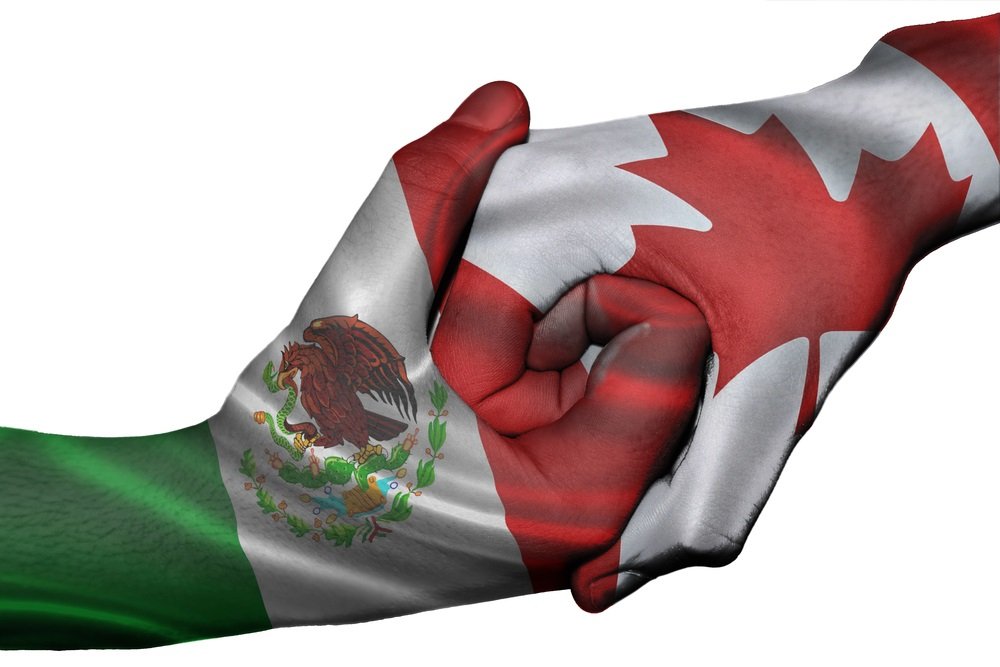
On the political side, some justify tariffs (or the threat thereof) as a negotiation tool. Unfortunately, statements made by the President-Elect have undermined his negotiation power. Trump proposed imposing special tariffs on Canada and Mexico because of illegal drugs and immigrants coming into the US. This proposal likely destroyed any negotiation power Trump might have had because it rendered him uncredible and unreliable. In his first administration, Trump renegotiated the North American Free Trade Agreement (NAFTA) with Mexico and Canada. The new agreement, the US-Mexico-Canada Agreement (USMCA) addressed these issues and others. The point of this new treaty was to prevent such arbitrary cycles of tariffs and retaliation.
Unfortunately, by signaling he supports new, arbitrary tariffs, Trump has signaled in no uncertain terms that the treaty is not worth the paper it is written on. In game theory terms, Trump has defected and now the rational behavior by the other parties is to defect as well. They stand to gain nothing from negotiation because any agreement would be worthless. Given the Mexican President signaled that in response to tariffs, she would also defect rather than negotiate, we see Trump’s bargaining position has already weakened.
(As an aside, using tariffs as a negotiation tool only works under a very specific set of circumstances, none of which currently exist for the US. But that, as well, is a matter for a different blog post)
As I said at the beginning, these are simply concerns that I have. How things actually shape up will matter. Some of what I have written here may end up not mattering at all. I guess we’ll just have to see.
