

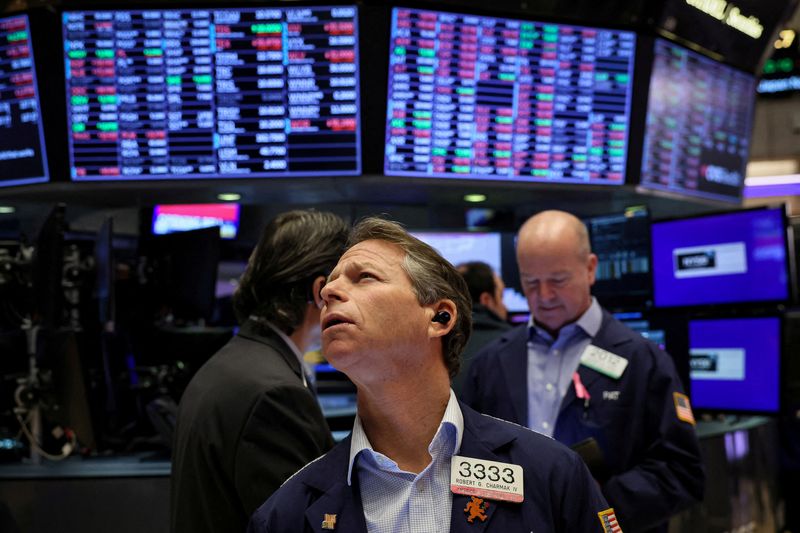
© Reuters. FILE PHOTO: Traders work on the floor at the New York Stock Exchange (NYSE) in New York City, U.S., January 9, 2024. REUTERS/Brendan McDermid/File Photo
By Mike Dolan
LONDON (Reuters) – Record peaks, pricey valuations, narrow markets, frenzied tech bandwagons and even punchy alternatives in bonds – all surely gnaw at U.S. household savers to lighten up on stocks.
Yet, not a bit of it.
In a sort of strange long-term momentum play, U.S. households lucky enough to have substantial savings find themselves shacked up with equities like never before.
JPMorgan long-term strategists Jan Loeys and Alexander Wise unpick what they dubbed the American “love affair” with equity and show how the share of stocks held by households and non-profit funds, such as university endowments, had quadrupled over 40 years to record levels of more than 40%.
While that may seem a modest share of total savings, it’s actually grown steadily since a nadir of around 10% in the 1980s, far exceeds equivalent equity holdings in other major countries and seems at odds with an ageing population that might reasonably be minded to “de-risk” investments into retirement.
The equivalent stock share among savings of Japanese and German households, for example, is only 13% and 16%, respectively, and it’s about 26% in France, the JPMorgan team estimate. And, more pointedly, these have not increased at all in about 30 to 40 years.
Despite all the whys and wherefores of that behaviour, one key reason revolves around inertia, some satisfaction and not a little hope about the future.
Using data from the Federal Reserve’s U.S. financial accounts report, Loeys and Wise posit that the 40-year rise in the share of equity in household savings may simply be down to passive outperformance of stocks over that period.
In other words, savers just sat tight rather than actively chasing markets either way.
‘GO WITH THE FLOW’
Unlike professional fund managers, who tend to ‘mean revert’ or retain target weightings by selling when outperformance of one asset class inflates the relative share of holdings in portfolios, households have closed their eyes and crossed their fingers.
For the past 40 years at least, it’s hard to argue with it as a strategy.
“One possibility, contrary to how we all like to think of strategic asset allocation, is that end investors may not really have a strong view, or even a vague one, on how much they want to allocate to different asset classes and simply go with the flow,” the JPMorgan strategists wrote.
Given that U.S. equities earned almost 11% per annum over the past 35 years – more than twice the annual return on bonds – simply compounding those returns over the period without chopping and changing would have led to that steady quadrupling of the stocks share of their investments.
That’s not to say it’s necessarily about indifference – more an extrapolation of past performance and confidence that it can continue. And in a circular feedback loop, that very confidence to hold ever larger shares has seeded at least half the outperformance of U.S. equity versus the rest of the world – with the rest coming in the way of faster earnings growth.
There are other reasons of course – low economic volatility and interest rates over those decades encouraged more risk-taking and the rise of cheaper passive investment vehicles and direct equity-buying tools drew many into the equity space.
What’s more, Loeys and Wise reckon we may have hit a high watermark that leads to some change of behaviour as macro volatility climbs over the coming decade, higher yields make bonds more attractive and demographic ageing eventually demands that at least some risk gets taken off the table.
However, don’t hold your breath.
They conclude: “The move toward lower equity allocations by U.S. households and non-profits is not imminent as return expectations are probably still quite bullish and households do not change allocations that fast.”
DAMAGING TO YOUR WEALTH
That said, fear of a narrowly-led, overvalued stock market at all-time highs surely creates some nervousness.
After all, the and indexes have roughly doubled from pre-pandemic levels and forward price/earnings multiples – while below historic peaks – are 20%-30% above long-term averages.
Time to lighten up?
Hold your horses, says Duncan Lamont, head of strategic research at Schroders (LON:).
With a deep dive into 100 years of market returns, Lamont reckoned cashing out of stocks at record highs – where they’ve been at almost a third of 1,176 months since 1926 – would have been very costly over time.
Average inflation-adjusted stock returns in the 12 months after hitting new records are superior to those from any other month – 10.3% versus 8.6%. And that stacks up over the long run.
Put another way, $100 invested in U.S. stocks in 1926 would be worth $85,000 in inflation-adjusted terms at the end of last year – annual growth of 7.1%.
However, cashing out of stocks in a month when they hit a new record and only returning when they were not would have meant that final figure was just $8,780 – some 90% less, with an annual “real” return of 4.7%.
“It is normal to feel nervous about investing when the stock market is at an all-time high, but history suggests that giving in to that feeling would have been very damaging for your wealth,” Lamont concluded. “There may be valid reasons for you to dislike stocks, but the market being at an all-time high should not be one of them.”
The opinions expressed here are those of the author, a columnist for Reuters.
