
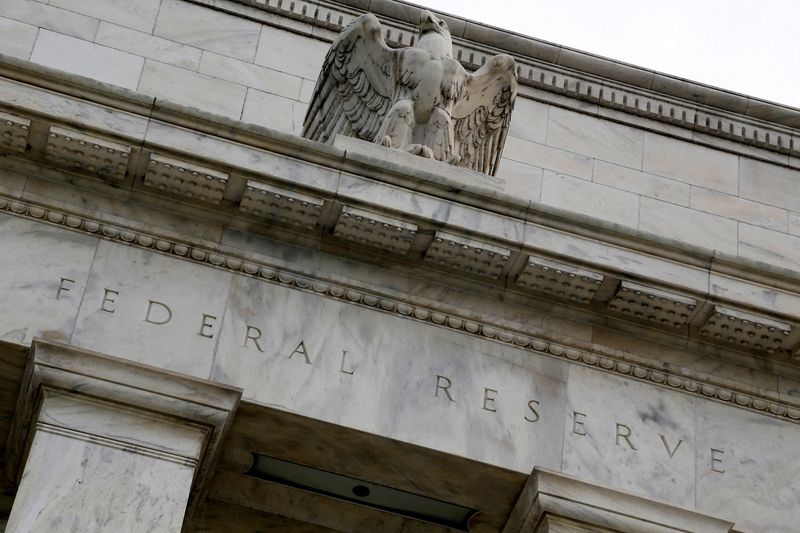
© Reuters. An eagle tops the U.S. Federal Reserve building’s facade in Washington, July 31, 2013. REUTERS/Jonathan Ernst/File Photo
By Mike Dolan
LONDON (Reuters) – Few central bank watchers think the electoral cycle will change the course of monetary policy – but it could complicate the precise timing of interest rate moves next year.
Now that markets seem convinced rate cuts are coming in 2024 in the U.S. and Britain, many are pondering just how elections in both countries may affect the sequencing – rather than the direction per se.
The Federal Reserve lit the rate-cut fuse on Wednesday as 11 of its 19 policymakers pencilled in 75 basis points or more of rate cuts next year – despite cloaking the public message with words of vigilance about above-target inflation and not declaring victory just yet.
The Bank of England, still dogged by inflation well over a percentage point above the U.S. equivalent, was far more reluctant to sound the rate-cut klaxon – preferring to push back against overzealous market expectations for now.
But markets still expect both the Fed and European Central Bank to deliver up to 150 basis points and 110 basis points of cuts, respectively, through a year that contains a U.S. presidential election in November and – according to UK bookmakers at least – a likely UK election in the fourth quarter or possibly even as soon as the second quarter.
Jealously guarding their operational independence from the political process and insisting on hard-nosed analysis that follows strict mandates, both the Fed and BoE repeatedly deny any influence whatsoever from polling dates. Maybe so.
But it’s that very sensitivity to accusations of bias either way toward incumbent governments that may, at the margin at least, affect the timing of possible changes in credit policy just ahead of a public vote where the state of the economy, savings returns and borrowing may be influential issues.
A boost to the “feel-good” economic factor just before an election, for example, could be open to accusations of bias that challenge central banks’ objectivity – even if they claim to be solely data-driven. And vice versa.
Any wider urgency behind interest rate changes may trump all that of course. And what’s more, most of the impact of rate changes take time, with several months of a lag – and in many instances markets deliver effective easing or tightening well in advance of expected moves anyway.
But when rates are merely being recalibrated, as they are now, the timing of the voting could be cause for hesitation in the weeks and months leading to an election – if only for optics of impartiality.
‘POLITICAL CONSEQUENCES’
A look at the Fed’s long history of independence shows little clear pattern, however.
Policy rates were held steady for six to 12 months before the 2020, 2016, 2012 and 2000 U.S. presidential elections – only to be cut sharply after the 2000 poll and raised sharply after the 2016 vote.
In 2020, the depth of the coronavirus pandemic dominated policy despite the tightness of the race, but the near-zero rates before the election were kept in place for two years after Democratic President Joe Biden’s victory anyway. Likewise in 2012, when post-financial crisis rates were on the floor both before and after.
Sharp (OTC:) cuts just after the 2000 election owed more to the looming business investment and dot.com bubble burst. Rate hikes after 2016 were rooted in long-flagged “normalisation” amid planned post-election fiscal boosts.
In all other cases over the past 45 years, the prevailing rate policy trend before the poll continued on regardless.
Next year’s U.S. presidential election looks set to be as tight as the last one – with Fed forecasts painting a picture of a “soft landing” for the economy in which inflation subsides without a recession or big rise in unemployment.
But Fed futures are currently almost fully priced for a cut at all four policy meetings between March and July, with even odds of another at the September gathering – just over six weeks before the Nov. 5 election.
If the Fed wanted to stall for six months ahead of the election, it could still deliver its median forecast of 75 basis points of easing by moving at the March 19-20 and April 30-May 1 meetings and holding off on a third cut until the Nov. 6-7 meeting. But if it were eventually to see the need to agree with current market expectations, then it would have to do that in 50-basis-point clips.
For the BoE, the independence optics may be sharper despite its public dismissal of such influence – not least as the central bank has only been operationally free for the past 26 years and recently faced questions over a political review of its mandate.
Uncertainty about the timing of UK elections makes that harder to parse, however, especially as the current government only has to give six weeks notice of a national poll. And yet that fact alone may bail the BoE out of any protracted hiatus – even if it has, perhaps coincidentally, never changed rates in the two months before an election since gaining its independence in 1997.
Right now, even in the face of Thursday’s push-back, markets see the first BoE quarter-percentage-point cut coming as soon as May, a second one by August, a third by September and another by the end of 2024. A near two-month gap between the September and November meetings could well give it some cover.
In the end, elections won’t change the bigger monetary policy picture for long.
That said, many observers still insist interest rate levers matter a lot the other way around – even if not necessarily right in the lead-up to polls.
More broadly, Yale University economist Ray Fair reckons his models suggest Fed success in getting inflation back to the central bank’s 2% target next year while keeping the economy growing could be a major boost to Democrats’ electoral hopes.
“This is not to say that the Fed is political. The Fed’s main goal at the moment is to get inflation down to 2%, not to help one political party,” he wrote earlier this year. “But the political consequences of its actions are huge.”
The opinions expressed here are those of the author, a columnist for Reuters
