
Stay informed with free updates
Simply sign up to the Renewable energy myFT Digest — delivered directly to your inbox.
The writer, a former US Treasury secretary, chairs the Paulson Institute
One of the most urgent and under-appreciated energy challenges facing the US is the artificial intelligence race with China. America is in the lead, but Beijing is investing heavily to close the gap. The question for Washington is: can the US stay ahead without a national energy strategy to power it?
The energy landscape has changed dramatically in recent years. Russia’s invasion of Ukraine reshaped it overnight. Prices soared and governments scrambled to reduce reliance on Russian gas. Energy security became paramount. As Europe and other regions that are not energy independent seek to address these vulnerabilities, they are increasingly looking to solar and wind to reduce fossil fuel dependence.
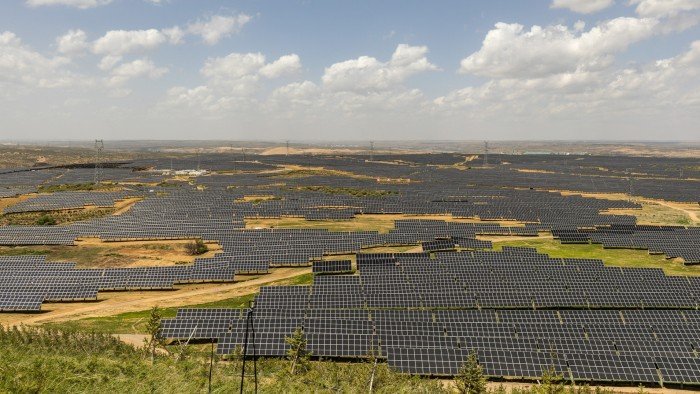
China is forging ahead, pairing long-term industrial strategy with massive investment in both AI infrastructure and the energy to support it. Its data-centre market is expected to grow by nearly $275bn between 2025 and 2029. It invested more in renewables in 2024 than the US, EU and UK combined. Beijing’s clear ambition is to dominate the technologies of the future, understanding that energy policy will be key.
Meanwhile, in the US, as AI models become more complex and are deployed at greater scale and cloud power grows, electricity demand is rising faster than utilities can build capacity. Some data centres now consume as much power as mid-sized cities. In Virginia, they consumed roughly a quarter of the state’s power load in 2023. This has increased concern over strains on the system and higher residential bills, leading to new regulations and an effective moratorium on building data centres in the state.
The US must develop and deploy a clear-eyed national energy strategy that prioritises speed, flexibility and cost-effectiveness. Since demand for electricity substantially exceeds supply, it makes sense to think of clean electricity as an “addition” to existing energy supplies. In fact, nearly all additional electricity in the US last year came from solar and wind — traditional energy sources can’t meet the need.
Gas cannot fill the void in the short or medium term because of turbine shortages. Coal won’t solve the problem because decommissioned utilities cannot be ramped back up fast enough to meet urgent needs (and air pollution harms health). Expansion of nuclear power is an essential part of the solution, but the US lags years behind and China is far ahead in developing cutting-edge nuclear power.
Given America’s abundance of natural gas, many data centres will still rely on it but smarter, faster models are emerging. For example, a hybrid model that uses solar and battery storage or peaking gas backup in periods of high demand is quicker to scale up, because of equipment order and assembly lead times, air permits and interconnection. These also require less upfront investment, and “all-in costs” are comparable to baseload gas.
This model is not without risks. A near-term shock to the solar or storage ecosystems would leave a big hole just as AI power needs are soaring. Without existing solar incentives, which have driven significant onshoring to create a level playing field with China, and with the US administration’s tariff regime, the all-in costs of the hybrid model will rise. But sticking with gas would be to sacrifice speed of development and bet against the rapid decline of solar and battery storage costs, which fell roughly 20 per cent last year and more than 80 per cent over the past decade.
The right answer isn’t to choose one energy source over another, but to create, quickly, the conditions for scaling up what works. This means the low-tax, light-regulation environment that enabled the US renewable energy boom during the first Trump administration. We should also exempt technologies such as long-duration batteries from import tariffs, while doubling down on support for US-based solutions in utility-scale storage. As for how utilities recover costs, we must encourage investment in technologies that bring down energy prices for all.
AI is a major driver of electricity demand. But it also has the potential to unlock substantial supply gains. We can’t afford to miss this moment. More capacity, lower costs and greater energy security are within our grasp.
The US still has built an advantage in energy independence. The test is whether we can meet the energy needs of the next era of innovation. If so, we will be in a stronger position in AI than any other nation for decades to come.
