
Hi everyone, this is Lauly, sending greetings from rainy and windy Taipei.
It’s been two weeks since the US presidential election, and yet the most common topic of conversation among Asia’s tech suppliers is still President-elect Donald Trump’s return to the White House.
An executive with a server and notebook computer supplier told me that the first thing his American client asked him days after the election was: “Are you ready?”
Peter Chen, chair of Taiwanese electronics maker Qisda, told an investors conference that his “heart started to worry” and that he still remembered the four years under the Trump administration before and during Covid.
Furthermore, at a recent media dinner with a tech supplier, one of the executives half-jokingly said the event was supposed to be celebratory but the mood was now clouded by uncertainty about the future.
Most tech suppliers Nikkei Asia reporters have been in touch with are bracing for higher tariffs on China or increased pressure to invest in the US But the good thing is: this time, they are better prepared. After years of a Washington-Beijing trade war, a significant portion of tech manufacturing capacity has been shifted from China to south-east Asia, India and North America.
An executive at a supplier to Apple and Microsoft told me his company has drafted “contingency plans for 18 scenarios” should the trade war between the world’s two largest economies escalate. While he may have been exaggerating for effect, he was serious when he said his company can quickly add more capacity outside of China if needed, which is completely different than when the trade war started six years ago.
But even if suppliers can adjust manufacturing capacity on the fly, the technology race between the two superpowers promises to bring even more challenges. All eyes, especially in the semiconductor industry, will be on how tensions play out after January.
We’ve already seen the Biden administration rush to finalise $6.6bn in Chips Act money for Taiwan Semiconductor Manufacturing Co, the world’s largest contract chipmaker, ahead of Trump’s return to office. That announcement also came with somewhat surprising news that TSMC would eventually produce its upcoming A16 chips, the most cutting-edge offering in its product road map, in Arizona, too.
China, meanwhile, recently released a detailed set of export control regulations covering many chemicals, raw materials, equipment and metals that are commonly used in the global tech supply chain, defence equipment, aviation and spacecraft.
As an Apple supplier executive once told me: “There’s no crystal ball to predict the future. But what is sure is that we need to buckle up and brace for a bumpy road ahead.”
Also, make sure to join us on November 28 for a webinar with Chris Miller, author of Chip War, Yeo Han-koo, former trade minister of South Korea, and our own chief tech correspondent Cheng Ting-Fang as we delve into this ever-changing industry. Register here and be sure to submit your questions for the panel ahead of time.
Solar eclipse
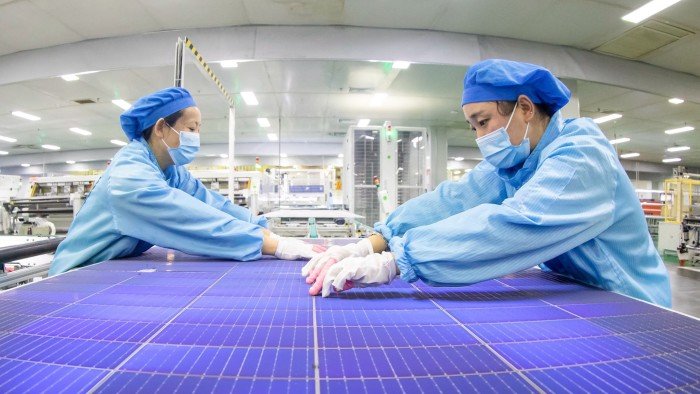
China’s complete line-up of cost-competitive solar energy products have become an easy answer for Asian governments and companies looking to achieve ambitious green energy goals. Such supply chain dominance, covering each of the key sectors in solar energy infrastructure, is hard to break, write Nikkei Asia’s Cheng Ting-Fang and Lauly Li.
This tech feature begins with a walk through a solar energy farm nestled amid the durian and pine trees of Kulim, Malaysia, and continues on a journey through the supply chain of solar panels, inverters, chip materials and more. Interviews with clients and competitors reveal how Chinese players have come to dominate the global industry, despite US tariffs and other trade barriers.
Washington has accused Beijing of unfairly subsidising its solar industry, but whether the incoming Trump administration will take the same approach is an open question.
Reaching out
Leading Chinese tech companies are trying to poach top US artificial intelligence talent that can help them accelerate the race to profit from generative AI, writes the Financial Times’ Eleanor Olcott.
Alibaba, ByteDance and Meituan have all been building their AI teams in California in recent months, despite Washington’s efforts to curb China’s development of the cutting-edge technology.
Chinese tech groups are banned from importing the highest-end Nvidia AI chips to China, but there are no restrictions against them from accessing the silicon to power model-training in the US.
Alibaba is recruiting an AI team in Sunnyvale in California’s San Francisco Bay Area and has approached engineers, product managers and AI researchers who have worked at OpenAI and the biggest US tech groups, according to three people familiar with the matter.
ByteDance has the most established AI footprint in San Jose, with multiple teams working on different projects, including one focused on integrating AI features into TikTok.
But these companies face an uphill battle in convincing top talent to jump ship, even with attractive compensation packages and promises of more responsibilities. Industry insiders said that American tech workers who aid Chinese AI development risk getting caught up in geopolitical tensions and Washington’s increased scrutiny of Chinese tech groups.
Preparing for pressure

China is accelerating efforts to boost domestic chip production amid an anticipated increase in pressure from the US under a second Trump administration, Nikkei’s Shunsuke Tabeta writes.
The Chinese self-sufficiency rate in semiconductors has risen from around 14 per cent in 2014 to 23 per cent in 2023 and is expected to reach 27 per cent in 2027, according to data from Canadian research firm TechInsights.
The state-backed China Integrated Circuit Industry Investment Fund, or the Big Fund, as it is commonly known, has played a critical role in this growth. The fund’s first phase launched in 2014 with registered capital of Rmb138.7bn ($19.2bn at current rates). The second phase followed in 2019 with Rmb204bn, then a third this May with Rmb344bn.
But Chen Nanxiang, chair of China’s leading memory chipmaker Yangtze Memory Technologies Co (YMTC), has warned that “changes and risks” in the global environment and tighter restrictions on China’s access to US technology are anticipated.
$3bn, 480 petaflops, one goal
Taiwan plans to spend roughly $3bn over the next three years on artificial intelligence data centres and applications to cement the democratically ruled island’s leading position in the global tech supply chain, the government’s top science official told Nikkei Asia’s Thompson Chau, Cheng Ting-Fang and Lauly Li in an exclusive interview.
Wu Cheng-wen, minister of science and technology, said the government plans to budget about $1bn annually to bolster Taiwan’s AI prowess. This includes a goal of increasing the government’s total computing capability from 20 petaflops to 480 petaflops over the next four years in order to enhance “AI sovereignty”, or the ability of a state to develop and control the technology.
Petaflops are a unit of measurement used for calculating computing performance. One petaflop is equivalent to 1,000tn floating-point operations per second.
Wu said the Lai Ching-te administration is also keen to strengthen co-operation with the US under Trump, and that Taiwan is willing to share technology with global democratic allies, including the US, Japan and Germany. Such a collaborative approach will allow Taiwan to “foster mutual growth with friendly countries”, Wu said.
Suggested reads
-
EU to demand technology transfers from Chinese companies (FT)
-
Robots and rails give Vietnam supply chains facelift (Nikkei Asia)
-
Japan proposes $1.3bn investment in Rapidus (Nikkei Asia)
-
Samsung shares rise on ‘desperate’ buyback plan (FT)
-
LG adds software jobs in Vietnam as country moves up value chain (Nikkei Asia)
-
China’s smartphone makers head upmarket in European push (FT)
-
Xiaomi’s EV success clouded by shrinking smartphone margins (Nikkei Asia)
-
EV batteries are getting cheaper, but can they be safe too? (Nikkei Asia)
-
TSMC secures $11.6bn in funding as US Chips Act faces uncertain future (FT)
-
The geopolitics of chips: A manufacturing miracle (FT)
#techAsia is co-ordinated by Nikkei Asia’s Katherine Creel in Tokyo, with assistance from the FT tech desk in London.
Sign up here at Nikkei Asia to receive #techAsia each week. The editorial team can be reached at techasia@nex.nikkei.co.jp.
