

(This April 2 story has been corrected to clarify that Total is jointly building 11,000 charging points, not operating, in paragraph 26)
By Andrew Hayley
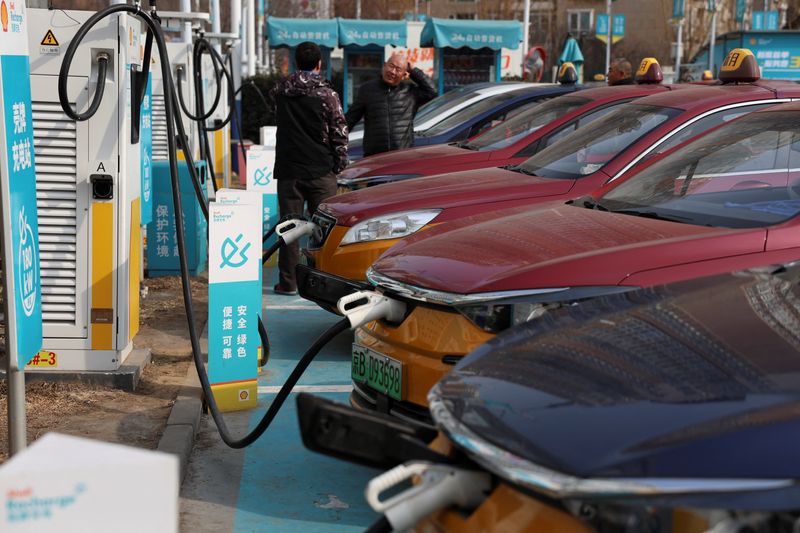
BEIJING (Reuters) – Tucked away on a side road in suburban Beijing, the Xiaowuji battery charging station opened by Sinopec (OTC:) in December 2023 offers a glimpse of China’s post-gasoline future.
Boasting 70 fast electric vehicle charging points, coffee machines and massage chairs, the station is one of thousands being built by the state-run oil giant across the country as it looks to adapt to battery dominated driving.
EV sales in the world’s largest auto market are expected to account for 40% of the 23 million cars sold this year. China’s gasoline demand is predicted to peak by 2025 and could halve by 2045, making a strategic shift an imperative for its biggest oil refiners and marketers, Sinopec and PetroChina.
The state-owned oil companies together operate about 50% of the more than 100,000 gas stations in China and fuel sales account for almost half of their revenue.
“The national oil companies see the writing on the wall, which is why they are working to adapt their service stations to a lower-carbon economy,” said Erica Downs, a researcher at the Center on Global Energy Policy at Columbia University.
Other global energy companies like Shell (LON:) and TotalEnergies (EPA:) are also looking to use the lessons learned to date from smaller early adopting EV markets like Norway and apply them on a much larger scale in China.
But China’s public EV charging sector is beset by market fragmentation, overcapacity, low utilisation and losses, posing challenges for oil companies attempting to adapt their business models.
On a recent weekday afternoon, 54 of the 70 charging points at the Xiaowuji station stood idle. Most of the customers were taxi drivers, one of whom said charging there was faster, though slightly more expensive, than charging at home.
Sinopec, which operated 21,000 charging points at the end of 2023, has earmarked 18.4 billion yuan ($2.55 billion) to its distribution segment this year for the construction of an integrated energy station network, up 17.2% on last year. The group plans to build 5,000 charging stations by 2025.
PetroChina, which operates 28,000 charging points via recently acquired subsidiary Potevio New Energy, announced plans to increase capital spending on marketing and distribution by 49.8% to 7 billion yuan in 2024, focused on comprehensive stations providing oil, gas, hydrogen and charging, according to company filings. The company plans to build a further 1,000 EV battery swapping stations this year.
Each has a market share of roughly 1% of the 2.73 million public charging points in China.
PetroChina did not respond to a request for further comment on its distribution strategy. Sinopec declined to comment.
CHINA’S OVERCAPACITY PROBLEM
Most EV owners in China can charge their vehicles at their housing complexes, meaning 68% of the 8.6 million charging points in China are slower, non-public chargers.
In Norway, where fully electric vehicles account for about 21% of cars on the road and more than 90% of new car sales, charging station operators report high levels of at-home charging and high variability of public charging utilisation.
Circle K, the largest public fast charging operator in Norway said its drop-in charging business was profitable, but noted that, unlike in China, the increase in EV usage in Norway had surpassed growth in public charging points.
In the second half of 2022, there were seven EVs in China per charger. By comparison, the ratios in the U.S. and Europe were 14.6 and 17.6 cars per charger, respectively, according to data from the China Passenger Car Association.
China’s charging market is also highly fragmented. The top five companies hold a 65.2% market share, according to the Electric Vehicle Charging Infrastructure Promotion Alliance.
With so much competition to serve relatively fewer EV drivers, many charging points see low utilisation, standing idle for much of the day.
Charging points operated by Star Charge, the largest player, are estimated by Rystad to earn only $9.58 to $9.94 in revenue per day. Chargers operated by TELD, the No. 2 vendor, are estimated by Rystad to generate $12.77 to $13.25 per day.
TELD, a subsidiary of Qingdao TGOOD Electric Co, reported a 26 million yuan loss in 2022.
Star Charge did not respond to a request for comment. TELD said that China’s EV market is still developing and utilisation would increase.
However, foreign majors with smaller, more geographically- concentrated charging footprints have reported better results.
“Our utilisation rate is more than double the national average level,” said Anne Solange Renouard, vice president of marketing and services at TotalEnergies China, which is building 11,000 charging points in a tie-up with utility China Three Gorges Group.
“We started to develop additional services, such as carwash, food offers and resting areas to improve the customer experience and answer their needs in terms of e-mobility.”
Shell, which operates 800 standalone charging stations in the country and recently opened its largest charging station globally in the southern city of Shenzhen, has similarly reported better utilisation rates of around 25% in China, with EV drivers visiting charging stations twice as often as conventional vehicles visit petrol stations.
Abhishek Murali, a senior analyst at Rystad Energy, said making a profit on EV charging anywhere globally is tough and predicted consolidation in China that could see power grid operators emerge as the biggest winners.
($1 = 7.1656 renminbi)
