
Beijing is tightening its grip on cutting-edge Chinese technology, aiming to keep critical knowhow within its borders as trade tensions with the US and Europe escalate.
Chinese authorities in recent months have made it more difficult for some engineers and equipment to leave the country, proposed new export controls to retain key battery technologies, and moved to restrict technologies for processing critical minerals, according to multiple industry figures and ministry notices.
The country’s safeguarding of leading technologies comes amid added tariffs from US President Donald Trump and a trade row with Europe over cars, which threaten to spur more local and foreign groups to move production elsewhere.
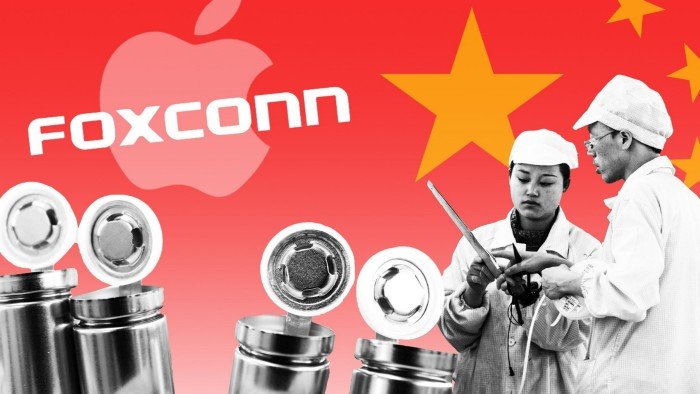
Among the companies to be hit is Apple’s main manufacturing partner Foxconn, which has been leading the Silicon Valley group’s supply chain diversification into India.
People familiar with the matter said Chinese officials had made it difficult for the Taiwanese-owned contract manufacturer to send machinery and technical Chinese managers to India, where Apple is keen to build up its supply chain.
A manager at another Taiwanese electronics company said that they too were facing challenges sending some equipment out of China to plants in India, though he noted shipments to south-east Asia remained normal.
An Indian official alleged China was using customs delays to impede the flow of components and equipment heading south. “Electronic industry supply players have been told not to establish manufacturing and assembly operations in India,” the official said, asking not to be named. Media site Rest of World earlier reported on some of Foxconn’s issues.

Analysts say Beijing’s emerging playbook resembles the western tech transfer restrictions it has loudly criticised as unfair. The informal controls appear in particular to target China’s geopolitical rival India, with some Chinese groups saying that projects in south-east Asia and the Middle East remain unaffected. But Beijing is also increasingly rolling out formal export restrictions on key technologies that apply worldwide.
“A strong supply chain and skilled workforce are some of the few advantages China still has these days,” said an investor in one company facing issues moving some technical engineers abroad. “You don’t want to lose that to other countries.”
China’s commerce ministry last month proposed restrictions on the export of technologies related to lithium extraction and making advanced battery materials, both areas where the country has a leading position.
“China is building up a large export control muscle and being quite deliberate in what they choose to control,” said Antonia Hmaidi, a senior analyst at the Mercator Institute for China Studies. “Fundamentally it’s about keeping China central to global supply chains,” she said.
Hmaidi said Beijing was often targeting areas near the top of the supply chain where Chinese groups controlled materials and technological processes, while leaving end products uncontrolled.
Cory Combs at consultancy Trivium China said that the interventions Beijing had put forward in the battery supply chain represented “a new class of export controls”.

If adopted in full, the controls could prevent China’s battery giants with factories in Europe from moving their entire supply chain abroad. Groups such as CATL may need to continue importing battery materials like advanced lithium iron phosphate (LFP) cathodes from China instead of being able to produce or buy them locally, according to a person briefed on the matter.
Chinese breakthroughs in LFP technology have underpinned the rise of its battery giants, displacing the South Korean and Japanese groups, which once dominated the battery industry.
Attempting to catch up, Korean groups had begun partnering and buying LFP cathodes from China, which last year produced 99 per cent of all LFP cathode active materials, according to Benchmark Mineral Intelligence.
The new controls could threaten those deals. A spokesperson for a leading Korean battery producer, which asked that their company not be named, said that they had communicated their concerns to the Chinese commerce ministry.
“We can’t rule out some adverse effects on our partnership with a Chinese company if the guidelines don’t reflect our concerns,” the person said.
Sam Adham, head of battery research at analysis firm CRU Group, said: “The Koreans need high-end Chinese tech, but [with the new export controls] they may only be able to access last year’s technologies — namely what is on the roads at the moment.”
The outlined curbs on exporting lithium extraction technology could complicate developments under way from the US to South America. A person close to CATL said the group would need to apply for export licences to use Chinese technology at a $1.4bn project in Bolivia to extract lithium from the country’s salt flats.
Anna Ashton, founder of China focused consultancy Ashton Analytics, said Chinese groups had pioneered technology to extract and process lithium rich brines from deep underground making viable many new mining projects.
“Ironically, contracting with Chinese companies is currently the most efficient means of bringing non-Chinese sources of mined and processed lithium online,” she said.
In strategic materials and minerals, Beijing has gradually broadened its curbs to include both controlling exports of the key elements — such as rare earths, tungsten and tellurium, among others — to also restricting the technologies used for their extraction, refining or processing.
In December 2023, China expanded the controls even further, to the technology and processes that turn refined rare earths into the metals and permanent magnets used in electric vehicles, wind turbines and electronics.
“China manufactures something like 95 per cent of the world’s permanent magnets,” said an employee of a US group building up an alternative supply chain.
“The net effect of these export controls is that industrial diversification in some of these supply chains is curtailed.”
China’s commerce ministry did not respond to a request for comment. Foxconn and CATL declined to comment.
Additional reporting by Gloria Li in Hong Kong, Song Jung-a in Seoul, Nian Liu in Beijing
