
Unlock the Editor’s Digest for free
Roula Khalaf, Editor of the FT, selects her favourite stories in this weekly newsletter.
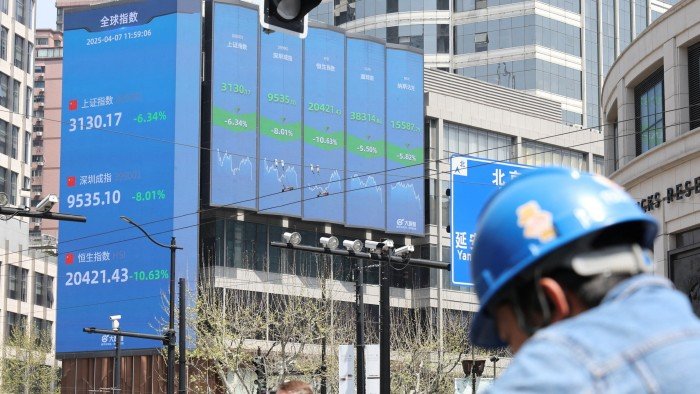
As the Chinese stock market reeled this week from Donald Trump’s “liberation day” tariffs, Beijing launched a co-ordinated government effort to support share prices.
Huijin Central, a sovereign wealth fund, issued a rare statement declaring itself a member of the “national team” — a term for Chinese institutions that work together to support the stock market.
It promised to increase its shareholdings, and was soon joined by China Chengtong Holdings, a state asset manager, which said it would invest Rmb100bn ($13.6bn) in stock markets.
China Reform Holdings pledged Rmb80bn, while the National Council for the Social Security Fund, controlled by the Ministry of Finance, said it would also increase its holdings. In addition, the National Financial Regulatory Administration eased rules on stock purchases by insurers, many of which are state-owned.
By the end of Tuesday, more than a hundred of China’s biggest listed companies, including state-owned oil company Sinopec, China Mobile and Moutai — the baijiu spirit brand favoured by the republic’s founder Mao Zedong — had also unveiled pledges to buy back their own shares.
The CSI 300 — in sharp contrast to Monday’s 7 per cent crash — has regained ground, helped in part by the avalanche of announcements, commitments and market orders.
“The first real battleground of the tariff war is financial markets, especially stock markets,” said Ting Lu, chief China economist at Nomura, adding that he expected China’s “stabilisation funds” or “national teams”, “supported by the PBoC, to intervene significantly in stock markets over coming weeks”.
A crucial gauge of confidence, the stock market has taken on an even more significant role given a property market slowdown that has seen new home prices fall for much of the past two years. It has also been a major focal point of Beijing’s efforts at stimulus, as it struggles to reinvigorate a slowing economy beset by weak consumer confidence.
A raft of central bank announcements in September included two People’s Bank of China programmes of at least Rmb300bn to finance share buybacks and purchases, and a Rmb500bn swap facility to fund financial institutions’ share purchases. A market rally following those announcements, also bolstered by renewed optimism over China’s tech sector, has now been squashed by Trump’s tariffs.

The idea of a national team of powerful institutions came to prominence after China’s stock market crash of 2015-16. The approach has evolved from support for individual stocks to wider indices, especially through exchange traded funds.
Goldman Sachs noted that inflows into ETFs for A-shares — the stock of mainland China companies trading in Shanghai and Shenzhen — were Rmb170bn on Monday and Tuesday. Goldman estimated from Wind data that the national team bought Rmb740bn of A-share equities in 2024.
“Just looking at ETF activity, clearly this is quite significant and we haven’t seen that since Covid,” said Kinger Lau, chief China equity strategist at Goldman. “I think it’s very clear that the national team has been very involved.”
Central Huijin’s mention of the Chinese-language term — guojia dui — was seen as an unusually explicit acknowledgment of its role. It also described itself as a “stabilisation” fund and said it was “optimistic about the bright future of China’s economy” and its capital markets development.
On Monday, various regulators and local state-owned enterprises in Zhejiang province, in the east of China, held a “symposium” on repurchases, with the local head of the PBoC saying they “play an important role in maintaining the stable operation of the capital market and boosting market confidence”.
The government has previously delivered a message that “the [key performance indicators] for all these companies [should] include investor returns”, said Jason Bedford, a former banking analyst at UBS. “I suspect these KPIs will go into overdrive in the current environment.”
China had mounted a co-ordinated movement that included Central Huijin increasing its ETF holdings and regulators’ encouraging both state-owned enterprises and private companies to do buybacks, said Meng Lei, China equity strategist at UBS Securities.
“It’s not just about the size of the fund inflows,” he added. Central Huijin and the PBoC made announcements as soon as the shock of the extra tariffs became clear, setting expectations that they would put a floor under the market.
Analysts have focused on the prospect of more domestic stimulus in coming weeks and months as the trade war escalates and GDP targets come under pressure, with Nomura’s Lu suggesting “high-profile” policy rate cuts could be made sooner than expected.
But the stock market “has become a more important element in the whole stimulus package”, said Goldman’s Lau, who pointed to a first-of-its-kind emphasis on “stabilising” it at the Two Sessions meeting of top officials in March.
On Wednesday, the Chinese stock market was a picture of relative calm, with the CSI 300 closing 1 per cent higher. “It seems intervention carries some negative connotation among investors,” Lau said, “but historically many markets have done that.”
