
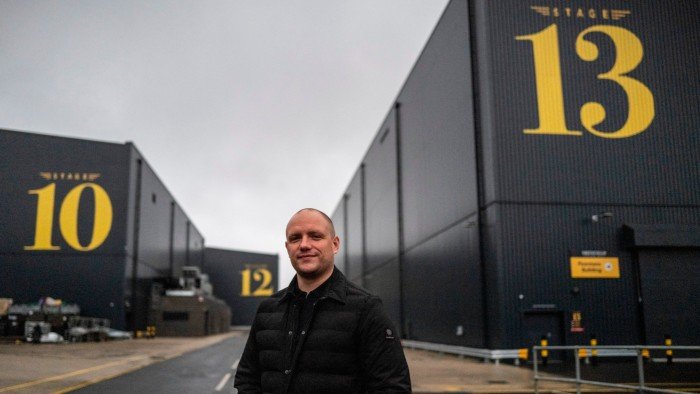
The sprawling Shinfield film studio complex near the London commuter town of Reading is eerily quiet on a drizzly Friday, but Dean Horne says the warehouses and backlots will be transformed in the new year.
The site, which hosts high-end movie and TV productions such as Ghostbusters: Frozen Empire and the Star Wars series The Acolyte, is aiming to be 80 per cent full in 2025 after construction of the 1mn square-foot project was completed last spring.
The legacy of Hollywood strikes meant that 2024 was tough, said Horne, vice-president of global studio operations for US-based owners Shadowbox. But freelance crew members are starting to get booked up and the pipeline “is looking excellent”, he said walking across the floor of a 30,000 sq ft sound stage. “That buzz around the place — you can’t beat it.”

The UK’s Labour government will need bullish predictions like this to come to fruition soon, after GDP figures just before Christmas confirmed the UK economy is listing badly. The creative industries has been one of the UK’s top three growth sectors since the financial crisis, according to new analysis provided to the Financial Times, helping to drive expansion in the all-important services sector.
Prime Minister Sir Keir Starmer, who in December set out his policy “milestones” in a speech at Pinewood film studios, will seek to galvanise eight key sectors including creative industries, as well as defence and life sciences, in an upcoming industrial strategy.
“Labour have not played their hand well on growth policies so far and we are heading into a tough 12 months, so it is critical that this industrial policy bears fruit,” said Neville Hill at Hybrid Economics. “They have made good choices in the sectors they are focusing on. But they need to get the policy mix right if these sectors are to deliver a meaningful economic tailwind later in the parliament.”

The UK’s film production industry is a case study in the potency of well-targeted government interventions. Asked what convinced Shadowbox to invest £400mn in the Shinfield development, chief executive Peter Rumbold put long-standing UK tax credits at the top of the list, alongside the country’s experienced production crews.
Analysis from Boston Consulting Group provided to the FT shows how important it is that the UK’s disparate creative industries bolster their momentum alongside the wider services sector, which represents 80 per cent of total UK economic output.
Boston Consulting defined the “creative and entertainment” sector as including TV and film production, video games, marketing and advertising, architecture, performing arts, music, museums and sports. The sector grew 31 per cent between 2010 and 2022, the third-largest real-terms expansion in gross value added in the period, outpacing manufacturing, financial services and pharmaceuticals, and underscoring its importance to the economy.

The UK’s industrial strategy advisory council first met in December and chancellor Rachel Reeves plans to focus on slashing regulations in the key eight growth sectors early in the new year.
The stakes are high, given governments around the world are becoming more interventionist in creative industries, said Raoul Ruparel, of BCG’s Centre for Growth, citing trends such as South Korea’s cultivation of K-Pop to the growth of the Saudi Pro League in football.
That means ensuring existing UK business incentives, including in entertainment, remain “best in class”, he said, as other countries seek to emulate them.
Some lobbyists fear the UK will be hamstrung by a lack of fiscal firepower as Reeves prepares for a tough public spending settlement this summer. But Greg Clark, a former Conservative minister who is one of the members of the new advisory council, insists there is more to a successful industrial strategy than lashings of public money.
“People sometimes think industrial strategy is only about physical industries and just about disbursing government money. But that isn’t what it should be all about,” he told the FT. “It’s not that there won’t be some money, but it also needs to be about creating an innovative and agile regulatory environment, as well as a strong skills base.”

Backing the creative industries will be a “key focus” of the industrial strategy, said a government spokesperson, with policy working across government to help the sector thrive.
Among the key challenges will be strengthening existing regional “clusters” of businesses, according to economists who have examined the creative sector.
“These industries rely a lot on clusters, and that takes you to planning issues,” said Jonathan Haskel, a former Bank of England policymaker who is helping to advise a government task force on creative industries. Regulation must permit housing and enterprises to be built where they are needed for the clusters to flourish, he said.
This means deciding whether to focus on building up existing strengths or fostering new clusters in other parts of the country, said Emily Fry, a researcher at the Resolution Foundation. “Is it doubling down on London and the South East, or looking to other regions . . . to see where you can build those industries?”
Either way, improved access to finance needs to be a key priority, given many of the companies in the creative sector are relatively small and struggle to obtain the financial support they need, industry players said.

Skills development is also expected to play a key part in the creative industries strategy, given the sector is so heavily dependent on freelancers who do not have deep-pocketed employers to pay for training.
Facilitating movement of creative workers into the country, for example via cheaper, “fast track” visas, would help, said Gareth Ralphs of the Thames Valley Chamber of Commerce, whose region includes some of the UK’s biggest film production sites. Industry lobbyists are also pinning their hopes on a reset of UK-EU relations to smooth some of the post-Brexit barriers to mobility.
Critically, the government will also have to strike a delicate regulatory balance between protecting the artistic intellectual property created in the UK while encouraging trends such as the rise of artificial intelligence.
“The growth of the UK’s creative industries is linked closely to its ability to protect and commercialise its IP,” said Bernard Hay, head of policy at the Creative Industries Policy and Evidence Centre.
“A lack of copyright protection for creative content which may be used to train new AI models might not only hamper creatives’ abilities to generate value from their work, but also disincentivise the creation of new IP.”

The UK’s heavy reliance on the service sector could prove to be a source of resilience in the coming few years, as US president-elect Donald Trump vows to impose greater barriers to the trade in physical goods. Overall, exports of services account for about 18 per cent of UK GDP, the largest proportion of any G7 country.
But that will hinge on the country’s ability to build on its comparative advantages at a time when other countries are aggressively cultivating globally mobile investors.
Samantha Perahia, head of production UK at the British Film Commission, stresses the need for stability now that Reeves has confirmed the fiscal regime for film and TV production. “It’s making sure we don’t give with one hand and put up barriers to investment with the other.”
