
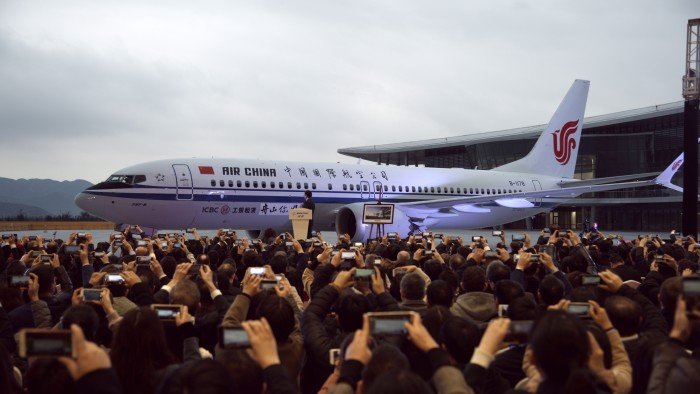
For the past seven years, Zhoushan airport near Shanghai has been the delivery point and completion centre for new Boeing jets in China. But on Monday, against the darkening skies of a trade war, one 737 aircraft was heading back to where it came from.
Beijing has suspended orders for new jets after tariffs spiralled and Boeing chief executive Kelly Ortberg this week confirmed the company had taken back two planes that were in China due for delivery and is in the process of bringing back a third.
The returned planes illustrate how Donald Trump’s escalating trade war has disrupted US business in one of the world’s biggest markets.
For many well-known American companies, the prospect of a sharper break between the US and China threatens a vast corporate infrastructure that ranges from the factory floor to the end consumer, which has been central to the growth prospects that they have sold to their investors.
Even though Washington has for years encouraged US companies to “de-risk” their presence, many still have a deep reliance on Chinese supply chains or, like Boeing, sell products into the mainland. Others have ambitions to tap into China’s fast-evolving consumer market even as growth slows and political tensions mount.

“It’s stunning in my mind less how much US companies have reduced their exposure to China and more how heavily exposed they are to China,” said Isaac Stone Fish, chief executive of Strategy Risks, a business intelligence firm in New York.
As well as facing volatility from the White House’s escalation of tariffs, US companies in China also risk a backlash from Beijing, which has the power to put any business in its crosshairs.
Authorities responded to earlier tariffs by targeting PVH Group, the owner of Calvin Klein and Tommy Hilfiger, citing an alleged boycott of Xinjiang cotton and marking the first time a company with major in-country operations had been added to China’s unreliable entity list, which can result in fines and blocks on trading and investing. Beijing also added California biotech firm Illumina to the list.
Since Trump earlier this year began ratcheting up tariffs on Chinese goods, which now stand at 145 per cent after his “liberation day” escalation, pressure from Beijing has increased for some companies.
Authorities last month summoned Walmart — whose parent in America is one of the biggest drivers of US imports from China — over reports that it was pressuring mainland suppliers to cut prices in an attempt to reduce the impact of tariffs.
Yet Beijing has also been keen to keep western businesses onside and bring in foreign investment at a time of weaker economic momentum. President Xi Jinping met international business leaders in March, including Bridgewater’s Ray Dalio as well as executives from FedEx and Qualcomm.
China has granted some tariff exemptions on American imports and is considering lifting other duties, an American chamber of commerce official said on Friday.

The Chinese government is unlikely to want to alienate big investors, said James Zimmerman, a partner at law firm Loeb & Loeb who works with US groups in Beijing, though he added that companies remain wary.
“We have not seen any actual coercion but many companies are seeking advice on the risks of being on the receiving end of any retaliatory measures by China and best practices on how best to mitigate the risk of any retaliatory actions,” Zimmerman said.
One of the main US businesses facing China risk is Tesla, led by close Trump ally Elon Musk. The electric vehicle maker has a factory in Shanghai which accounts for more than 40 per cent of its production capacity, and has benefited from billions of dollars in subsidies, cheap loans and tax breaks from the Chinese government. The company also relies on battery cells from China for its US-assembled vehicles.
Among other US companies with significant China exposure, Strategy Risks cited Colgate-Palmolive, a big purchaser of Chinese toothbrushes, Intel, where China drove 29 per cent of revenues last year, and cigarette-maker Philip Morris International, because of China’s dominance of manufacturing capacity for lithium-ion batteries used in e-cigarettes.
Colgate-Palmolive executives told analysts on Friday that the company has in the past several years reduced its reliance on raw materials and finished products from China. But they said tariffs are still likely to add $200mn to the company’s costs this year, equal to about 2.5 per cent of its total cost of goods sold.
Philip Morris chief financial officer Emmanuel Babeau said this week the company does not “currently anticipate a material impact on our business from recently introduced or discussed tariffs”.

“Overall our companies are committed to the China market despite geopolitical tensions,” said Eric Zheng, president of the American Chamber of Commerce in Shanghai. He pointed to an emphasis on a “China for China” strategy that came into focus during Covid border closures, with companies developing and producing goods in China for the domestic market, rather than exporting overseas.
“Our retail members are probably more optimistic about the potential here,” he added.
Although domestic demand has struggled under the weight of a property slowdown, US multinationals still plan to expand into the country’s vast and evolving consumer market.
McDonald’s, which owns a 48 per cent stake in its mainland entity, is aiming to have more than 10,000 outlets in China by 2028, compared with 5,500 in 2023 and half that in 2017. Starbucks, which has faced fierce competition from domestic coffee outlets, opened 790 new stores on a net basis in the year to last September.
Disney this year received approvals to expand its Shanghai theme park, the first in the mainland, which opened in 2016. Disneyland’s launch “was a great honour for us Shanghainese”, said Zhou Peicheng, a 55-year-old retiree visiting for the first time as crowds queued on a weekday morning.

Inside Sam’s Club in Shanghai, one of several outlets for Walmart’s members-only warehouse stores in the city, there are few immediate signs of the trade war.
“For us ordinary people, daily life doesn’t have much to do with politics,” said one middle-aged customer carrying 30 eggs and 2 litres of milk. “Your typical citizen only pays attention to goods and prices,” he added.
Walmart has been growing in China: its business expanded 23 per cent in the country year-on-year in the most recent quarter.
But the case of Boeing highlights how suddenly plans can change. Ortberg said this week that the company still had some 50 China deliveries planned for this year but insisted business would not be disrupted.
“It’s an unfortunate situation but we have many customers who want near-term deliveries so we plan to redirect the supply,” he said. “We’re not going to continue to build aircraft for customers who will not take them.”
Additional reporting by Zehra Munir in New York and Chan Ho-him in Hong Kong
