
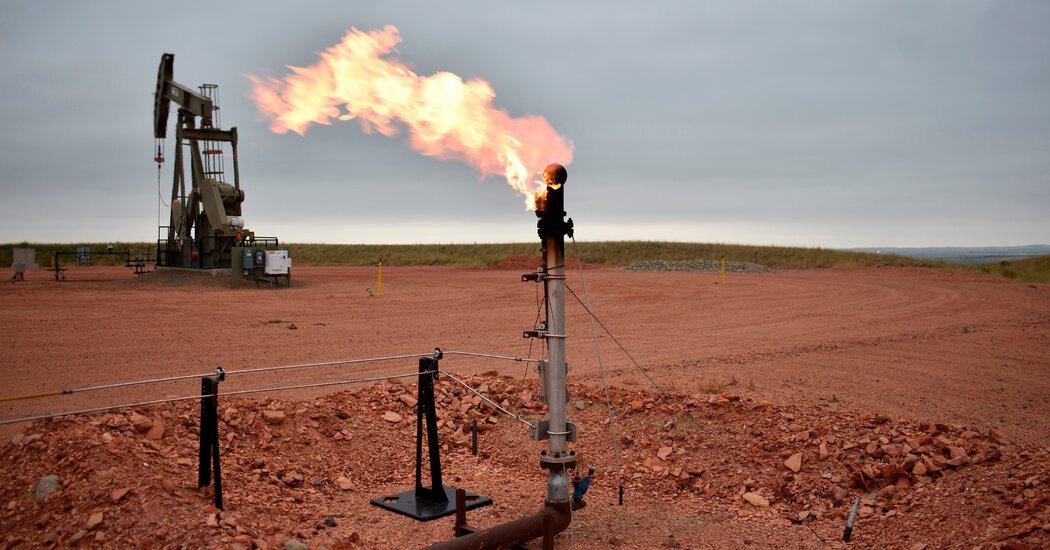
The Biden administration’s crackdown on methane leaks from oil wells is based in part on a new powerful policy tool that could strengthen its legal authority to cut greenhouse gas emissions across the entire economy — including from cars, power plants, factories and oil refineries.
New limits on methane, announced Saturday by the Environmental Protection Agency during the COP28 climate talks in Dubai, take aim at just one source of climate warming pollution. Methane, which spews from oil and gas drilling sites, is 80 times more powerful than carbon dioxide when it comes to heating the atmosphere in the short term.
But within the language of the methane rule, E.P.A. economists have tucked a controversial calculation that would give the government legal authority to aggressively limit climate-warming pollution from nearly every smokestack and tailpipe across the country.
The number, known as the “social cost of carbon,” has been used since the Obama administration to calculate the harm to the economy caused by one ton of carbon dioxide pollution. The metric is used to weigh the economic benefits and costs of regulations that apply to polluting industries, such as transportation and energy.
As scientists have increasingly been able to link planetary warming to wildfires, floods, droughts, storms and heat waves, estimates of the social cost of carbon have grown more sophisticated.
The higher the number, the greater the government’s justification for compelling polluters to reduce the emissions that are dangerously heating the planet. During the Obama administration, White House economists calculated the social cost of carbon at $42 a ton. The Trump administration lowered it to less than $5 a ton. Under President Biden, the cost was returned to Obama levels, adjusted for inflation and set at $51.
The new estimate of the social cost of carbon, making its debut in a legally binding federal regulation, is almost four times that amount: $190 a ton.
E.P.A. officials say they intend to use that figure in all the agency’s climate regulations moving forward.
“This is an enormous victory — this rocks. It’s awesome!” said Michael Greenstone, the Obama administration economist who first came up with the idea of using the social cost of carbon to create an economic justification for climate policy.
“It brings the U.S. government to the frontier of climate science and economics, after we had fallen behind,” said Mr. Greenstone, who now directs the Energy Policy Institute at the University of Chicago. “And it means that it will be justified to have more stringent climate regulations. That will mean that polluting power plants and cars will not be able to emit as much.”
The new number will be put into action right away: the E.P.A. plans this spring to release final regulations to curb carbon dioxide from cars, trucks and power plants. Plug the new number into the agency’s proposal to tighten tailpipe emissions by ramping up sales of electric vehicles or into its proposal to eliminate pollution from power plants, and the economic benefits of each rule could increase to more than $1 trillion, much greater than the estimated cost to the affected industries. It would be similar for new rules to cut pollution from steel and cement plants, factories and oil refineries, which Mr. Biden is planning if he wins reelection to a second term.
“With such a high number, many more actions to fight climate change will pass the cost-benefit test,” said Michael B. Gerrard, director of the Sabin Center for Climate Change Law at Columbia University.
That’s a crucial point in the legal fight over the regulations: historically, when the government can show that the economic benefit of a regulation is greater than its cost, the courts are likely to uphold those rules against legal challenges.
“This number means that the government has a weapon that it can use to justify anything it wants to do,” Elizabeth Murrill, the Republican solicitor general of Louisiana, said in an interview.
Ms. Murrill is part of a group of Republican state attorneys general that is preparing to fight the climate regulations coming from the Biden administration, which they see as a government assault on industry.
A federal judge had dismissed one challenge to the Biden administration’s decision to set the cost of carbon pollution at $51 a ton. Ms. Murrill said the new number should be easier to attack in court because it would carry much greater economic consequences.
“Now we’ve got a concrete application of the numbers and now we can go back and challenge everything again,” she said.
E.P.A. officials said they are prepared for any legal challenge. They spent more than two years working on a 182-page analysis, documenting the scientific and economic methods that they used to consider the damages to livelihoods, property values and commodity costs from climate change.
“It’s a huge deal, and it reflects the impacts of climate change that people are living in their daily experience,” said Vicki Arroyo, E.P.A.’s associate administrator for policy, in an interview.
“If you look at the recent National Climate Assessment these numbers reflect what the scientific community has said is the cost to society of climate change,” said Ms. Arroyo, pointing to the release last month of a sweeping report documenting the impact of climate change on American lives, from rising fatalities during extreme heat in the Southwest, earlier and longer pollen seasons in Texas, northward migration of crop pests in the Corn Belt, and more damaging hailstorms in Wyoming and Nebraska.
The assessment includes a chapter on economics, reflecting an expanding field of research into the financial costs of a warming planet and how they impact households, businesses and markets.
Researchers for the National Academies of Science concluded in 2017 that the Obama-era estimate that every ton of carbon pollution results in $42 of damage to the economy was outdated, and recommended that the government revise the figure. A study last year in the journal Nature concluded the price should be $185 per ton.
Mr. Trump, the frontrunner for the 2024 Republican presidential nomination, could try to shrink the cost of carbon metric if he wins the White House, as he did when he cut the Obama-era number.
But Mandy Gunasekara, who served as chief of staff of the E.P.A. in the Trump administration, said that given the research and analysis underpinning the new number, it could be difficult for a new administration to easily reduce it.
“There is a heavy degree of legal security,” given the number’s inclusion in the new methane regulation, said Ms. Gunasekara, who is now a visiting fellow at the Heritage Foundation, a conservative research organization that is writing the blueprint for the next Republican administration’s energy and climate agenda.
Still, she said, a future Republican administration is likely to try.
