

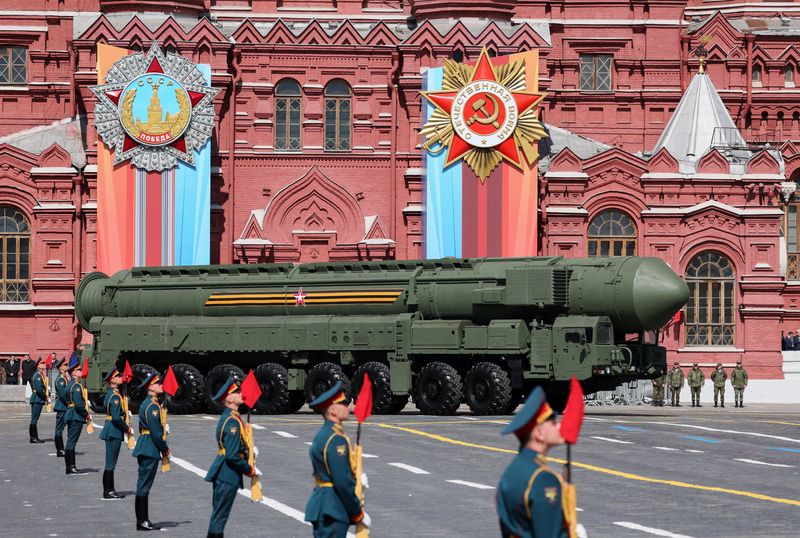
© Reuters. FILE PHOTO: A Russian Yars intercontinental ballistic missile system drives in Red Square during a military parade on Victory Day, which marks the 78th anniversary of the victory over Nazi Germany in World War Two, in central Moscow, Russia May 9, 2023. S
2/3
By Darya Korsunskaya and Alexander Marrow
(Reuters) – Russia’s economy rebounded sharply from a slump in 2022, annual data showed on Wednesday, but the growth relies heavily on state-funded arms and ammunition production and masks problems that are hampering an improvement in Russians’ living standards.
President Vladimir Putin, who is seeking re-election in March, has said the economy is developing and has a safety margin sufficient to allow Russia to successfully transition away from the West amid sanctions imposed over the Ukraine war.
But Russia-based economists say the economy is now showing serious signs of overheating as Moscow ploughs on with what it calls a “special military operation” in Ukraine and that for all the current optimism, stagnation or recession now looms.
Statistics service Rosstat’s GDP growth assessment on Wednesday showed a 3.6% rebound from a revised 1.2% drop in 2022, but economists Reuters spoke to say the headline figure gives little insight into most Russians’ living standards.
“If a defence company builds a missile or a shell, they explode somewhere and GDP grows,” said economist Sergei Khestanov. “But the civilian economy receives very little benefit from this process.
“The Soviet Union produced many tanks and missiles, but the people did not feel this.”
Russia’s Centre for Macroeconomic Analysis and Short-term Forecasting (CAMAC) attributes around 60-65% of increased industrial output in the last two years to the Ukraine conflict.
Other economists say Russia is pumping the economy with one-time, unproductive investments that yield limited future benefit.
“Production in the military-industrial complex is, to put it bluntly, throwing money out of the economy,” said economist Alexandra Suslina. “Conventional tanks and bombs are something that are used once and give no splashback to the economy.
“It is impossible to create a high-tech machine that could further contribute to growth from the remains of a tank.”
‘NOT ALL GROWTH IS GOOD’
The International Monetary Fund expects Russia’s economy to grow faster than all G7 economies this year but less than emerging European economies. Military expenditure has supported economic growth of countries at war throughout history.
The IMF, whose 2.6% prediction exceeds that of Russia’s own economy ministry at 2.3%, said the country’s tight labour market had supported wage growth. Real wages have now started falling, CAMAC said.
“Inflation is too high and companies’ financial position is no longer secure enough to quickly raise wages even in the face of a pronounced labour shortage,” CAMAC economists wrote.
With real disposable incomes, the situation is worse, they said, with pensions and benefits not quite indexed to inflation, which stood at 7.4% in 2023 after an 11.9% reading in 2022.
Unemployment is at a record-low 2.9%, with hundreds of thousands of people having fled Russia or joined the military in the past two years.
According to Rosstat, Russia’s labour productivity index, one of Putin’s key national development goals, fell 3.6% year-on-year in 2022, its steepest annual fall since the aftermath of the global financial crisis in 2009.
Labour Minister Anton Kotyakov has said Russia needs to increase labour productivity in order to become more technologically self-sufficient.
Labour productivity data for 2023 will not be published until late-2024, but the authorities’ warnings about manpower shortages suggest there was no rebound in that figure last year.
Wage growth is also concentrated in regions and sectors that benefit from the sharp increase in spending on defence and security this year to almost 40% of all budget expenditure.
“Not all growth is good if the benefit from this growth is mainly acquired by a very limited circle of economic agents,” said Yevgeny Nadorshin, chief economist at PF Capital.
“The bulk of the population is not experiencing income growth – or in the best case, it is in single digits in nominal terms.”
RISK OF OVERHEATING?
Further evidence for Russia’s stretched labour market is record high capacity utilisation, which hit 81% in the final quarter of 2023, up from 80.7% the quarter before.
Meanwhile, stubbornly high inflation suggests the economy is growing faster than potential, forcing the central bank to maintain high interest rates.
“If we try to drive faster than the car’s design and push on the gas as hard as we can, then the engine will overheat sooner or later and we won’t get far,” Central Bank Governor Elvira Nabiullina said in December.
“We may go fast, but not for long.”
It may be too early to talk of recession, said CAMAC experts, but there are signs the economy is starting to stall, in sectors such as car production and construction.
The IMF expects Russian growth to fall to 1.1% next year, well below the world’s advanced and developed economies.
“I don’t see current economic growth as lasting or qualitative,” said Nadorshin. “I see it as a harbinger of an approaching economic crisis, perhaps the first since 2004, which may not even need an external shock.”
