
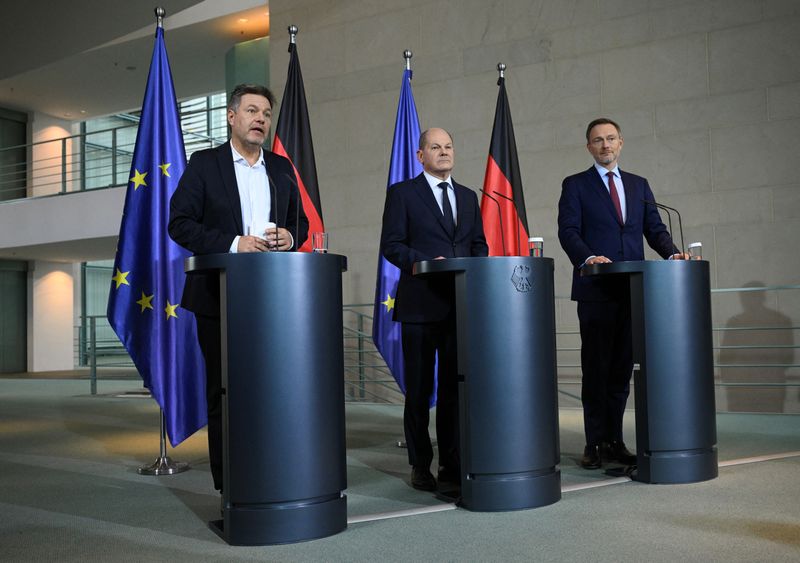
© Reuters. German Chancellor Olaf Scholz is flanked by Economy and Climate Minister Robert Habeck and Finance Minister Christian Lindner to comment on the ruling of Germany’s Constitutional court that the government’s re-location of 60 billion euros ($65 billion USD
By Andreas Rinke and Sarah Marsh
BERLIN (Reuters) – Germany’s budget crisis has given new momentum to reforming self-imposed borrowing limits even among the opposition conservatives, as hunger for sorely needed investment trumps an earlier political obsession with fiscal rectitude.
A constitutional court ruling on Nov. 15 against a budget manoeuvre to get around Germany’s “debt brake” threw the financial plans of Chancellor Olaf Scholz’s coalition into disarray.
It also indicated that his and future governments would have to stick more closely to the spirit of the brake, which limits a government structural budget deficit to 0.35% of gross domestic product, even as spending needs rise.
Business and political leaders fear Berlin will not be able to finance responses to growing challenges, from climate change to the Ukraine war. Europe’s largest economy has already suffered years of chronic under-investment, contributing to its current stagnation, economists say.
Calls are growing for reform of the brake, even among conservatives, whose complaint prompted the court ruling. Those in power at state level and having to deal themselves with the consequences of the ruling are particularly open to a new debate.
Billions of euros in state subsidies agreed with U.S. chipmaker Intel (NASDAQ:) for planned plants in the Saxony-Anhalt – considered key for Germany’s transition to a carbon neutral economy – are now up in the air, for example.
“It’s about strategic investments – there must be a way (to finance them),” the conservative state premier Reiner Haseloff told Reuters. “Otherwise these technologies will go to the United States.”
German under-investment is already around 300 billion euros over the past decade vis-a-vis other AAA-rating economies, according to Scope Ratings.
Haseloff was one of 10 senior members of the Christian Democratic Union (CDU) or its Bavarian sister party the Christian Social Union (CSU) that Reuters spoke to who has come around to the idea of the need for a reform allowing for greater investment without throwing fiscal caution to the wind.
Others have even started to campaign publicly for reform.
“As I have long been saying, we must fear that the debt brake becomes ever more a brake on the future,” said Berlin mayor Kai Wegner on social media platform X.
Still, reforming the brake would mean changing the constitution, which requires a two-thirds supermajority in parliament and still looks a long way off.
Federal CDU leader Friedrich Merz, who is reaping the benefit of a government in turmoil, continues to say Germany should stick to the brake.
But so do even the fiscally hawkish Free Democrats (FDP), who are in coalition with Scholz’s centre-left Social Democrats (SPD) and the Greens. A government spokesperson said on Friday reform was not on the agenda for now.
CHANGING TIMES, CHANGING RULES?
Germany introduced the brake with cross-party consensus in 2009 in the wake of the global financial crisis and at the dawn of the European debt crisis.
But it has had to suspend the brake since the onset of the coronavirus pandemic in 2020 – which it is allowed to do in the event of “exceptional emergencies” – in order to finance its response.
Since then, further crises have piled up, forcing it to resort ever more to off-budget funds, even as debt has become more expensive with interest rates rising.
The court ruling on Nov. 15 against a budget manoeuvre to shift 60 billion euros of unused pandemic aid to a fund for a green transition has suggested Berlin will need to stick more closely to the spirit of the brake going forwards.
It also forced the government this week to suspend the brake for the fourth year running – a clear sign reform was necessary, said ING Chief Economist Carsten Brzeski.
“The debt brake was implemented when Europe had a debt sustainability issue and Germany wanted to lead by example,” he said. “Now, particularly Germany has a growth and competitiveness issue. When times change, debt brakes should also change.”
Germany’s debt-to-GDP ratio was only marginally above 60%, while it was above 100% in France, Italy and Spain, he said.
“Germany is now experiencing fully self-inflicted self-destruction,” he said.
To a standing ovation at a Greens party conference, Economy Minister Robert Habeck on Friday questioned whether the debt brake was applicable in changed times from “when climate protection was not taken seriously, wars were a thing of the past, China was our cheap workbench”.
“With the debt brake as it is, we have voluntarily tied our hands behind our backs and are going into a boxing match,” he said.
The Greens’ campaign programme ahead of the last election included debt brake reform to allow for greater investments. Proponents of reform are growing more vocal in Scholz’s SPD too.
The opposition far-left Left party has always been against the brake.
TWEAKS, NOT A REWRITE
Conservative politicians still fear reforming the break will foster fiscal laxity at home and indirectly elsewhere in Europe. To avoid that, they are proposing very targeted solutions.
Lawmaker Roderich Kiesewetter proposed exempting all investments in the military as well as support for Ukraine from the brake, rather than rewriting it altogether.
Others have proposed solutions that do not involve touching the brake, such as creating a new off-budget fund written into the constitution, like the special fund to upgrade the military established after Russia’s invasion of Ukraine last year, to focus on investment.
The issue is to become more pressing for the conservatives at the latest by the 2025 federal elections, said one member of the CDU’s federal leadership. Polls suggest they are on track to win, meaning the government’s fiscal woes will become theirs.
Given the need for a supermajority, debt brake reform would be a project for another grand coalition of Germany’s traditionally strongest parties, the SPD and conservatives – like the one which introduced it in the first place, said Stefan Marschall, political scientist at the University of Duesseldorf.
“Any reform would require cooperation,” he said. “So whether reform comes quickly is questionable.”
