
Every so often, a Chinese company releases a new AI model, and Americans freak out.
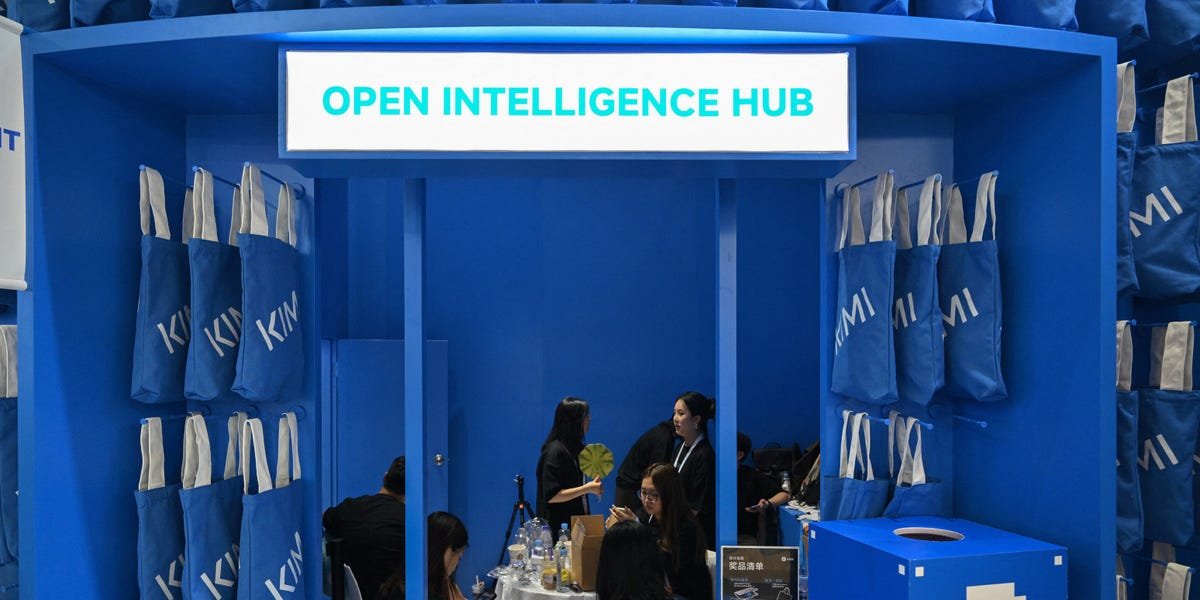
That’s what happened last week when China’s Moonshot AI debuted Kimi K3, which crushed a bunch of notable benchmarks. By most accounts, Kimi K3 rivals some leading US models at a fraction of the expense.
The new model triggered another round of panic that China is closing in on the US in the race to corner the AI market and accusations that the Chinese are training their models on the backs of the work already done by Anthropic, OpenAI, and Google. (Earlier this month, Business Insider’s Ali Barr highlighted the irony in that accusation.)
Increasingly, the tension boils down to a distinct strategy divide between the two countries: The Chinese have embraced open-source or open-weight models, while the US mostly remains closed.
Read more about Moonshot’s latest model
Debate over open or closed models
A debate erupted on X over the weekend after an OpenAI executive published a lengthy reaction to Kimi K3.
“I am personally surprised the Chinese state continues to allow the open sourcing of models this good, given potential risks,” Dean Ball, a former senior advisor on AI to President Donald Trump who is newly OpenAI’s head of strategy, wrote on X.
He said the open-weight strategy would lead to full “AI communism” and that open models can be “decelerationist” because they “deter AI capex.”
What really got the conversation going, though, was this:
“I would guess that the Trump Administration will at some point realize that their best strategy here would be to create large amounts of regulatory risk around the use of open-weight Chinese models,” he wrote.
Ball suggested that manufacturing fear, uncertainty, and doubt — or “FUD,” for those in the know — in the regulatory process would cause most American companies to avoid using open models.
He later clarified that this was his prediction, not a recommendation, and that he supports open-source up until the point AI becomes too dangerous, which he said would be a “sad day.”
The response was swift and widespread.
Fabricating regulatory confusion in support of American AI labs sounds a lot like “regulatory capture.” That’s when government agencies tasked with regulating an industry design rules to support it, often on the advice of industry insiders themselves.
Anthropic and OpenAI have maintained that their models are too powerful to be open — that doing so would be dangerous, allowing anyone to wield their tools for any end, with little oversight. A closed system gives the maker greater overall control, including over security, access, and pricing. The labs have warned that the open-weight models coming out of China are a threat to national security and to their businesses.
David Sacks, a venture capitalist who served as Trump’s first AI and crypto czar before moving in March to cochair the president’s Council of Advisors on Science and Technology, said the “weaponization of regulatory uncertainty” was “completely unacceptable.”
“We are at a critical inflection point in AI policy. The leading closed labs, already a duopoly in terms of AI model revenue, want the government to eliminate their open source competition,” he wrote on X in response to Ball’s post. That “duopoly” refers to OpenAI and Anthropic. “They have laid their cards on the table. It is time for the rest of Silicon Valley — the vast majority that still values open competition — to do the same.”
Sacks’ All-In” podcast cohost and fellow VC, Chamath Palihapitiya, was equally direct: “The future is open source,” he wrote on X. “We need to embrace it and get on with it.”
Suhail Doshi, a prominent software engineer and entrepreneur, said American AI labs trained their products on “humanity’s data and didn’t pay a cent.”
“Any lobbying or legislation that calls for banning open weight models in the name of ‘distillation’ is total BS,” he wrote on X. “This is a fight against future American innovation.”
A Citrini Research analyst who goes by Jukan on X disagreed with Ball and the warnings about a Chinese takeover, writing that open source models don’t automatically position companies to dominate. He said DeepSeek, for example, can operate more efficiently — which keeps token costs lower — because of its proprietary operations, not just its open-source framework.
“Chinese companies may lack sufficient compute capacity to serve all the inference demand themselves, but they are not selling at a loss or failing to recoup their training costs,” Jukan wrote.
