
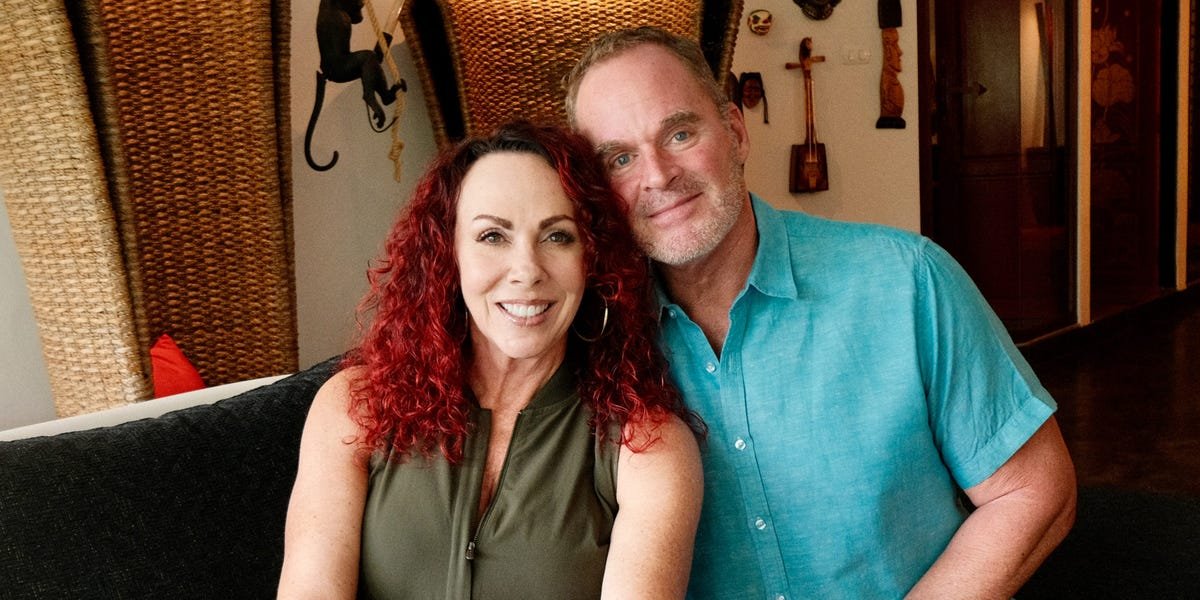
Tye Pierpont got her first passport a few months before turning 40, and she knew exactly how she wanted to celebrate that milestone: with a trip to Thailand.
She’d never left North America, and Thailand felt exciting.
“Back in 2008, that seemed to me the most exotic, crazy place. I didn’t want to go to Paris or Spain. I wanted to go to Thailand,” Tye, now 57, told Business Insider.
She and her now-husband, Chip, spent that first trip in the chaotic city streets of Bangkok, the Thai capital, and on the sandy beaches of Phuket. Over the next decade, they kept returning to Thailand for vacations.
They were living a comfortable life in Austin. Tye, who had spent years competing in bodybuilding competitions, was a personal trainer. Chip worked for the US federal government.
Amanda Goh/Business Insider
Then the pandemic struck, and it got them thinking about their futures.
“Anything could happen, and we’ll never get to live our dream,” Tye said.
As they reconsidered their plans, they met with a financial advisor, who ran the numbers and told them they could retire earlier than expected.
Their plan had long been to live in Chiang Mai — Thailand’s second-largest city — and didn’t see a reason to put it off any longer.
Amanda Goh/Business Insider
In June 2021, they sold their home in Austin and spent the next six months traveling across the US on what Tye called “their farewell tour.”
That December, Chip retired at 56 after 34 years of service and qualified for a federal pension. Soon after, they moved to Chiang Mai.
The place they kept coming back to
Thailand has long attracted overseas retirees, in part because of its long-stay visa options, including the retirement visas the couple holds.
Amanda Goh/Business Insider
Exact figures for American retirees in Chiang Mai are hard to pin down, but at least 7,178 were receiving Social Security benefits there as of December 2024, according to the most recent US government data.
More broadly, foreigners make up a sizable share of Chiang Mai’s population. In 2025, Thai civil registration data recorded 160,958 foreign residents in the province, or about 9% of its roughly 1.8 million people.
For many retirees, Chiang Mai offers a middle ground between the intensity of big cities and the quieter coastal life.
Amanda Goh/Business Insider
“We never have to go to Bangkok, for everything we need is here, from food to clothes to any kind of services,” Tye said.
Years before they officially made the move, they had already started putting down roots. In 2019, they bought a condo in Chiang Mai as a vacation home. When they relocated, it became their full-time home.
Tye estimates they spent around 4.5 million Thai baht, or about $138,000, buying the house, and another $37,000 renovating it.
Their home is situated between Chiang Mai’s Old City and Nimman, a lively neighborhood known for its cafés and international dining scene.
Amanda Goh/Business Insider
“It’s funny because we did no research and ended up in the place where people who actually had done a lot of research said was the premier spot to be,” Chip, 61, told Business Insider.
Early last year, the couple bought the unit next door to theirs. They paid 2.6 million Thai baht and spent about $23,700 on renovations.
Amanda Goh/Business Insider
“We thought, you know, someday we may want to blow through there and make like a massive apartment,” Tye said. For now, they’re using it as a rental on Airbnb.
Unlearning the rush
In a typical month, Chip and Tye — who did not keep detailed expense trackers while they lived in the US — estimate they spend between $4,000 and $5,000. When they travel, that figure can go up to $7,000.
“I would say we travel a lot,” Tye said. “We drink, not super expensive wine, but pretty nice wine. We have a meal-prep service that makes our dinners. I mean, we want for nothing.”
Amanda Goh/Business Insider
They start most mornings with a light workout either on their Peloton or by running stairs, before they walk to the nearby gym.
That’s where they usually have lunch, then either run errands or head home for a nap.
“We are kind of home bodies, but once or twice a week we’ll go to dinner at someone’s house or go to a restaurant, go to wine tastings,” Tye said. “We also play golf on Wednesdays.”
Amanda Goh/Business Insider
Early on, many of the people they met didn’t quite feel like their crowd.
Back in Austin, most of their friends were around their age. In Chiang Mai, they found the social scene split between retirees in their 60s and 70s and younger digital nomads in their 20s and 30s.
“So, that first year was tough,” Tye said.
They eventually made friends through neighbors in their building. Many were older, and they’ve grown close over time.
“They aren’t as interested in working out,” Tye said, laughing. “But they all knew who Bad Bunny was before the Super Bowl, because that’s what we have to listen to at my house.”
Amanda Goh/Business Insider
The couple says they’re enjoying an unstructured life in retirement.
“For 15 years, everything was exactly timed because of her diet and her competition, and our training. Everything was down to the second,” Chip said.
“Schedules just give me PTSD,” Tye added.
These days, the only things they schedule and adhere to are doctor appointments. They also follow a piece of advice from a friend: Get one thing done a day, and treat everything else as a bonus.
“We’re retired, you know. So what if it takes us longer to get there?” Tye said.
