

Author
Ahmed Barakat

Author

Share


In the latest Bitcoin news, Arthur Hayes, BitMEX co-founder and chief investment officer of Maelstrom, published a detailed macro framework on February 17 arguing that AI-driven white-collar job losses will ignite an AI credit crisis severe enough to force the Federal Reserve into large-scale money printing, and that Bitcoin, as the asset most directly wired to global fiat liquidity, will be the primary beneficiary, ultimately reaching a new all-time high and potentially hitting BTC $1 million.
The argument is not a simple bull take: Hayes frames two distinct scenarios and explicitly warns traders to keep leverage limited until the Fed shows its hand.
The analytical core of the Substack post, titled This Is Fine, is a quantitative model estimating the credit damage that a 20% reduction in US knowledge workers would inflict on commercial bank balance sheets.
Hayes uses Bureau of Labor Statistics data, putting the current knowledge worker population at 72.1 million out of a total working population of 164.5 million.
Applying a 20% displacement scenario generates approximately $330 billion in consumer credit losses and $227 billion in mortgage losses, a combined $557 billion that, net of existing loan loss reserves, represents a 13% write-down of US commercial bank equity.
Thirteen percent sounds manageable in aggregate, but Hayes notes the distribution is the problem. The eight Too Big to Fail institutions are adequately capitalized; the thousands of smaller regional banks are not.
The market will identify the weakest balance sheets, crush their stock prices, trigger regulatory capital breaches, and spark depositor flight, a sequence Hayes compares directly to the regional bank collapses of early 2023, but at greater magnitude because the underlying cause is structural and irreversible rather than idiosyncratic.
Discover: Everyone’s Got a Take. Get Free $25 to Actually Trade Yours
Bitcoin News: BTC as the Fiat Liquidity Fire Alarm
Hayes describes Bitcoin as “the global fiat liquidity fire alarm” and “the most responsive freely traded asset to the fiat credit supply.”
The divergence between Bitcoin and the Nasdaq 100, with Bitcoin declining sharply from its October 2025 all-time high while the Nasdaq held relatively flat, is, in his reading, not noise but signal: the market is already pricing the deflationary impact of AI job losses on consumer credit, even if the broader equity complex has not yet caught up.
The mechanism is familiar from 2008. Credit losses impair bank assets, weaker institutions approach insolvency, the Federal Reserve panics and initiates Federal Reserve money printing at scale, fiat liquidity surges, and Bitcoin reprices sharply higher.
Hayes draws the historical parallel explicitly: a 20% near-term knowledge worker displacement is, by his calculation, roughly half as severe as the 2008 GFC credit event, which still required over a decade of monetary expansion to repair. The Fed’s response to an AI-driven crisis would logically be at least as aggressive.
What makes the AI version potentially faster and more disruptive than the China manufacturing shock of the 2000s is the nature of the work being automated. Blue-collar manufacturing jobs manipulate physical atoms; the displacement took decades.
Knowledge workers manipulate digital information, which AI tools can replicate at the speed of light. Hayes argues the pace of AI job losses will therefore compress dramatically relative to historical labor transitions, leaving less time for the credit system to absorb the shock gradually.
Discover: Your Market Calls Are Worth Something. Start With Free $25 on Kalshi
The Fed’s Political Paralysis and the Two-Scenario Trade
Hayes does not expect the Fed to act preemptively. His read on the institution is that it requires a visible crisis, failed banks, frozen credit markets, and collapsing depositor confidence before it will override internal political resistance and press the liquidity button at the scale needed.
That delay is itself a risk factor for traders: the worse the initial credit-destruction event, the larger the eventual monetary response, and the more violent Bitcoin’s recovery from whatever lows it hits during the dislocation.
This is where Hayes lays out the two-scenario structure that shapes the trade. Either Bitcoin’s drawdown from $126,000 to the low $60,000s was the full downside move and equities will eventually converge lower to confirm the macro thesis, or Bitcoin has further to fall as the credit crisis develops and stocks decline sharply.
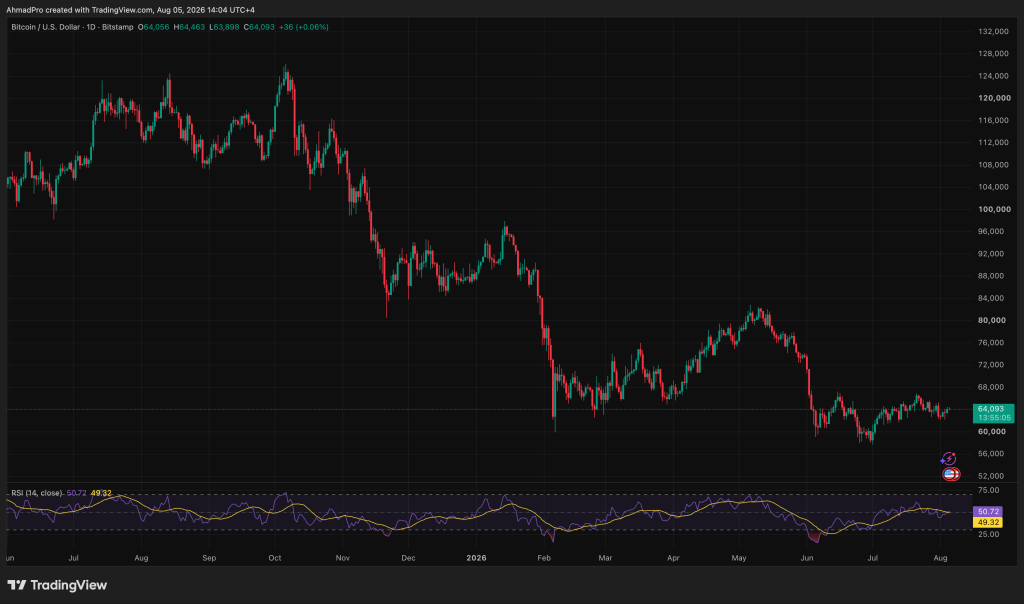
Neither scenario supports adding leveraged exposure now. Hayes is explicit: wait for a confirmed Fed pivot before deploying aggressively into risk assets. For active traders tracking current Bitcoin technical levels, the implication is that the next major entry signal comes from the Fed’s balance sheet, not from price action alone.
Once the Fed does blink, Hayes said Maelstrom will deploy excess stablecoins into two specific altcoins: Zcash and Hyperliquid. The selection of Zcash is notable given Hayes’ prior public exit from ZEC following a protocol bug; the return to the position signals a reassessment.
Hyperliquid’s inclusion reflects the view that a surge in fiat liquidity benefits high-beta DeFi infrastructure with genuine revenue and usage metrics.
Discover: Get Paid to Be Right, $25 to Start on Kalshi
Don’t Miss Out on Our $1,000 USDT Airdrop on ByBit
