
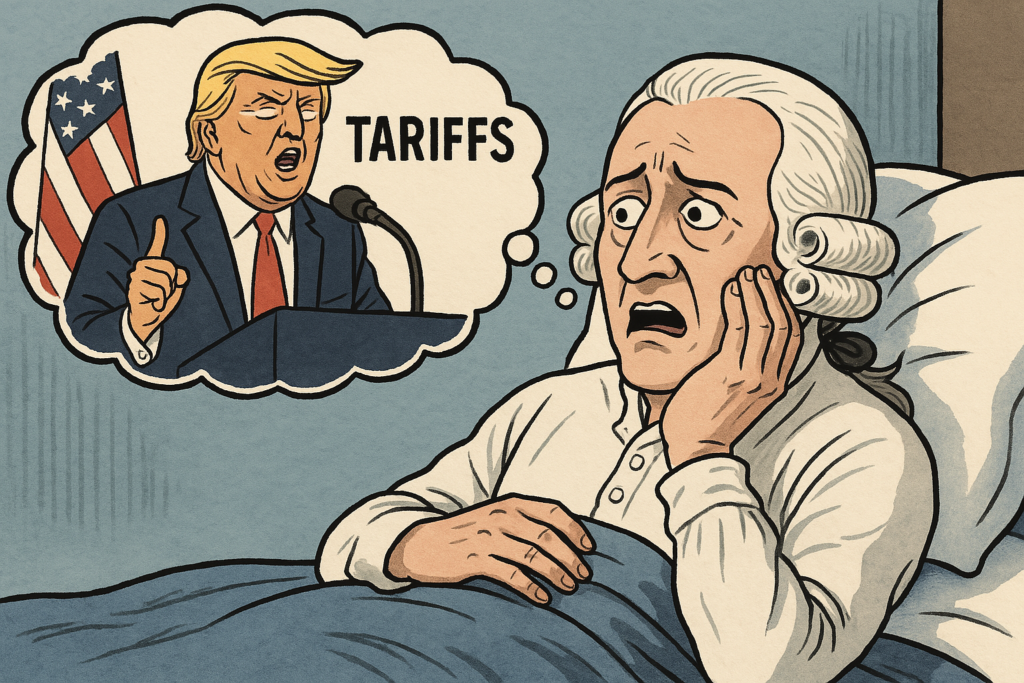
Someone asked recently what would change as a result of the world being plunged into a trade war by the Rose Garden tariffs. I quipped that either Adam Smith would be proved wrong or we’d all get poorer. (This is also true of the scaled-back tariffs, which still leave American tariffs higher than they’ve been in a century.)
In response, as sometimes happens, they brought up Adam Smith’s arguments for tariffs. These arguments come from Book 4, Chapter 2 of Wealth of Nations. They’re a red herring, as we’ll see. But let’s look at how they apply.
There are two instances in which Smith says you can always justify managing trade, and two cases in which managing trade can’t be automatically condemned. Restrictions on imports can always be justified (1) in shipping because it’s tied to military defence, and (2) by taxing imports at the same rate that domestic goods are taxed to create a level playing field. Trade restrictions shouldn’t be automatically condemned when (A) they are retaliatory tariffs, or (B) free trade is being phased in.
So what’s the big deal? Retaliatory tariffs are right there in the list. Why would the Rose Garden tariffs vex Adam Smith?
Smith is very specific about when retaliatory tariffs are appropriate. “There may be good policy in retaliations of this kind, when there is a probability that they will procure the repeal of the high duties or prohibitions complained of.” (IV.ii.39) In other words, retaliatory tariffs are good if they secure freer trade. Israel’s elimination of tariffs against the United States did not spare them. When Vietnam and the European Union offered to eliminate all tariffs, the administration rejected these offers as insufficient. If these were meant to be retaliatory tariffs, they’ve failed.
But the Rose Garden tariffs were never retaliatory. They were not based on how much other countries tariff the United States. They are not even based on estimates of non-tariff barriers. The White House confirmed that the method used to calculate the tariffs was the trade deficit divided by U.S. imports from that country, then divided again by 2 (Unless a country does not run a trade deficit with the United States, in which case the tariff was set to 10%).
So it’s not about retaliation, but—at best—a negative trade balance. And we all know what Adam Smith said about the balance of trade, right?
“Nothing, however, can be more absurd than this whole doctrine of the balance of trade, upon which, not only these restraints, but almost all the other regulations of commerce are founded. When two places trade with one another, this doctrine supposes that, if the balance be even, neither of them either loses or gains; but if it leans in any degree to one side, that one of them loses and the other gains in proportion to its declension from the exact equilibrium. Both suppositions are false.” (WN IV.iii.a)
But anyway, Adam Smith’s arguments about tariffs are a red herring if we want to know what Adam Smith would think of these tariffs.
The effect of the tariff announcement in the Rose Garden was not simply to raise the price of international trade. As Thomas Sowell observed, the tariff announcement also introduced uncertainty that makes foreign investment and globally integrated supply chains more vulnerable—more risky—at the same time as the tariffs themselves make international trade more expensive. The overall effect of these policies is the effect of all trade restrictions: they effectively shrink the global market. Exchanges that would otherwise make sense become more expensive and they don’t happen.
Adam Smith’s core economic insight, the one from which all other arguments in the Wealth of Nations follows, is that the wealth of nations is a product of the division of labour (Book 1, Chapter 1), of cooperation facilitated by our natural propensity to truck, barter, and exchange (Book 1, Chapter 2). The division of labour is limited by how many people we can divide labour between, what Smith calls the “extent of the market” (Book 1, Chapter 3).
If we will not be poorer because the tariff announcement in the Rose Garden shrunk the number of potential trades, and with them the extent of the market, then the division of labour is not the source of the wealth of nations. If the Rose Garden tariffs won’t make us all poorer, then Adam Smith was wrong about everything.
If Smith was wrong about everything, who cares when he says tariffs are good?
Related content:
CEE Entries: Protectionism, Mercantilism
WealthofTweets: Book 4, Chapter 2
WealthOfTweets: Book 4 Chapter 3
Jon Murphy, The Political Problem of Tariffs
