Republicans are seeking to prevent a duly elected state Supreme Court justice from taking her seat. If they succeed, election denial will be institutionalized.
Donald Trump’s return to the White House Monday has no less an analyst than Martin Wolf of the Financial Times asking, “Will US democracy survive Donald Trump’s second presidency?”
Good question.
Here’s another one: Will US democracy survive the theft of a Supreme Court seat in North Carolina?
While the Trump question is surely legitimate, and concerning, the North Carolina question is no less consequential.
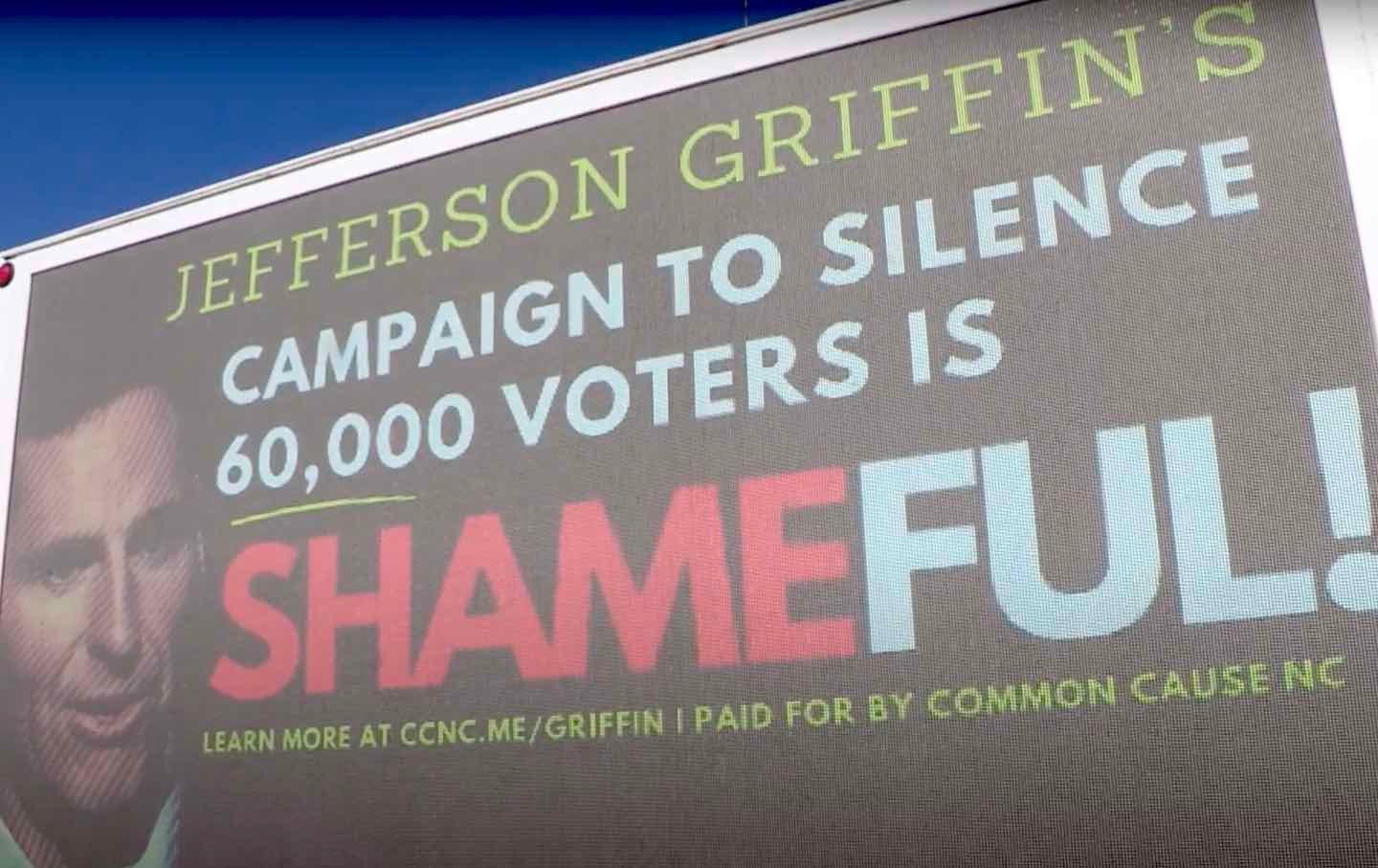
In the same November 5 election that saw Trump narrowly defeat Democrat Kamala Harris, another Democrat, North Carolina Supreme Court Justice Allison Riggs, narrowly won a full term on the North Carolina Supreme Court. But her victory has yet to be officially confirmed, because the Republican majority on the high court is blocking certification of the results—out of deference to a Republican legal strategy that seeks to disqualify tens of thousands of ballots that voters, state election officials, and election experts say were legitimately cast. The attempt by defeated Supreme Court candidate Jefferson Griffin and his GOP allies to reverse the result has shaken democracy advocates in North Carolina and nationally.
“That the Supreme Court of North Carolina would delay certification of this election and consider Judge Griffin’s far-fetched legal claims is a replay of the 2020 efforts to overturn the results of the presidential election, which did irreparable harm to American democracy,” says former US senator Russ Feingold, the president of the American Constitution Society.
Current Issue

“At a time when state courts must serve as a bulwark to protect voters’ right, reproductive and other healthcare rights, the rule of law, and democratic institutions, this effort to subvert the will of the voters serves as a warning we must heed about what the conservative legal movement will attempt in states throughout the country.”
The win by Riggs in the high-court race was a big deal in North Carolina, a swing state where Democrats have been surging in recent years—a fact that has Republicans increasingly concerned that their party’s ability to compete in free and fair elections is dimming. Although Republicans on the court retained their 5-2 majority even with Riggs’ win, the Democrats won November 5 statewide contests for the posts of governor, attorney general, secretary of state, and superintendent of public instruction. And while the Democratic presidential nominee, Kamala Harris, did not win North Carolina’s electoral votes, she kept the presidential competition so close that both she and Trump were barnstorming across the state in the last days before the election.
North Carolina’s high court has become a particular focus for Republicans because its conservative majority has kept the Grand Old Party in the running politically, having upheld partisan gerrymandering of legislative and congressional maps that favor the GOP, along with multiple assaults on voting rights. The November 5 win by Riggs provided the latest evidence of the Democratic surge and the prospect that the court might in coming years via additional election wins or appointments by Democratic Governor Josh Stein have a Democratic majority that would respect democracy and the rule of law.
So North Carolina Republicans are mounting a wildly antidemocratic effort to prevent the loss of the judicial power that has so frequently benefited them politically.
This is not the first time that North Carolina Republicans have created a firestorm after losing a statewide race. This is the party that, after losing the governorship and other statewide positions last fall, moved in the GOP-controlled North Carolina legislature to formally disempower Governor Stein and other Democrats.
But what’s happening now with the North Carolina court race raises serious concerns about the future of judicial elections in that state and others across the country.
State court races have grown increasingly contentious, and expensive, in recent years. Why? Because they matter. The 2023 flipping of control of the officially nonpartisan Wisconsin Supreme Court, from a 4–3 conservative majority to a 4–3 progressive majority, has already transformed debates in the state about everything from gerrymandering to voting rights, abortion rights and labor rights. Democrats and Republicans nationwide have come to understand that winning court contests is just as important as winning races for legislative seats and executive-branch posts.
Popular
“swipe left below to view more authors”Swipe →
But what happens if Republicans—inspired by Trump’s “big lies” about past elections and disregard for democratic norms—decide not to accept election results they don’t like from court races and other contests? What happens if they use every avenue to undermine the process by “[challenging] the rules that were in place for elections and get votes retroactively discarded,” as Ann Webb, the policy director for Common Cause North Carolina, suggests?
The answer, says the policy analyst, is stark. “If there’s a never-ending process of challenging election rules and results after the fact,” says Webb, “our entire system could come to a standstill.”
The scenario is playing out right now.
Even as people across the United States and around the world watch Trump’s inauguration with deep concern, they should also be eying developments in North Carolina with wariness about what they portend for democracy.
At the root of the conflict is the fact that North Carolina had a close election result. That’s not uncommon in North Carolina or the rest of the country.
But what happened next is irregular—and unsettling.
While Riggs won by a mere 734 votes, Democrats were certain that her victory was secure after an official canvass of the numbers, and a pair of recounts—one a full review of machine counts, the other a “hand-to-eye” recount of a sampling of ballots from the state’s 100 counties, and both conducted by bipartisan observers following official mandates. All of these reviews confirmed the Democratic justice’s advantage. Indeed, as the Riggs campaign announced in early December, “The initial vote count confirmed Justice Riggs’ victory…and a statewide machine recount confirmed her win by the exact same margin. The sample hand recount, which also confirms her win, is the third and final count of votes.” Despite protests from her Republican opponent, Griffin, the North Carolina State Board of Elections determined that there was no justification for additional recounts and concludeded on December 10, “That recount showed Riggs with a 734-vote lead.”
That should have been the end of it.
But Republican partisans refused to accept the result. On January 7, the North Carolina Supreme Court’s Republican majority voted 5–1 (with Riggs recusing herself) to block the state’s elections board from certifying the results. Why? Because Griffin is pursuing an attempt to reject the ballots of 60,000 North Carolinians who legitimately cast ballots in the 2024 election. An analysis of the targeted ballots has determined that Black voters are twice as likely to be disqualified as white voters, and that young voters could also be disqualified at high rates.
“This is hugely dangerous for democracy in North Carolina,” says Webb.
For democracy in North Carolina, yes, but also for democracy in America. “If Republicans are successful in invalidating fair and legal votes past an election date like this, this will have broad implications across the county,” argues former North Carolina governor Roy Cooper.
Common Cause North Carolina, the North Carolina NAACP, the ACLU of North Carolina, and other civil rights and democracy groups have all decried the GOP move as a power grab by “a losing candidate [who] wants to throw out your ballots using desperate and outlandish legal theories, all in order to steal a seat on the North Carolina Supreme Court.”
The analysis of the ballots targeted for protests by the Griffin campaign conducted by the Raleigh News & Observer discovered that most of the challenged votes were cast by Democrats or people who were not affiliated with either major party. In addition, it was clear that ballots cast by constituencies that have traditionally voted Democratic in North Carolina have seen disproportionately high levels of protests. For instance, the News & Observer “found that Black registered voters were twice as likely to have their votes challenged as white voters.” Another relevant finding: “Voters aged 18 to 25 were the largest age group among the challenged voters, accounting for about 23% of all protests, despite making up about 12 percent of the electorate.”
That’s a red flag, not just for North Carolina but for the whole of the United States.
“The eyes of the entire country are on this race because the implications of having free and fair elections that are being questioned and potentially overturned are devastating,” says former governor Cooper, who argues that this GOP attempt to disenfranchise enough voters to overturn an election result poses a threat “not just for Justice Riggs and the millions of North Carolinians who voted for her but for any election in the future.”
More from The Nation

And while the “I was for it before I was against it” crowd opposing the ban now stretches from Chuck Schumer to Donald Trump, that doesn’t mean they’re right.
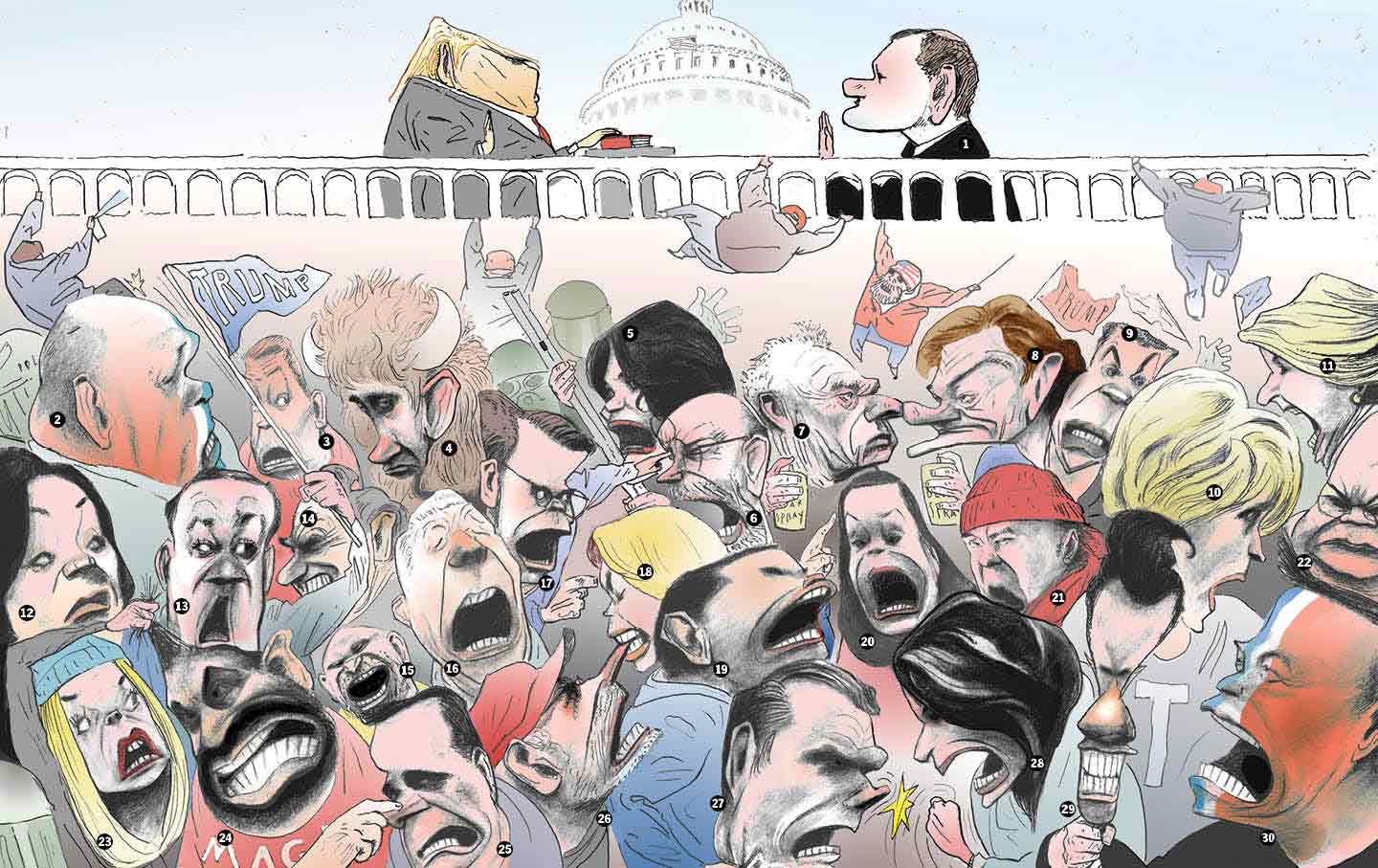
In 2020, after losing his bid for reelection to Joe Biden, Donald Trump summoned a mob to the Capitol. Today, as we mark the peaceful transfer of power, we offer this reminder.
The political media calls Trump a “populist.” But as Dr. King made clear in a 1965 speech, American populism was a movement against everything Trump stands for.