
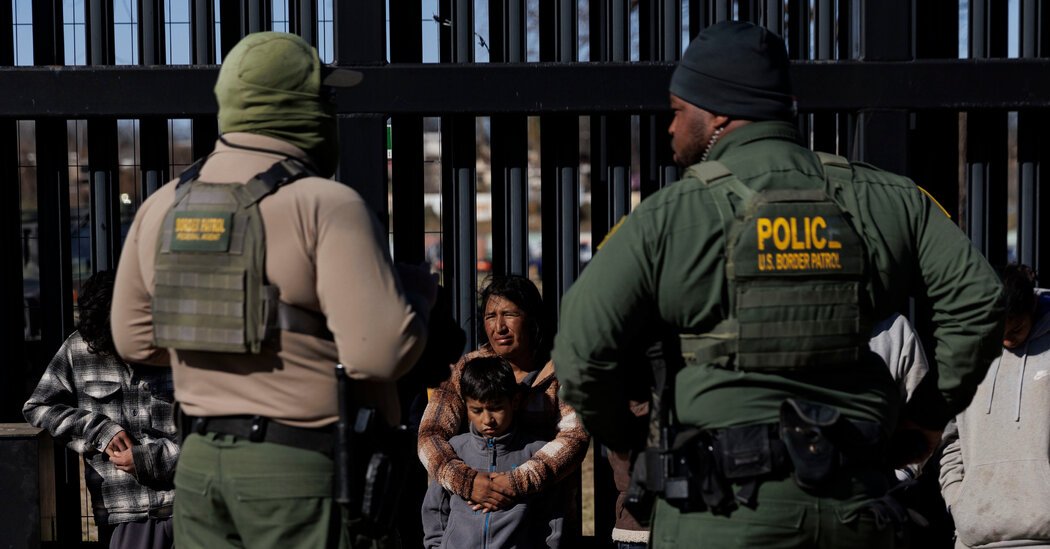
The Biden administration is suing the State of Texas over a new state law that would empower state and local police officers to arrest migrants who cross from Mexico without authorization.
On Thursday, a federal court in Austin is hearing arguments over whether to halt the implementation of the law, which is set to go into effect on March 5.
The case has far-reaching implications for the future of immigration law and border enforcement and has been closely watched across the country. It comes amid fierce political fighting between the parties — and within them — over how to handle illegal immigration and follows the impeachment by House Republicans of the secretary of homeland security, and the failure of a bipartisan Senate deal to bolster security at the border.
Texas has said its law is necessary to deter migrants from crossing illegally, as has happened in record numbers over the past year. The Biden administration argues that the law conflicts with federal law and violates the U.S. Constitution, which gives the federal government authority over immigration matters.
What does the Texas law say?
The law passed by the Texas Legislature, known as Senate Bill 4, makes it a crime to cross into Texas from a foreign country anywhere other than a legal port of entry, usually the international bridges from Mexico.
Under the law, any migrant seen by the police wading across the Rio Grande could be arrested and charged in state court with a misdemeanor on the first offense. A second offense would be a felony. After being arrested, migrants could be ordered during the court process to return to Mexico or face prosecution if they don’t agree to go.
Texas lawmakers said they had designed S.B. 4 to closely follow federal law, which already bars illegal entry. The new law effectively allows state law enforcement officers all over Texas to conduct what until now has been the U.S. Border Patrol’s work.
It allows for migrants to be prosecuted for the new offense up to two years after they cross into Texas.
How does it challenge federal immigration authority?
Lawyers for the Biden administration argue that the Texas law conflicts with numerous federal laws passed by Congress that provide for a process for handling immigration proceedings and deportations.
The administration says the law interferes with the federal government’s foreign diplomacy role, pointing to complaints already lodged against Texas’ border actions by the government of Mexico. The Mexican authorities said they “rejected” any legislation that would allow the state or local authorities to send migrants, most of whom are not Mexican, back over the border to Mexico.
The fight over the law is likely to end up before the U.S. Supreme Court, legal experts have said. If so, it will give the 6-to-3 conservative majority a chance to revisit a 2012 case stemming from Arizona’s attempt to take on immigration enforcement responsibilities. That case, Arizona v United States, was narrowly decided in favor of the power of the federal government to set immigration policy.
Immigrant organizations, civil rights advocates and some Texas Democrats have criticized the law because it could make it more difficult for migrants being persecuted in their home countries to seek asylum, and it does not protect legitimate asylum seekers from prosecution in state courts.
Critics have also said that the law could lead to racial profiling because it allows law enforcement officers even far from the border to arrest anyone they suspect of having entered illegally in the previous two years. The result, they warn, could lead to improper traffic stops and arrests of anyone who looks Hispanic.
Wait, didn’t the Supreme Court already rule against Texas?
Not in this case.
Texas and the Biden administration have been battling for months over immigration enforcement on several legal fronts.
One case involves the placement by Texas of a 1,000-foot barrier of buoys in the middle of the Rio Grande, which Gov. Greg Abbott said would deter crossings. The federal government sued, arguing that the barrier violated a federal law over navigable rivers. In December, a federal appeals court sided with the Biden administration, ordering Texas to remove the barrier from the middle of the river while the case moved forward.
A second case involves Border Patrol agents’ cutting or removing of concertina wire — installed by the Texas authorities on the banks of the Rio Grande — in cases where agents need to assist migrants in the river or detain people who have crossed the border. The Texas attorney general, Ken Paxton, filed a lawsuit claiming that Border Patrol agents who removed the wire were destroying state property.
It was a fight over an injunction in that case that reached the Supreme Court on an emergency application. The justices, without giving their reasons, sided with the Biden administration, allowing border agents to cut or remove the wire when they need to while further arguments are heard in the case at the lower court level.
Why the stakes are higher now
Unlike the other cases, the battle over S.B. 4 involves a direct challenge by Texas to what courts and legal experts have said has been the federal government’s unique role: arresting, detaining and possibly deporting migrants at the nation’s borders.
“This will be a momentous decision,” said Fatma E. Marouf, a law professor and director of the Immigrant Rights Clinic at the Texas A&M University School of Law. “If they uphold this law, it will be a whole new world. It’s hard to imagine what Texas couldn’t do, if this were allowed.”
The federal government is seeking an injunction to prevent the law from going into effect next month.
Arguments over a possible injunction were being heard on Thursday by Judge David A. Ezra of the Western District of Texas, who was appointed to the bench by President Ronald Reagan.
“To the extent Texas wishes to help with immigration enforcement, it can do so by working cooperatively with the federal government,” lawyers for the Justice Department wrote in a motion seeking the injunction, “or by working with Congress to change the law.”
But, the department added, Texas “may not unconstitutionally usurp the federal government’s authority in core areas of federal control: the entry and removal of noncitizens.”
Lawyers for Texas, from the office of Mr. Paxton, argued in their motion opposing the injunction that the new law would not be in conflict with existing federal law.
The state’s lawyers also described the record number of migrant arrivals at the Texas border as “a full-scale invasion of transnational criminal cartels” and argued that Texas has the power to defend itself. They pointed to Article I, Section 10 of the U.S. Constitution, which bars states from engaging in war on their own “unless actually invaded.”
The state has cited the same constitutional provision in the other pending cases between Texas and the federal government. But legal experts said the argument was a novel one and might not figure prominently in this case.
Judge Ezra, who also presided over the buoy barrier case, shot down the argument of “invasion” powers in his decision in that case.
“Such a claim is breathtaking,” he wrote.
