
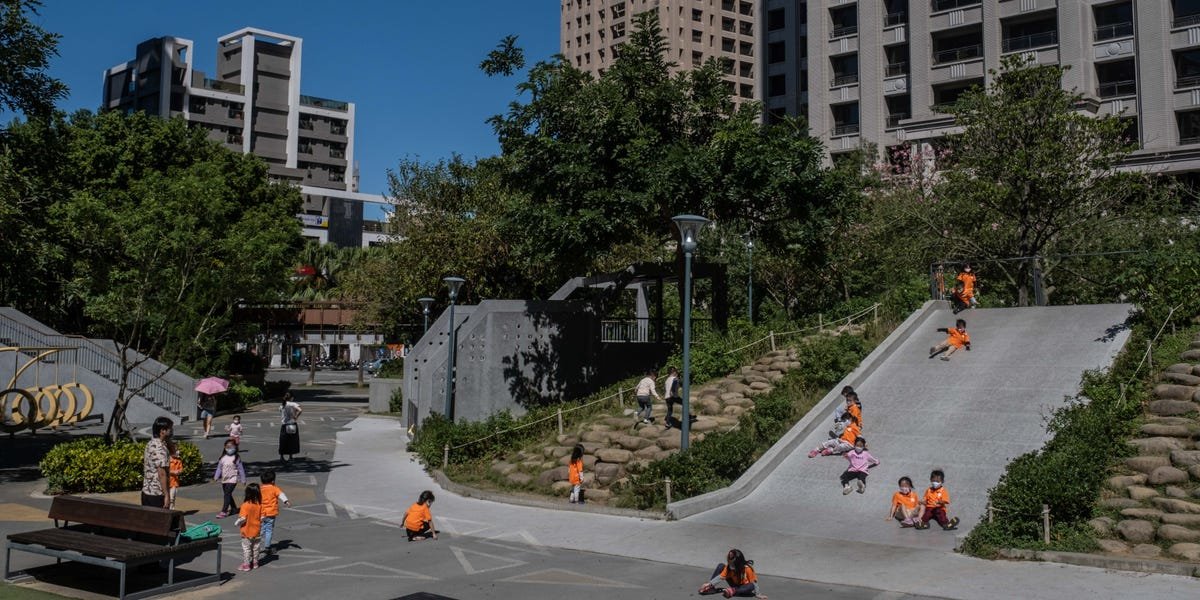
“The most lucrative industry in Hsinchu isn’t chips. It’s kindergartens,” a Taiwanese friend quipped when I mentioned my trip to the chip city, 50 miles south of Taipei.
He was half-joking, but it’s not far from the truth.
Hsinchu, home to Taiwan Semiconductor Manufacturing Company and a dense network of tech firms that form the world’s chip supply chains, is now the rare place in Taiwan where people are still having babies — if they can afford to.
While most of Taiwan struggles with one of the world’s lowest birthrates, Hsinchu’s numbers have held just above the national average, fueled by high salaries, economic stability, and a wave of young professionals starting families.
The same boom that’s driving Taiwan’s place in the global economy is also drawing sharp lines between who can afford to build a life and who can’t. In Hsinchu’s wealthiest boroughs, parenting is a high-investment, high-competition pursuit. But rising housing costs and inequality are pricing many young locals out entirely.
During my visit to Hsinchu in late May, I found glossy new high-rise housing lining the tracks as my high-speed rail train pulled into the city.
Huileng Tan/Business Insider
At a mall, I watched an elementary schooler casually pay for his solo lunch at the next table, while I balked at my $25 bill at a bougie French café.
“Whenever I go to Hsinchu, I feel like there are so many kids around and wonder if we really have a low birthrate,” my friend added.
Tech jobs bring stability — and babies
Taiwan’s total fertility rate, or TFR, hit just 0.87 per woman in 2023 — holding steady from 2022 after seven straight years of decline.
It ticked up to 0.89 per woman in 2024 — a “dragon year,” traditionally seen as auspicious for births — but remained well below the 2.1 replacement rate. For comparison, the US had a rate of less than 1.6 in the same year.
Against this backdrop, Hsinchu’s baby bump — with a steady TFR rate of around 1 per woman — is modest but meaningful. Hsinchu County, an up-and-coming region that is home to part of the science park and where many young families choose to settle, clocked a TFR of 1.02 in 2023.
Even a slight boomlet matters in a super-aged society where one in five people is over 65.
“Taipei is the capital, but it’s increasingly filled with older rather than younger residents because the city is very functional for daily living, but the good jobs are elsewhere,” Dachrahn Wu, an economics professor at National Central University in Taiwan, told me.
Where parenting is strategy — and big business
In some ways, the children of Hsinchu are the real face of a city reshaped by global demand for chips.
Once a farming town, Hsinchu has transformed into Taiwan’s Silicon Valley.
In 2023, TSMC employees alone accounted for at least 2% of all children born in Taiwan, despite making up just 0.3% of the island’s population.
Related stories

Business Insider tells the innovative stories you want to know
Business Insider tells the innovative stories you want to know
Higher fertility and migration have made Hsinchu city and county the only two administrative regions in Taiwan with more young than old people, according to Taiwan’s interior ministry.
“Chip and tech companies in Hsinchu typically hire engineers out of graduate school, so they would be in their late 20s when they start working for these firms. This is the prime age for marriage and family formation,” said Wu.
Cities like Taoyuan in the northwest of Taiwan — home to another industrial zone — also show a higher fertility rate than the rest of Taiwan, likely for similar reasons, said Wu, who heads a research institute on macroeconomic trends.
Tech wealth
While tech has driven Taiwan’s recent wave of wealth, most people aren’t in semiconductors. About two-thirds of the economy — and the workforce — are in the lower-paid service sector, official data shows.
That gap helps explain why Hsinchu, and especially its tech workers, are thriving while much of the country falls behind.
The Guanxin borough near Hsinchu’s tech zone has been Taiwan’s wealthiest district for five straight years.
In Guanxin, the average annual household income was 4.614 million Taiwan dollars in 2023, the latest year for which the statistic is available — about 3.6 times Taipei’s average.
Huileng Tan/Business Insider
“Raising children is expensive, and those working in tech are not just making attractive salaries, they can also afford the time to provide quality care for them because the wife can be a stay-at-home parent,” said Wu.
Here, tutoring and enrichment schools line the ground floors of modern high rises guarded by heavy doors.
“The culture of education in this area is very intense,” said Karen Chang, a 41-year-old stay-at-home mother who lives in the area.
Chang, who used to work an administrative job in tech, now spends her days managing the household while her husband works long hours in tech. Her children attend English enrichment classes several times a week, joining peers from other affluent families.
Mandy Liang, another stay-at-home Hsinchu mom, has two daughters enrolled in English and piano classes in addition to regular school. Five months of native-taught English classes cost $1,700 per child.
Huileng Tan/Business Insider
She and Chang traded notes on the prices of their kids’ private classes and meal boxes. They concluded that prices in places like Guanxin are higher because, as Chang said, “wages in the science park are much higher than those outside.”
Liang acknowledges that the cost of living in Hsinchu is high. But her husband, a private math tutor, is a testament to the chip boom’s spillover benefits into the local economy.
“I’m a Hsinchu native, so I’m like a boiling frog. I don’t quite feel the gradual increase in prices,” said Liang.
Intense competition
Hsinchu’s parenting culture mirrors East Asia’s high-pressure models, where children are prepped early for elite schools.
Here, the pressure is matched by resources from tech wealth.
“Many of the mothers here are full-time caregivers, and they’re incredibly invested,” said Chiang Chung-hua, the principal of Hsinchu Gaofeng Non-profit Kindergarten.
Huileng Tan/Business Insider
Chiang said his preschool aims to develop kids, typically age three to six, holistically, instead of focusing on academics. Even then, what parents sign their kids up for after school is out of his hands.
“There’s pressure, even when your kids are still small,” he said as kids ran up to us, swinging from his arm before meeting their parents to go home.
Much of that pressure comes from moms’ informal networks — sharing tips, organizing classes, and helping with admissions. Many of these women have moved to Hsinchu from other cities for their husbands’ jobs.
The competition starts early. Chang recalled an interview at a prestigious elementary school where both parents and children were evaluated via an interview and playtime observation. They didn’t get in.
Chang said she wasn’t disappointed by the setback because they loved the school where her son ended up.
The cutthroat competition and resources required to raise children are putting pressure on the baby boomlet.
“Kindergarten enrollment has dropped. We used to fill a new incoming class in one round — now, it can take two or three,” Chiang said.
The price of prosperity
Not everyone is winning in Hsinchu’s tech boom. For locals without high-paying jobs, starting a family is harder than ever.
Housing prices have nearly doubled over the past five years, pushing many residents out of the city center and into Hsinchu County, where new luxury condos and high-end car dealerships cluster around the high-speed rail station in Zhubei. Here, the neighborhood mall is fronted by Tesla and Cartier.
“Growing up, I never thought I would not be able to afford a home here,” said Cassy Tsai, a 30-year-old native of Hsinchu.
Tsai, who worked on a bank trading desk in Taipei until recently, said she had considered buying property. She decided against it on a $40,000 annual salary.
“It costs so much that I would have to cut back on everything else — like travel,” she said. “I want to have some flexibility.”
Cassy Tsai
Tsai is currently in Amsterdam, where she recently began a master’s program. She isn’t sure whether she’ll return to Taiwan or stay abroad.
Her uncertainty reflects a growing tension in Taiwan: What happens when prosperity depends on one industry and prices out everyone else?
In a city reshaped by chips, the next generation’s future may depend on more than economic growth — it’s about who gets to stay and thrive.
If Tsai returns to Taiwan, she said she’s open to joining the very industry that reshaped her hometown.
