
Here are some housing articles that caught my eye:
1. A recent paper by Sven Damen, Matthijs Korevaar & Stijn Van Nieuwerburgh has the following abstract:
Residential properties with the lowest rent levels provide the highest investment returns to their owners. Using detailed rent, cost, and price data from the United States, Belgium, and The Netherlands, we show that this phenomenon holds across housing markets and time. If anything, low-rent units hedge business cycle risk. We also find no evidence for differential regulatory risk exposure. We document segmentation of investors, with large corporate landlords shying away from the low-tier segment possibly for reputational reasons. Financial constraints prevent renters from purchasing their property and medium-sized landlords from scaling up, sustaining excess risk-adjusted returns. Low-income tenants ultimately pay the price for this segmentation in the form of a high rent burden.
I have not read the paper, so I have no evidence against any of the claims made in the abstract. Nonetheless, it’s worth noting that this is exactly the result I would have expected based on my experience being a landlord back in Boston. I think of that experience as being one of the two biggest mistakes in my life (along with writing a textbook.) I found that the return from being a landlord is not worth the aggravation, at least for me. I would expect potential landlords to insist on a higher rate of return—a “compensating differential”—before being willing to invest in property in a low-income area where the problem tenants are especially common.
2. In a recent post, I argued that the so-called “housing bubble” was a myth, it never happened. I cited the fact that real housing prices had fully recovered to 2005-06 levels, and thus if prices were obviously too high back at that time, then they must also be too high today. Some commenters argued that real housing prices are not the correct metric, and that housing really was overvalued in 2005-06. But Kevin Erdmann has a post that suggests other measures of housing affordability are also back at 2005-06 levels:

If this ratio is again much too high, are we about to have another 2008-style crash?
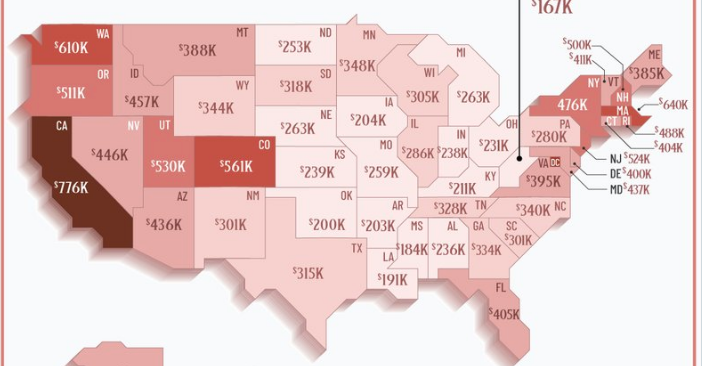
3. There’s an ongoing debate about the cause of the recent migration from blue states to red states. Matt Yglesias has a tweet that suggests the problem is housing prices:

To avoid reasoning from a price change, it’s best to look at the relationship between prices and quantities. Yglesias implicitly does this and correctly claims that the migration to red states is primarily caused by building restrictions in blue states that raise housing prices and push people to places where housing is cheaper. The high housing prices in blue states suggest that these are very desirable places to live, at the margin. Here’s Bloomberg:
A 1,100-square-foot (102-square-meter) house on a cul-de-sac in the city of Santa Clara recently sold for $2.2 million, drawing 11 offers, said Vinicius Brasil, an agent with Keller Williams. It was an average home in a spot that’s not necessarily the most prestigious, but conveniently close to companies like Apple and Nvidia, he said.
But the story is a bit more complicated than the generalization that people are moving from expensive blue states to cheap red states. Illinois is an inexpensive blue state than continues to lose population, even relative to purple states like Wisconsin and red states like Indiana. Colorado and Washington are expensive blue states that are gaining population. This suggests that housing costs are not the only factor driving interstate migration.
The “revealed preference” that can be inferred from price and migration data strongly suggests that the public regards Colorado and Washington as better than average blue states, while Illinois is regarded as a worse than average blue state. Some of that may reflect things like weather, but not all. South Dakota has a growing population despite worse weather than Illinois and more expensive housing. One thing South Dakota does not have is a state income tax, which is also true of fast-growing Texas, Florida, Nevada, Tennessee and Washington. (That’s not to deny that weather is a big factor in Florida’s rapid growth.)
4. In the past, I pointed to Austin as an example of how housing construction could reduce rents. New data suggests the gains were even larger than I had imagined, far larger:
Nowhere in the country have rents declined as much as they have in Austin — now 22% off the peak reached in August 2023, according to Redfin. The median asking rent is $1,399 per month, down $400 in less than three years. . . .
In 2021 — which Reed calls “the year of extreme” — developers poured into Austin as pandemic-era corporate relocations surged and remote workers flocked to the city seeking lower taxes, sunny weather, a plethora of tech startups and a robust social scene. Builders typically take two years to go from buying land to welcoming tenants, and as their cranes climbed into the sky, the new arrivals crammed in to the existing apartment stock. . . .
Then came the flood of new apartments. Developers dumped almost 50,000 rental units on the city in 2023 and 2024, according to Fannie Mae data. That represented a 14% increase in the supply, the biggest on a percentage basis for any major US metro area.
