
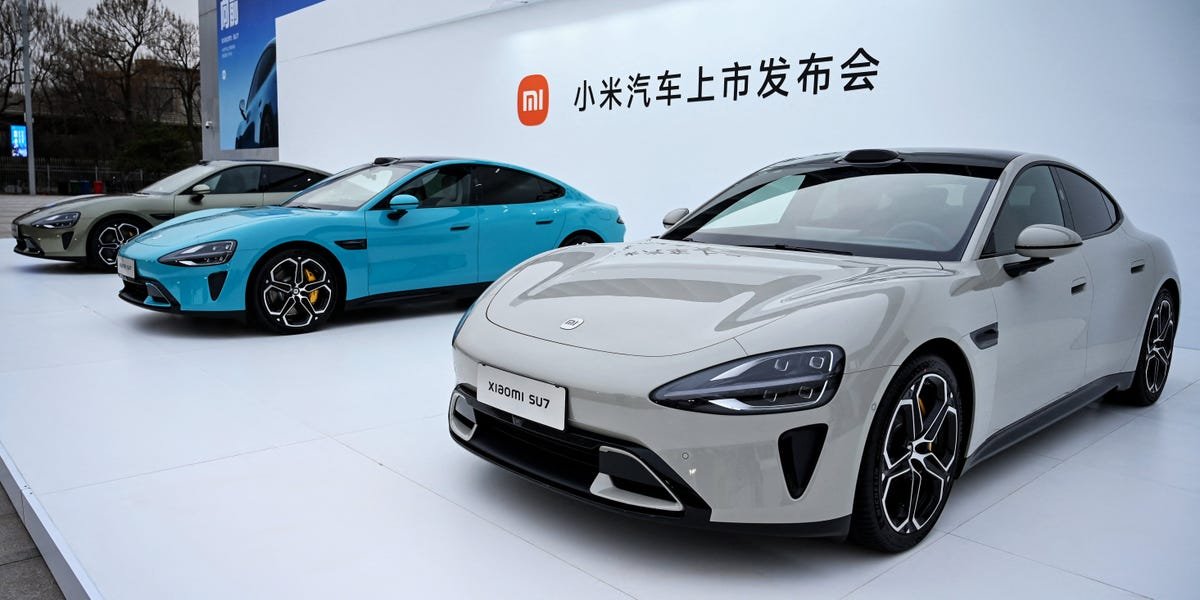
China’s EV revolution has got US auto executives running scared.
Asked about the rapid growth of Chinese electric car companies like BYD at the Aspen Ideas Festival, Ford CEO Jim Farley called it “the most humbling thing I have ever seen.”
The boss of the Detroit automaker described the cost and quality of the electric vehicles coming out of China as “far superior” to those in the West, adding that they posed an existential threat to Ford and the US auto industry.
“We are in a global competition with China, and it’s not just EVs. And if we lose this, we do not have a future Ford,” Farley said.
It’s not the first time the Ford CEO — who was so impressed by Xiaomi’s SU7 sedan he flew one over to the US — has sung the praises of China’s affordable, high-tech electric cars.
Unlike Farley, US drivers have little chance of getting behind the wheel of a BYD or Xiaomi, thanks to high tariffs on Chinese EVs. Here’s what they’re missing out on:
Affordability and variety
EV sales in China have far outpaced those in the US. Almost half of new car sales in the country last year were electric, compared just 10% in the US, according to the International Energy Agency.
As Farley noted, consumers in China have a far greater range of high-quality electric models to choose from than those in the US, and they often don’t need to break the bank either.
The average price of an EV in the US in May was around $57,000, according to Cox Automotive, with the $32,000 Nissan Leaf the cheapest model on the market.
WuYuan/Getty Images
By contrast, the average price of an electric car in China was around $31,500 as of December, with best-selling models like the BYD Seagull selling for under $10,000.
Related stories

Business Insider tells the innovative stories you want to know
Business Insider tells the innovative stories you want to know
“Chinese and US EVs are currently in a very different place,” said Will Roberts, head of automotive research for battery and EV consultancy Rho Motion.
“China has an incredibly broad range of EVs catering to the needs of the entire market, while the development of EVs for many popular manufacturers in the US is still at a comparatively early stage,” Roberts said, adding that Western markets often underestimate the quality of vehicle products and manufacturing in China.
Software superiority
Many of China’s biggest car companies have their roots in the tech world. Tesla rival BYD started out manufacturing cell phone batteries, and EV startup Xpeng dabbles in flying cars and humanoid robots.
As a result, China’s EVs are packed with futuristic tech, with features such as autonomous driving, voice recognition, and in-car AI assistants often coming as standard.
While Apple scrapped its long-running car program last year, its Chinese rivals, Huawei and Xiaomi, have entered the EV industry.
Xiaomi’s second car, the YU7 SUV, amassed over 200,000 orders in three minutes when it launched last week, and Farley specifically praised the two companies for leveraging their smartphone and consumer tech ecosystem to build a unique software experience.
GREG BAKER/AFP via Getty Images
“They have far superior in-vehicle technology. Huawei and Xiaomi are in every car,” Farley added. “You get in, you don’t have to pair your phone. Automatically, your whole digital life is mirrored in the car.”
“Legacy auto is going from analog to digital, and EV companies in China have started in digital, live in digital, so this is second nature to them,” Tu Le, managing director of Sino Auto Insights, told BI.
He said that many EV startups in China have prioritized developing their own tech stacks rather than relying on third-party software and technology.
“Companies like Nio and Xpeng, they want to create the stack and develop and code the software themselves. So, it’s a much more seamless experience,” Tu Le added.
At Aspen, Farley said that US automakers were limited in their ability to offer features such as phone mirroring because tech giants such as Google and Apple “decided not to go into the car business.”
But Tu Le said competing with China’s high-tech upstarts on software would require the Detroit automakers to undertake a cultural overhaul.
“They would need to disrupt themselves, on a department-by-department level,” he said.
Supply chain stranglehold
At the heart of China’s cost advantage lies its effective stranglehold over crucial EV components such as batteries.
The Asian superpower produces nearly all of the world’s Lithium Iron Phosphate (LFP) electric vehicle batteries, and Ford, Tesla, and Toyota have all sourced their EV power packs from Chinese battery giants CATL and BYD.
Other crucial automotive supply chains, such as rare earth magnets, are overwhelmingly centred on China, allowing local EV giants to build the vast majority of parts in-house and drive down costs.
Attempts by Western automakers to catch up have been mixed.
Ford and Tesla are building new battery plants in Michigan and Nevada to lower costs, but Ford is planning to license designs for the batteries being built there from CATL.
Tu Le said the West had a long way to go before it could even come close to competing with China in manufacturing key EV components such as batteries.
“We want to be competitive, we want to be in the same room. We’re not even in the same building right now,” he said.
