
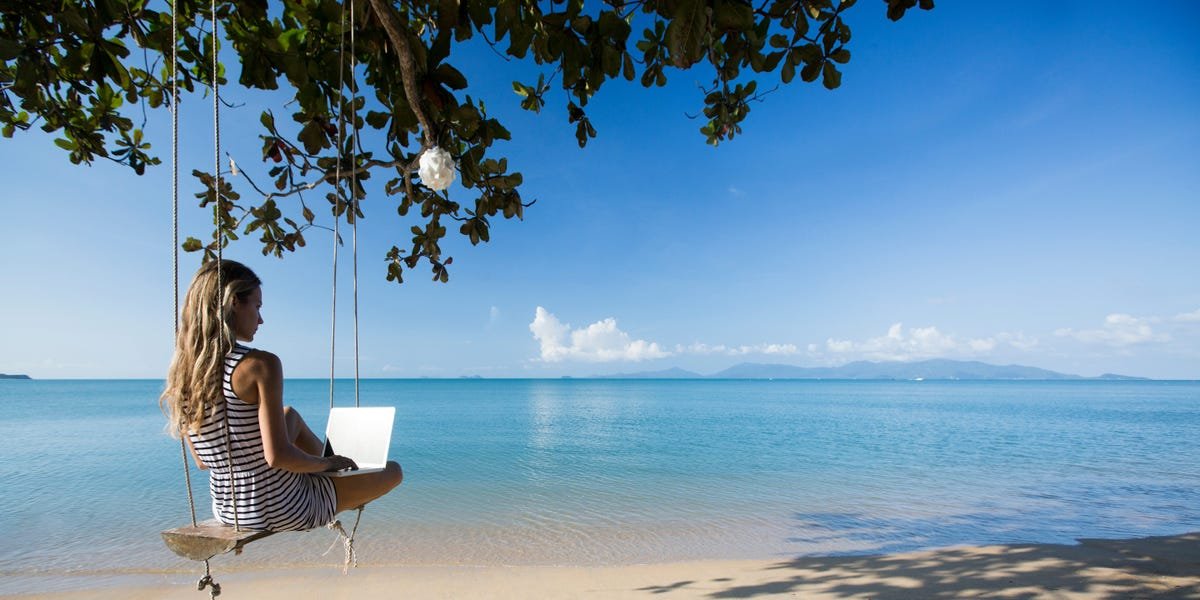
- 29 countries offer residence visas for remote workers, or “digital nomad visas.”
- Spain and Italy have joined the growing list of countries offering digital nomad visa programs.
- Governments hope the visas will help develop more sustainable tourist economies.
In the lead-up to the election, Business Insider reported millions of Americans were considering leaving the country if former President Donald Trump won his 2024 campaign. After his victory was announced, searches for the phrase “moving to Canada” spiked — along with inquiries about international digital nomad visas.
The specialized visas allow remote workers to live and work in countries like Malta, Portugal, and Costa Rica — as long as their income comes from outside the country.
And as some American tourists consider moving abroad, dozens of countries have, in recent years, launched special visas designed specifically for remote workers to drive tourism in their countries.
In some countries, the visas have become so popular that they’ve had to start turning people away. As of October 2024, for example, Cyprus is no longer accepting digital nomads after it filled the 500 slots it had available for its visa program.
Nonetheless, there are still plenty of options elsewhere. Here are 29 countries that offer visas specifically for remote workers, the minimum income required to apply, and how much they cost.
Europe digital nomad visas
Yuriy Biryukov/Shutterstock
Malta, an island south of Italy, has a permit that allows nomads to keep their jobs elsewhere and legally stay in the country for one year with a chance of renewal.
To be eligible, you must be from a country outside the EU and EEA and have a minimum gross annual income of 42,000 euros. The Nomad Residence Permit requires applicants to have health insurance, hold a valid travel document, have a rental or purchase agreement, and pass a background check. There is no application deadline, but there is a 300-euro application fee.
Alexander Spatari/Getty Images
Latvia introduced its digital nomad visa in February 2022, allowing applicants to spend up to a year in the country with the opportunity to renew for another.
Digital nomads must either work for a company based in a member state of the OSCE (Organization for Security and Co-Operation in Europe) or a company registered in one of those countries for at least six months.
They must also have health insurance and make at least 2.5 times the country’s average monthly salary of the previous year, which the government website reports is about $4,043 (€3,843). There’s also a $63 (€60) state fee for the visa application.
Alexander Spatari/Getty Images
To apply for Romania’s digital nomad visa, digital nomads must show proof they can work remotely, either as freelancers, business owners, or employees of a company registered outside the country.
Applicants are also required to have a clean criminal record, medical insurance for the duration of the visa with a minimum liability of $31,580 (€30,000), make at least three times the average gross monthly salary in Romania, around $3,467 (€3,300), and pay an application fee of $126 (€120).
Tanatat pongphibool ,thailand/Getty Images
Known as the White Card, the digital nomad visa in Hungary requires applicants to be employed by a company outside the country, have shares in a company outside the country, or work as a freelancer.
In addition to providing proof of health insurance and proof of accommodation, those keen on getting a White Card must earn at least $3,146 (€3,000) a month. Application fees can cost as much as $297 (€284).
Ian.CuiYi/Getty Images
Croatia allows non-EU citizens to apply for its digital nomad visa program, which grants up to one year of residency for remote workers.
The program also allows residency for close family members of the visa applicant so long as the family meets the country’s income requirements. To be eligible, applicants must make a minimum of 2,870 euros a month (or $3,035) or have a minimum of 34,440 euros (or $36,430) already available in their account.
Talia Lakritz/Insider
In Iceland, a long-term visa for remote work can grant you 90 to 180 days while working. The program requires that you are from a country outside the EU and EEA and also from a country that does not need a visa to travel to the Schengen area (US citizens can travel to Iceland without a visa).
Applicants must also have a monthly income of 1,000,000 Icelandic króna (or $7,156) or 1,300,000 Icelandic króna if they bring a spouse.
Maglara/Getty Images
Greece started its Digital Nomad Visa in 2021 and is still operating today. The program lets non-EU digital nomads, with a 3,500-euro monthly income, stay for 12 months.
The application fee is refundable at 75 euros, and there’s also an administration fee of about 150 euros.
proslgn/Shutterstock
Portugal has been kind to digital nomads. With its “Temporary Residence Visa for the Exercise of Professional Activity Provided Remotely Outside the National Territory,” or D8 visa, launched in 2022, non-EU nomads can still freely work there.
Applicants must be over 18 years old, prove income over 3,280 euros a month, and show proof of accommodation for at least 12 months. The application fee ranges from 75 to 90 euros.
Pavel Tochinsky/Getty Images
Estonia launched its Digital Nomad Visa (DNV) program in 2020, offering up to a year of residency for eligible workers looking to live in the Northern European country bordering the Baltic Sea and Gulf of Finland.
Eligible remote workers must prove they earn at least 3,504 euros a month (or $3,706) and apply in person at their nearest Estonian Embassy or Consulate. Application fees range between 80 and 100 euros ($84 and $105).
Sina Ettmer Photography
Spain’s Digital Nomad Visa Program allows remote workers, their spouse or unmarried partner, and dependent children to reside in the country for one year.
Applicants must have an undergraduate or postgraduate degree from a “University, College, or Business School of prestige” or have at least 3 years of work experience in their current field, in addition to earning at least 200% of the monthly Spanish national minimum wage — currently set at 37.8 euros/day ($39) or 1,134 euros/month ($1,199).
Aleh Varanishcha/Getty Images
Italy’s Digital Nomad Visa is available to non-EU citizens who are highly specialized workers with careers that require post-secondary degrees or at least three years of professional training or experience.
The visa lasts up to one year for the applicant, their spouse, and dependent children. To be eligible, the applicant must prove that their salary is at least three times the annual minimum wage of 24,789 euros (or $26,221) and that they have at least 30,000 euros (or $50,000) worth of medical insurance coverage.
Asia and Africa digital nomad visas
Francesco Riccardo Iacomino/Getty Images
In April, Bali introduced a Remote Worker Visa (E33G), which allows digital nomads to work from Bali for a year. Foreign workers in Bali must be employed by a company outside Indonesia and receive a yearly income of at least $60,000.
The application fee for a standard single-entry visa costs 12,900,000 Indonesian rupiah, or about $810.
Alexander Spatari/Getty Images
The Destination Thailand Visa allows digital nomads to stay in Thailand for up to 180 days per visit, on a multiple-entry basis, within five years. The visa fee costs 10,000 Thai baht, or $284.
Applicants must be at least 20 years old and have at least THB 500,000, or about $14,400 USD, in their bank. Employed workers are required to have a foreign employment contract, while freelancers need a professional portfolio.
Marco Bottigelli/Getty Images
Japan introduced a new digital nomad visa in April. This visa allows holders to work remotely in the country for up to six months. Visa holders must be nationals or citizens of selected regions, including the US and UK.
Applicants must have an annual income of at least 10,000,000 Japanese yen, or $65,000, and submit their applications in person or by mail to the nearest embassy or consulate general of Japan. A single-entry visa costs $22, while a multiple-entry visa costs $43, but some countries, including the US, are exempt from this fee.
Lu ShaoJi/Getty Images
UAE’s virtual work residence visa allows holders to live and work remotely in the UAE — including Dubai and Abu Dhabi — for up to a year. Applicants must make at least $3,500 a month and have sufficient health insurance coverage within the country.
The service fee to apply for the visa is 300 United Arab Emirates Dirhams, or about $80.
Peter Adams/Getty Images
Cabo Verde’s Remote Working Program allows remote workers to stay for up to 6 months, with the option of renewal after. Individual applicants must have an average bank balance of 1,500 euros, or $1,570, in the past 6 months.
The visa fee costs 20 euros, and applicants must submit an online form to indicate their interest.
Johannes Mann/Getty Images
South Africa recently launched a remote work visa, which allows holders to stay for at least 3 months and up to 3 years. While details are still being finalized, the latest visa requirements state that applicants must have a salary of at least 650,796 South African Rand, or about $36,000, and a valid foreign-based employment contract.
Caribbean digital nomad visas
Orietta Gaspari/Getty Images
To receive a digital nomad visa from Grenada, you need a valid passport, an annual income of at least EC$100,000 a year, or about $37,000, full COVID-19 vaccination, and valid health insurance.
There is no application deadline. The fee is $1,500 for individuals, $2,000 for a family of four, and $200 for each additional dependent.
David C Tomlinson/Getty Images
St. Lucia’s Digital Nomad Visa program, “Don’t Just Visit, Live It,” has no income threshold. The one-year visa is available to remote workers, freelancers, and students.
The application fee costs $125 XCD (about $47) for a single-entry visa or $190 XCD (about $70) for a multiple-entry visa.
FrankvandenBergh/Getty Images
Curaçao’s Digital Nomad Visa, the At Home in Curaçao program, has no salary requirements. Still, you must be employed, own a business, or have freelance clients outside the country.
Health insurance, a clean criminal record, and proof of accommodation or a lease on the island are also required. The visa application fee is about $294.
BriBar/Getty Images
To qualify for Dominica’s Digital Nomad Visa, the Work in Nature (WIN) Program, you must be 18 years old and have a clean criminal record.
You will also need an income of at least $50,000 or have sufficient funds to support yourself and any family members accompanying you during a 12-month stay.
The application fee is $100. The individual visa costs $800, and the primary applicant can also apply for their spouse and dependents for a total fee of $1,200.
stevegeer/Getty Images
The digital nomad visa in Anguilla has no income requirements, but interested travelers must fill out an application at least 7 days before arrival.
Digital nomads also need proof of a negative COVID-19 test 3 to 5 days before they step foot on the island and proof of a health insurance policy covering COVID-19 complications.
Maria Ehrlich / EyeEm via Getty Images
To nab Antigua and Barbuda’s two-year visa through the Nomad Digital Residency Programme, applicants must be 18 or older, earn at least $50,000 a year, and have a clean criminal record.
Their employer must be outside Antigua and Barbuda as well. Application fees range from $1,500 for a single person to $3,000 for a family of three, plus another $650 for each additional dependent.
Kavitha Surana/AP
Introduced in June 2020, the Barbados 12-Month Welcome Stamp offers a one-year visa for digital nomads interested in the island and the opportunity to renew.
Applicants must make at least $50,000. Fees are $2,000 for an individual and $3,000 for a family bundle and must be paid within 28 days of application approval.
North, Central, and South America digital nomad visas
Cavan Images/Getty Images
The Work from Bermuda certificate was created for “remote workers, self-employed digital nomads and university students engaged in remote learning,” according to the program’s web page. It lasts for 12 months and is renewable on a case-by-case basis.
The application fee is $275, and interested applicants must be at least 18 years old, have a clean criminal record, and have valid health insurance.
There is no official salary requirement, but applicants must demonstrate that they “have substantial means” or a “continuous source of income,” though no official range is provided.
Arturo Rosenow/Getty Images
Colombia’s “Visa V Digital Nomads” program allows expats from more than 100 countries to live and work remotely in the tropical country for up to two years. Applicants must make a minimum income of three times the current legal monthly minimum wage in Colombia, which currently equals about $885 a month.
The application costs $54, and if approved, the Visa itself costs another $177. People hoping to become digital nomads in Colombia must also provide a contract or employment letter detailing their employment agreement and compensation details. Entrepreneurs may alternatively submit a letter outlining their business project and financial resources.
Shutterstock
Belize offers citizens of the European Union, the United Kindom, the United States, and Canada the chance to live and work in the country via its “Work Where You Vacation” program. Applicants can secure a six-month visa by proving they make a minimum annual income of $75,000 or $100,000 if applying with dependants. Kids under 18 are eligible to enroll in the country’s school system.
Applicants must submit a notarized banking reference, a police record, and proof of travel insurance. The visa costs $500 per adult and $200 per child.
Gianfranco Vivi
Costa Rica’s digital nomad program extends the country’s 90-day tourist visa to a full year with the option to renew for an additional year. Applicants must be foreign nationals who earn a minimum of $3,000 a month or $4,000 a month if applying with dependants.
All application materials must be submitted in Spanish. The application costs $100, while the visa is an additional $90.
Carlos Alkmin/Getty Images
Brazil’s digital nomad visa (VITEM XIV) allows foreign nationals from more than 100 countries to work remotely in the South American country for one year and to renew for longer.
The visa is available to remote workers who can prove a monthly minimum income of $1,500 or an available bank balance of at least $18,000. Applicants must submit a background check, a copy of their birth certificate, proof of valid health insurance in Brazil, and documents proving digital nomad status.
The visa costs $290 for US applicants and between $100 and $215 for UK applicants. Expats from all other countries will pay $100 for the visa.
