
The light at the end of the world is different. One of the first things I notice when I land in Nome, a tiny port town halfway up the coast of Alaska, is how bright it is. The sun sits on the horizon, its rays making a thin, sharp line that cuts between the grey sky and water. It seems both more and less powerful here, where there are only a few hours of daylight. Canary yellow and smoke are the colours that Rothko would have painted had he lived here.
It’s 10.40am on October 25, but the light makes it feel much earlier. Nome is more like a foreign country than any place I’ve been to in the US. Homes are lifted on stilts, as it’s difficult to build on permafrost. The local paper, the Nome Nugget, leads with stories about Indigenous People’s day and the latest storm to pummel the Bering Strait. The Iditarod Trail Sled Dog Race, perhaps the ultimate He-Man sporting event, finishes in this town, where commerce consists mainly of survival supply. Local bulletin boards advertise fish-skin tanning and gun raffles.
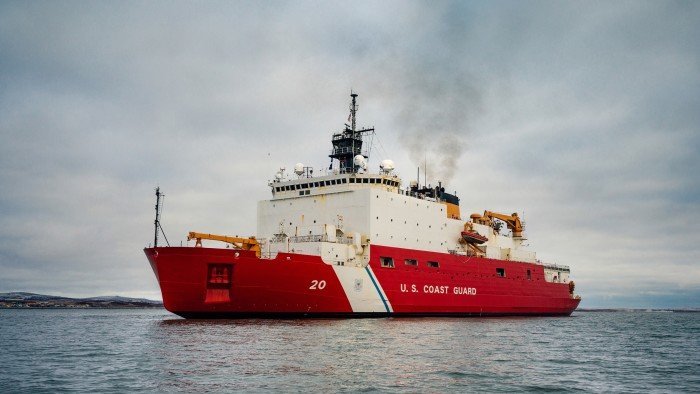
There is one other thing in Nome: the United States Coast Guard. This is the branch of the American military that polices the country’s waters for everything from drug trafficking and illegal fishing to Russian and Chinese spying. The Coast Guard does lots of other things too, like rescue distressed vessels or people, chart new shipping pathways and facilitate scientific research. I’m here to board the USCGC Healy, an “icebreaker” that can navigate through ice nearly 5ft thick. Of the Coast Guard’s fleet of 241 active “cutters”, which are ships 65ft in length or greater, only two are icebreakers.
The fact that the US has so few is the reason I’m here. These ships are crucial to exploring and protecting the Arctic, which is fast becoming one of the most hotly contested places on earth (and that was well before Donald Trump suggested buying Greenland). But the US hasn’t built a new icebreaker in quarter of a century. In fact, it can’t. Thanks to the dramatic shrinking of the commercial shipping industry, the country is incapable of efficiently producing vessels like this on its own. The most recent effort is five years behind schedule and wildly over budget.
The desperate need for ships is a rare point of bipartisan agreement. The Biden administration signed a deal with Finland and Canada to jointly produce more icebreakers. But the idea was actually first floated by Trump during his first term. Now, his National Security Council will push forward the “ICE Pact deal”, bringing Finnish engineering expertise to the US with the aim of building considerably more icebreakers for the US and its allies over the next 10 years. The bipartisan Ships for America Act, which offers support for America’s shipbuilders, was introduced last December and co-written by former Congressmen Mike Waltz, who is now Trump’s national security adviser.
“The president and I understand the economic and national security importance of a strong US maritime industrial base,” Waltz told the FT. “The president understands the strategic need to revitalise our commercial maritime industry and invest in additional US icebreaking capabilities.” Waltz said there would be a “whole-of-government effort to get ships on the water as quickly as possible [that] will include putting forth an emergency request to Congress for funding. We will remove any constraints that prevent US shipbuilders from delivering vessels on time and on budget and, when necessary, work with our allies to ensure we have the ships we need.”
Trump’s interest in the Arctic isn’t only martial, it’s commercial. Global warming has led to melting polar ice caps, opening up new sea lanes that could halve transit times between Asia and Atlantic ports. Currently, the best sea lane is along Russia’s northern coastline, which it claims as its own. But new passages in international waters would in effect redraft the blueprints for global supply chains, mitigating the effects of conflict and accidents at choke points, such as in the South China Sea and the Panama and Suez canals.
Less polar ice also means easier access to sea beds, where there are huge reserves of rare earth minerals, oil and natural gas. Competition between the US, Russia, China and other nations to see who will claim and tap those resources began years ago. That also means the Arctic is increasingly becoming a zone of military and espionage operation. This growing list of reasons means the Arctic is about to get a lot more attention.


October 25
The private sector is about efficiency: how to get something from A to B as fast and cheaply as possible. But the military is all about assessing and minimising risk. Perhaps that’s why the process of getting from shore to ship takes about 90 minutes, even though the Healy is only docked two miles off the coast. We have to gauge the best path through the ice forming in port, as well as suit up in survival gear, should we accidentally topple into the freezing water.
The Healy is a 420ft-long hunk of steel, painted red and white. Commissioned in 1999, she is technically classified as a medium icebreaker, although she is the Coast Guard’s largest vessel. Icebreakers clear paths by pushing straight into frozen-over water or pack ice, so they need to have three things most normal ships don’t: a strengthened hull, a shape that pushes broken ice around or under the vessel and the engine power to push through it all.
Above this brute-force capability, much on board is digital. There are huge servers running continuously that support everything from sonar and satellite readings to weather, communications and machinery sensor data. Elon Musk’s Starlink, which provides a lot of the wireless coverage available in the Arctic, has been transformational, not only for Coast Guard communications, but for the personal lives of staff. They can now stream movies and video chat with their kids during down time.
The Healy is a floating city with its own schedule. Cleaning happens at 3.30pm, officer meetings at 4.15pm, dinner at 5.30pm and so on. Order is one of the ways that people stay sane without much sunlight. There are two crews, each on 12-hour shifts. In the late afternoon, when the shift changes and some of the crew go to sleep, red lights illuminate the corridors and stairwells. It all makes me feel like an extra in The Hunt for Red October.
I can’t seem to remember the set traffic patterns up and down the nine decks, though the crew is forgiving as they bump into me on the stairs. Everything looks the same, and it takes me a couple of days to be able to reliably navigate to my “state room”, a roughly 200-sq-ft tenement-beige space that reminds me of my first college dorm room. It’s bleak, but as many sailors say, it’s better than a cubicle.
Actually, I’m living in Coast Guard luxury. I have only one roommate, a Woods Hole oceanographer named Maddie, who I rarely see. We share a bathroom with the six female Coast Guard staff in the adjoining room. I’m travelling between Siberia and the Seward Peninsula, and yet I can wash my hair, watch Netflix or work out on an elliptical machine in one of the two on-board gyms.
FT Series

This is the second in a multi-part series about the global contest for dominance in the Arctic. Melting ice is creating new geopolitical challenges and commercial opportunities, which the FT has dispatched reporters to cover first-hand. Read more at ft.com/arctic
Part one: How Greenland got caught in a clash of superpowers
The Healy is the premier science vessel for people who want to study the Arctic, and most of the scientists here have been trying to get on board for years. They are all studying complex climate systems: wave patterns, erosion on the Continental Shelf, how melting polar ice fuels storms and how those storms in turn cause more erosion. They’re looking at how the bloom of new algae brings humpback whales to the area to compete with the local whales, upon which tribal populations depend. They are measuring how changing water temperatures create more turbulent seas.
“The Arctic seas change more quickly than, say, Boston,” says Laurie Juranek, an oceanographer from Oregon State University, who is here to train younger scientists in ship work. “There’s something called ‘polar amplification’ that speeds up change. So, understanding what’s happening here gives us a better idea of what might happen elsewhere.” The cost of doing science missions on Healy can run to $70,000 or more a day, so it is often shared between multiple institutions and government agencies.
The value goes beyond pure science. While America used to dominate oceanography, the Chinese have built 64 oceanographic research vessels since 1990. “They aren’t just building commercial tankers, but ships to understand, explore and dominate this domain,” says Steve Brock, a former Naval officer who until recently was the senior adviser to Biden’s secretary of the navy. “That will have massive implications for economic and national security.”
Having more research vessels means getting to natural resource discoveries and mapping the sea floor faster, for example.
A few hours into our first day, we get an alert that it’s time to begin practising our emergency drills. I leave the science conference room, where I am taking notes, and walk outside into the wet, freezing air, praying I won’t fall overboard. Inching my way along a corridor wall in the dark, I reach a door that leads to a helicopter hangar that sometimes doubles as a basketball court. There, I join a group of the 113 people on board, and I’m given a giant red rubber survival suit to put on. It’s around dinner time and pitch black outside, but you can smell and feel the sea, which is roiling right below us.
Once our suits are on, we are assigned specific tasks, in case of a real emergency. Mine is collecting food and water but, after just one practice run, I’m pretty sure I couldn’t remember where the food locker is in a pinch. We are shown how to deploy life boats. Fortunately everyone aside from me seems competent.


October 26
Breakfast early in the mess hall. Everyone from the captain down eats together. We may fret about the military-industrial complex, but the truth is that the US military is about as close as America gets to socialism. It’s a world beyond commercial grasping, one where words like “honour” and “service” are used unironically.
Plus, to my surprise, the food is amazing. There are tonnes of fresh fruits and vegetables, including a lush daily salad bar, even a dedicated staff baker. Food is a huge part of morale building; one of the few pleasure points the crew has. Thank heavens for the stairs, I think, because I’m pigging out on freshly made sheet cakes, cinnamon rolls and good bread. There’s even a little specialty coffee shop run by staffers on their own time where you can get a decent latte.
Fully caffeinated, I hit the 9.30am science team meeting. It’s freezing but warmer than expected, so the group is fretting. What will happen if there’s no ice? There is also some concern that, because of weather, the Healy could get pulled too near Russian waters, or native whaling grounds, which we must steer clear of in hunting season.
This is one of the things that Clarissa Zeller, an environmental scientist and official observer of the mission for Alaska’s Yup’ik and Inupiat tribes, is watching. She’s 31, tall and lean with short black hair and a nose ring. Her job is to bring climate information back to the tribe. She tells me that local salmon are getting smaller and overfishing is a problem. Rapid changes in water temperature could affect the hunting patterns of whales, walruses, seals and salmon.
It’s cause for concern, she says, but not despair. “Our people historically have moved, and we may have to move again.” Her tribe was able to block a proposed copper mining project recently on the grounds that it would disrupt salmon fishing. Zeller sees herself as a “scientific diplomat”, sending daily updates to the tribes, and is surprisingly optimistic despite the challenges of climate change. She notes “as permafrost goes away, land will open up. I don’t know what that means yet. It could be good in some ways. Perhaps it’s an opportunity for agriculture.”
After lunch, I head up to the bridge. The view is stupendous. This part of the ship has a churchlike quality. The staff is quiet and formal, stationed at various computer screens or at points around the dozens of enormous windows looking out to the vast, endless expanse of grey blue sky and water. I chat with Lieutenant Commander Brian Williams, a visiting officer from the Coast Guard’s Pacific area and one of the many people on the ship thinking about icebreakers and national security.
Williams works on the Arctic Strategic Outlook Implementation Plan, which has three goals: working with coastal communities on resiliency; co-operating with the National Science Foundation on Arctic research; and, perhaps most importantly, building maritime capacity and security in the region. “We do a lot [of patrols and security collaboration] with Norway, Canada, Greenland, Iceland and the navy as well,” he explains. “The Healy is important because it enables us to meet presence with presence.” We’ve already seen a Russian science vessel. Both ships took note of each other for about 30 minutes and then moved on.
The US having only two icebreakers is a problem for Williams. “We often have to ask ourselves, do we keep Healy in the Arctic or send it further afield to drill with partners? There are the science goals, the drills with Europeans and other allies, and the need to create a presence in the North and South poles.”
Aside from increasing Russian presence in the region, China has declared itself a “near-Arctic” nation and deployed three new icebreakers. The country has spent billions to beef up its shipping industry over the past 20 years. While America has 185 privately owned oceangoing merchant vessels, China has 5,500. What bothers Williams is that the Chinese have been doing things with less transparency than in the past. “They didn’t tell anyone they were doing it,” he says of the new icebreakers. “People are looking for more collaboration to manage it all.”
It’s noon, and we are about to drop the first of the science teams’ sample-collecting equipment, a 6ft by 10ft tube, which will take water samples at different depths to measure temperature, salinity, oxygen and plankton levels. There will also be a plankton net and a soil grab. All the equipment must be handled carefully so it doesn’t touch anything and get contaminated.
The Healy’s captain, Michele Schallip, a sturdy, calm, kind-faced 49-year-old Coast Guard veteran, is watching from the bridge. “This is my third command of a cutter, and I love being at sea,” she tells me. The daughter of two commercial mariners from the upper peninsula of Michigan, Schallip has been sailing since she was a kid. “I just enjoy the sunsets and sunrises and how the ship moves with the different currents and rudder angles and propellers,” she says. Like many veteran sailors, she’s so attuned to the vibrations of the machinery onboard that she can sense a change while sleeping. Not that she sleeps much. “I’m on call 24-7, and I usually set my alarm for 6.30am.”
It takes six people to get the scientific equipment into the water safely. One of the scientists is at the computer screen that manipulates the on-deck crane; her hands are shaking as she moves the knob that controls the jaws of the device. Zeller, the tribal observer, watches, alongside a number of Coast Guard staff. It seems to me that this kind of science is a lot like long-haul flying, hours of boredom punctuated by moments of anxiety and discovery. The information gathered over the next few days will tell the team, and the Coast Guard, much about the changing nature of Arctic waters.
After dinner, I hang out on the mess deck for a while, spacing out to a Hunger Games prequel with some of the engineering staff. The best part of the day comes after we’ve all gone to bed. Some time before 3am, I get a text to come up on deck for a viewing of the Northern Lights. Pulling my parka over pyjamas, I stumble into the frigid air and am enveloped in a neon green glow that seems like it has been Photoshopped. The aurora borealis dances in the sky around us, pierced by an unbelievably bright moon and stars. I’m transfixed. Even veteran sailors are outside filming the event. It’s only a few days before the US presidential election and all its consequences. But right now, I feel very far away from all that and much nearer to the eternal.


October 27
We’ve hit ice! But it’s only baby ice, “pancake ice” as the scientists call it, oval shaped pieces that float and collide together, building thicker layers as they do. They look like a grey and white patchwork quilt on the water. Haley Howard, one of the watch officers on board, shows me how she looks for “leads” or seams in the ice that are easier for the ship to break. “It’s more art rather than science,” she says. “It requires a human touch.”
You can feel the vibrations and hear the slushing, cutting sounds as the Healy ploughs through the ice quilt. It’s a bit like nails on a chalkboard, and the sound gets louder the lower down into the ship you go. I wonder if this scraping sound is what the guys shovelling coal into the boilers of the Titanic heard before disaster struck, but I put this thought out of my mind and spend the better part of the day getting to know the crew.
Former Eagle scouts abound, as do people who have gone through college on the GI bill, which pays for those who have served in the military. Many have received vocational training and feel it should have the same respect as a four-year degree. Everyone seems to have multiple skill sets and interests. I meet a couple of young seamen who run a 3D-printing workshop onboard that can manufacture emergency parts for the ship. “It’s useful,” one tells me, “since Amazon Prime doesn’t deliver here.”
My brother was a technician on a navy submarine, so I’m familiar with how the US military can turn aimless young people into skilled adults. I’ve often thought the US should have a mandatory year of service. “No 18-year-old knows what they want to do,” says Brian Wheeler, the electrical division officer, who went to USC Santa Barbara and did a Coast Guard programme at the same time. He believes “elites vastly discount the value of military experience. The discipline and the expertise it gives you. Healy is a mobile, floating science station, and our job is to keep it going. It took me about three months to understand the whole thing,” he says, from diesel engine maintenance to desalinisation and sewage.
His boss, Ryun Konze, the ship’s jovial chief engineering officer, went to the California Maritime Academy. The 36-year-old with dark, reddish hair and glasses got into the field because he loved tinkering. As he tells me, “The academies supply a lot of labour to the private maritime industry,” where international shipping companies can pay well into six figures for veteran mariners. That makes it hard to keep people in the Coast Guard or navy. Aside from the outsourcing of shipbuilding, the main challenge for America’s maritime industry is skilled sailors and builders. South Korea, for example, had about 2,000 naval architects graduate last year. The US had 70. The Korean company Hanwha, which recently acquired the Philadelphia shipyard, has had to bring in retired workers from Korea to train the local workforce.
Like many staffers onboard Healy, Konze could easily double or triple his salary in the private sector. But he’s drawn to “the adventure of the Coast Guard. This ship is so incredibly unique in how it supports the nation. And there’s also this global mission of telling people, ‘Hey, this is what’s actually going on up here in the Arctic.’” He and others I interview have a strong desire to serve something greater than self and Mammon. Many people on Healy chose the Coast Guard, among all the divisions of the military, because it’s largely about helping people at home, rather than potentially killing people abroad.
After the 4.15pm meeting, I speak with Alex Hamel, the operations officer. He’s a serious man of few words, who is in charge of all onboard operations as well as navigational decisions. One of his big responsibilities on this journey is charting parts of the Northwest Passage, a new route connecting the Atlantic Ocean to the Pacific, skirting Greenland, northern Canada and Alaska. The US and others hope to lay fibre optic cables that carry 95 per cent of the world’s data flows undersea along this route and to use it to navigate the globe more quickly and efficiently.
I ask Hamel what he’s hoping to find on this mission, and he stares at me before he answers. “There are three ways across the pole right now. The northern sea route, the transpolar sea route [which is largely conceptual at this point] and the Northwest Passage. The Northwest Passage is of high interest to a lot of commercial entities, and it’s not well charted.” Indeed, only 15 per cent of the Arctic sea floor has been mapped at all. “We want to understand, with a high level of confidence, how to go from the Baffin Bay to the other side of the Pole.”
We are at the 74th latitude, well into the Arctic Circle. But you can’t see the stars tonight because a storm is coming.

October 28
The scientists are exhausted. They worked until 4am in a dark and snowy squall, and the weather will only get worse from here. I am also exhausted and rather foggy, but apparently this is normal for newbies. The lack of light is to blame, as well as seasickness medication delivered by a slow-release patch stuck beneath my right ear. A junior oceanographer who does much of her science in Antarctica tells me people on the ice stations there frequently suffer short-term memory loss.
I meet with visiting Captain Meghan McGovern, who works with the National Oceanic and Atmospheric Administration. Noaa, which dates back to Thomas Jefferson’s era, was started as an effort to map the Atlantic coastline. “The core idea here is to understand everything we can about the coast and the seabed in order to be able to get troops, supplies and any other assets to the right place with no problems,” she tells me. Her ship, the Fairweather, has sonar that is only good for shallow water. So, she says “our team is using Healy to map the Beaufort Sea [north of Canada] so that we can chart a safe corridor for transit and shipping, both military and commercial.”
By the time we pull back into port, her team will have mapped an area of the sea floor the size of Puerto Rico. As the Healy’s Captain Schallip tells me, “This is crucial because ships support about 80 per cent of the economy, which in turn supports national security. That requires shipbuilders and designers.” Like everyone else on board, she’s concerned about the fact that Healy is 25 years old and beginning to show it. One of the reasons that the weather is worse than expected is that we are out much later in the season than usual, after a fire onboard necessitated several weeks of repairs.
It’s disturbing to think that a country with a coastline almost 100,000 miles long, where 40 per cent of its population lives, can’t make its own ships in a timely or cost-effective way any more, can’t support its own logistics by sea and can’t even ensure the delivery of military supplies by sea without foreign help. (Today, commercial vessels transport roughly 90 per cent of US military equipment and supplies.)
The decline has many roots, but one key reason was the demise of subsidies for the commercial shipbuilding industry in the 1980s. Reagan officials, many of whom were security hawks as well as free-marketeers, mistakenly thought that military spending during the cold war would create enough demand to sustain US shipbuilding. But the fall of the Berlin Wall and the resulting “peace dividend” cuts hollowed out an industry already in decline. As the outgoing secretary of the navy, Carlos Del Toro put it in a speech at the Harvard Kennedy School in 2023, “History proves that, in the long run, there has never been a great naval power that wasn’t also a maritime power — a commercial shipbuilding and global shipping power.”
In this sense, the delinking of military and commercial shipbuilding and the outsourcing of the industry has come with serious negative consequences. Acknowledging this isn’t protectionist; it’s practical. The maritime sector was the rare industry that even Adam Smith thought worthy of state support, given its importance to both commerce and security. Former national security adviser Jake Sullivan told me before leaving office that he hoped “ships would be the new chips”, meaning a focus of a new US industrial strategy involving increased production at home and with allies. Whether or not the Trump administration makes good on that will be a big test of whether it will do industrial policy, or just talk about it.
By the time the evening meeting rolls around, all anybody wants to talk about is the weather. Brittany Amos, a navy weather forecaster on loan to the Healy, delivers the news that we’ll be heading into rougher seas. So far, it’s been 5ft to 10ft waves. We’ll soon be looking at 15ft to 20ft. Even though Healy is built to withstand 50ft waves, this news fills me with anxiety. Last night, I woke from the movement, which rolled me in my bunk. Nobody else seems concerned, but I can’t stop thinking of those CGI wave scenes in The Perfect Storm.
To calm myself, I speak to Amos about her work. Like so many, she came into the navy because she couldn’t afford college. Her ultimate ambition is to leave the service and become a data scientist. Part of this is about making more money, but part of it is about some of the political and cultural changes in the country. “People used to say, ‘Yeah, I’m proud to be serving my country,’” she says. “But now, with everything that’s going on, they’d probably say, ‘Yeah, I’m just proud to be doing a job.’ I think we’ve lost some of the spirit of pride in our country.”
I ask her when she thinks that changed. “I think it started to change in the 1980s. Everything became about individualism and no sense of common purpose, shared service.” Like many people I speak to on board, she’s relatively apolitical, blaming neither Democrats nor Republicans for the shift.
At 6.30pm, I spend 30 minutes outside, watching the science team put down nets to gather plankton. There are seven people on deck, all clipped into safety gear. A speaker blasts AC/DC’s “Highway to Hell” as they lay down the lines of netting. At midnight, the work has to stop because the wind and waves are too strong.


October 29
Bad weather today, and it’s too cold to go outside. The ship is now steaming on to the shelf break in the Beaufort Sea, where the seabed depth goes from 40m to 4,000m. Noaa mapped the area for the first time in history yesterday. Everyone is very keen to see what comes from the sonar readings.
This work is time consuming and difficult, but the importance of it becomes clear when you look at one of the many maps on the ship that show the world from a bird’s-eye view, looking down at the Arctic. Seeing the planet this way, you quickly sense how big Russia is, how geographically important Greenland could be in a warming world, and why America, as an Arctic nation, needs to better understand the vast terrain of a new and more geopolitically important world.
Shannon Doherty, a plankton scientist, is excited that her nets have come back full of shells containing isotopes that can be used to understand historic patterns in the waves, water and ice. The seamen that brought up the nets are now busy scrubbing the deck to the sounds of the Red Hot Chili Peppers, de-icing, just as you would an aeroplane’s wings. Healy was designed to work in these conditions, but there are fishing vessels that have had casualties because they get so much icing that they capsized. I decide not to think about this either, and go off to dinner. Soft tacos, beef tips with rice and braised broccoli. Warm brownies and ice cream for dessert. Not bad for the North Pole.
October 30
The big news is that the mapping team has found something: a “feature”, as they call it, that looks like an underwater volcano. What’s more, there may be a methane plume coming from it. That indicates the possibility of oil and gas. “I kind of wish we hadn’t found that feature right here,” Captain McGovern says, “because it’s right near a native community whaling ground.”
The team will continue validating the data and announce the final findings later, but if there’s a natural resource find, you can bet that both state-owned oil majors and private multinationals alike will be looking to bring icebreakers to investigate.
A plane from nearby Coast Guard Air Station Kodiak zooms overhead and radios the ship to see if it can do a “close fly-by” for practice. Healy says yes, and the plane flies within a few feet of us. “Thanks for the haircut!” jokes one of the bridge staff to the plane. The Kodiak base has been policing illegal fishing operations, along with Canada and Japan.
An icy wind whips up, flooding the bridge as staff come in and out with binoculars, looking for a science buoy that’s gone missing. It’s all white sky, flat light, grey sea and white caps, with a few lines of pancake ice on the horizon. Eventually, we get the buoy. There are many congratulations to the navigator (“nice driving!”) who has had to do a bunch of tight turns to retrieve it.
The captain calls a meeting to discuss whether the scientists should be allowed to go out in smaller boats to conduct experiments, given the weather. Small boats are riskier, but it would allow for better measurements of the ice and water. As with every major operations decision, key staff meet to rank the risk-reward of the mission based on multiple criteria. The water and air are freezing, and winds are gusting at about 20mph. There are very few waves, so for the Arctic this is medium risk and thus acceptable. The crew, including two Coast Guard staffers and four scientists, get into their personal protective equipment and start the launch of the same small boat we came in on. Within 30 minutes, they are in the water.
October 31
Two parties today, the first in the science lab, where the team shows off today’s finds, including some very active plankton (this is a good sign for ocean health), a tiny tetrapod and a little orange jellyfish swimming in a jar. Many of the crew, including the captain, have come down to take a look. One of the reasons that the environment is so rich is that we are currently in much shallower water — only 50m compared with 700-1,500m yesterday.
Many staff are busy making costumes for the Halloween party that will be held in the helicopter hangar tonight. I am preoccupied by the impending storm, which is predicted to come with 12ft waves and 45mph winds. We can’t move away from this one, because that could mean disrupting nearby whaling. Bowhead season is just finishing and Beluga season is starting. Zeller, the tribal observer, reports all this in the team meeting.
It’s easy to feel like Odysseus out here, lonely in a black and white world of danger. It’s beautiful but frightening. All the discussion about risk, and the technical and precise language used for ship operations, seems like part of the effort to keep people calm. As if things are under our control when encased in reassuring jargon and acronyms. But in fact, we are a tiny steel shape, ploughing through miles of ice.
I don’t need a haunted house to feel somewhat frightened, but the staff has built one for the party anyway. There are other childish pleasures: sugar cookies to decorate, non-alcoholic punch, crafts and a costume contest. It’s fun, but also poignant. All these young Americans who didn’t know what to do when they graduated, or did know but couldn’t afford college, are hanging out at the end of the world. They are prepared for more and expect less than I do and seem better for it. And they look genuinely happy.
November 1
We’re on the Chukchi Sea now, which separates Russia and Alaska, and there’s a kind of pulsating feeling on the ship from the waves and tilt. In the old days, sailors who had been to very extreme places like this had their ears pierced with a ring to show how badass they were. Now, people get tattoos.
Up on the computer deck, I notice a big map showing the position of Starlink satellites. One of the science technicians on board tells me that Musk can make or break communications on the ship. “It’s amazing that one man has all this power,” he says. “He could just turn it all off if he wanted. I guess this is hyper-capitalism at work.”
It’s the penultimate day on the ship for me and the scientists, so I do a final interview with Captain Schallip. We talk about some of her hardest moments: the onboard fire, rescuing two people hanging off a fishing boat after a storm, the death of a crew member last year. She tears up while talking about the last one.
Her leadership style is interesting. She’s open and accessible, but can be fierce. She has no partner, she admits that her work makes that hard, but has just bought a house in Seattle and likes to visit national parks in her spare time. Like most of the crew, she seems incredibly wholesome. “My favourite part of being in the Arctic is the nature,” she says and, as if on cue, several giant walruses emerge from the water. They swim near the ship, staring at us, their giant tusks and whiskers showing.
We are 24 miles from Cape Lisburne, charting a course that will put us into heavy rolling seas from mid-evening to after midnight. I ask a final question: what don’t people understand about this kind of work at sea? “Search and rescue is really glamorous,” Schallip says. “But the biggest thing we’re doing is protecting billions’ worth of commerce every day. It’s really about the economy.”
November 2
Our last day. After lunch, there is an all-hands “muster” in the hangar. Two junior crew members leaving Healy are given a tribute. The first officer lists the things they’ve done to help the mission, from refuelling to cooking. Everyone claps gratefully.
The captain is pleased with the way things have gone. “We were able to conduct our mapping mission and find a port access route. We were able to verify that the bottom is safe in this area for even large loads. We’ve helped chart a path from Canada down to the western coast of North America. That’s really important for the economy. It’s important for environmental protection. And it’s important for safety at sea.”
The weather will be smooth to Nome, where we will dock in time for everyone to file absentee ballots for the US presidential election. I know that like any military personnel, Schallip won’t swim outside her lane by offering any political opinions, but I can’t help but ask, given the geopolitical stakes of the world right now, does it feel different to be in your job today than even a few years ago?
She looks at a picture that the navy weather person has projected and enhanced on a big screen. It shows a mountain encircled by clouds. “Is that a lenticular cloud on that mountain?” the captain asks. She picks up her binoculars and has a look for herself. “No,” she says, putting down her binoculars, “it’s not different. We serve the nation. We have very clear statutory missions that we carry out. It’s our duty to carry them out. And we will do that, no matter who is in charge.”
Then she smiles, turns and picks up the binoculars again to take a look at the port, which has begun to freeze over. She sighs. “I just love that Tiffany blue of the sea ice.”
Rana Foroohar is global business columnist and associate editor at the FT.
Find out about our latest stories first — follow FT Weekend Magazine on X and FT Weekend on Instagram
