

Wisconsin public worker and teachers unions scored a major legal victory Monday with a ruling that restores collective bargaining rights they lost under a 2011 state law that sparked weeks of protests and made the state the center of the national battle over union rights.
That law, known as Act 10, effectively ended the ability of most public employees to bargain for wage increases and other issues, and forced them to pay more for health insurance and retirement benefits.
Under the ruling by Dane County Circuit Judge Jacob Frost, all public sector workers who lost their collective bargaining power would have it restored to what was in place prior to 2011. They would be treated the same as the police, firefighter and other public safety unions that were exempted under the law.
Republicans vowed to immediately appeal the ruling, which ultimately is likely to go before the Wisconsin Supreme Court. That only amplifies the importance of the April election that will determine whether the court remains controlled 4-3 by liberal justices.
Former Gov. Scott Walker, who proposed the law that catapulted him onto the national political stage, decried the ruling in a post on the social media platform X as “brazen political activism.” He said it makes the state Supreme Court election “that much more important.”
Supporters of the law have said it provided local governments more control over workers and the powers they needed to cut costs. Repealing the law, which allowed schools and local governments to raise money through higher employee contributions for benefits, would bankrupt those entities, backers of Act 10 have argued.
Democratic opponents argue that the law has hurt schools and other government agencies by taking away the ability of employees to collectively bargain for their pay and working conditions.
Union leaders were overjoyed with the ruling, which affects tens of thousands of public employees.
“We realize there may still be a fight ahead of us in the courts, but make no mistake, we’re ready to keep fighting until we all have a seat at the table again,” said Ben Gruber, a conservation warden and president of AFSCME Local 1215.
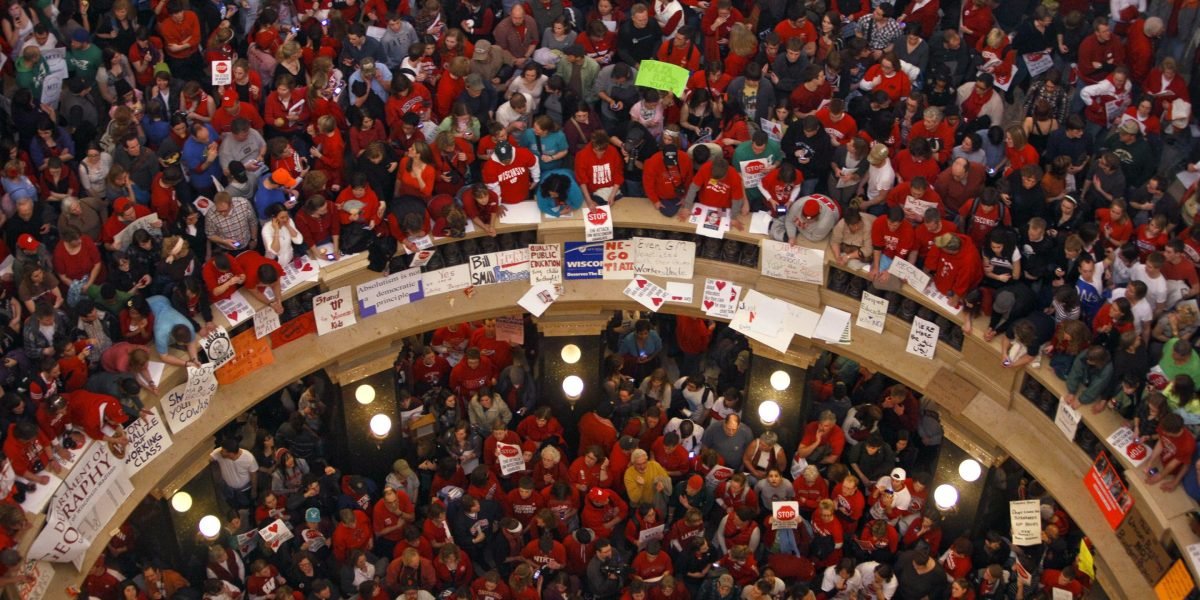
The law was proposed by Walker and enacted by the Republican-controlled Legislature in spite of massive protests that went on for weeks and drew as many as 100,000 people to the Capitol. The law has withstood numerous legal challenges over the years, but this was the first brought since the Wisconsin Supreme Court flipped to liberal control in 2023.
The seven unions and three union leaders that brought the lawsuit argued that the law should be struck down because it creates unconstitutional exemptions for firefighters and other public safety workers. Attorneys for the Legislature and state agencies countered that the exemptions are legal, have already been upheld by other courts, and that the case should be dismissed.
But Frost sided with the unions in July, saying the law violates equal protection guarantees in the Wisconsin Constitution by dividing public employees into “general” and “public safety” employees. He ruled that general employee unions, like those representing teachers, can not be treated differently from public safety unions that were exempt from the law.
His ruling Monday delineated the dozens of specific provisions in the law that must be struck.
Wisconsin Republican Assembly Speaker Robin Vos said he looked forward to appealing the ruling.
“This lawsuit came more than a decade after Act 10 became law and after many courts rejected the same meritless legal challenges,” Vos said in a statement.
Wisconsin Manufacturers and Commerce, the state’s largest business lobbying organization, also decried the ruling. WMC President Kurt Bauer called Act 10 “a critical tool for policymakers and elected officials to balance budgets and find taxpayer savings.”
The Legislature said in court filings that arguments made in the current case were rejected in 2014 by the state Supreme Court. The only change since that ruling is the makeup of Wisconsin Supreme Court, attorneys for the Legislature argued.
The Act 10 law effectively ended collective bargaining for most public unions by allowing them to bargain solely over base wage increases no greater than inflation. It also disallowed the automatic withdrawal of union dues, required annual recertification votes for unions, and forced public workers to pay more for health insurance and retirement benefits.
The law was the signature legislative achievement of Walker, who was targeted for a recall election he won. Walker used his fights with unions to mount an unsuccessful presidential run in 2016.
Frost, the judge who issued Monday’s ruling, appeared to have signed the petition to recall Walker from office. None of the attorneys sought his removal from the case and he did not step down. Frost was appointed to the bench by Democratic Gov. Tony Evers, who signed the Walker recall petition.
The law has also led to a dramatic decrease in union membership across the state. The nonpartisan Wisconsin Policy Forum said in a 2022 analysis that since 2000, Wisconsin had the largest decline in the proportion of its workforce that is unionized.
In 2015, the GOP-controlled Wisconsin Legislature approved a right-to-work law that limited the power of private-sector unions.
Public sector unions that brought the lawsuit are the Abbotsford Education Association; the American Federation of State, County and Municipal Employees Locals 47 and 1215; the Beaver Dam Education Association; SEIU Wisconsin; the Teaching Assistants’ Association Local 3220 and the International Brotherhood of Teamsters Local 695.
