
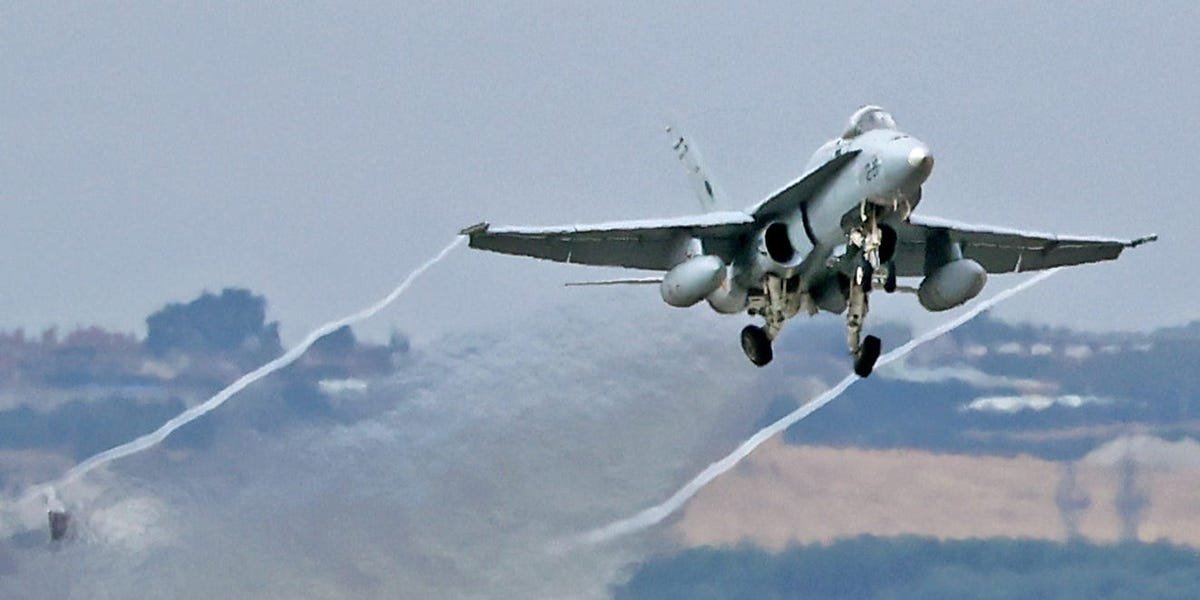
ŠIAULIAI AIR BASE, Lithuania — Lt. Col. Fernando Allen has logged over 1,000 hours flying the EF-18, an American-made fighter jet designed specifically for the Spanish air forces. He firmly believes it’s the “best machine ever made.”
Allen, the detachment commander of a Spanish Air Force wing deployed to Šiauliai Air Base to support NATO air policing operations, says the EF-18 fighter is perfect for intercepting fast-moving jets — or slow-flying drones.
“I think it’s the best multi-role asset because it’s very easy for the pilot to get all the info in the cockpit,” he told Business Insider during a visit to the air base this week. The jet’s screen layout, he explained, is what makes it simple.
Spain’s 15th Wing deployed to Šiauliai in Lithuania at the start of December for a four-month rotation to contribute to NATO’s Baltic Air Policing mission, designed to protect the airspace above and around Lithuania, Latvia, and Estonia — the Baltic nations on the front lines of the alliance.
Fighter jets are routinely scrambled on short notice from the Šiauliai base and other bases in the region to intercept Russian military aircraft flying over the Baltic Sea that aren’t using their transponders, haven’t filed official flight plans, or aren’t communicating appropriately with air traffic control.
Last year, NATO’s Air Command recorded more than 500 scrambles across allied airspace as part of its air policing missions and other defensive operations.
The 200-member Spanish detachment arrived at Šiauliai with 11 EF-18M fighter jets, upgraded versions of the twin-engine F/A-18 Hornet, designed by former American defense contractor McDonnell Douglas (which later merged with Boeing).
Joan Valls/Urbanandsport/NurPhoto via Getty Images
The fourth-generation F/A-18 made its first flight in the late 1970s and entered service with the US military in the early 1980s. The fighter jet has seen extensive combat experience across the Middle East and southeastern Europe and is flown by roughly half a dozen countries today.
Spain operates its own specialized version of the F/A-18 Hornet. The airframe of the EF-18 (“E” for España) is made in America, but Madrid has been responsible for upgrading and modifying the jets in the decades since it first purchased them, modernizing features such as the software.
The jet’s exterior may look the same as those flown by Finland or Canada, but the interior is completely different, with “all the latest technology,” said Allen, the detachment commander.
“It’s very easy to fly an F-18,” he said. “The most difficult part is to manage everything you have inside.”
‘You can fly very, very slow’
When the EF-18s deployed to Šiauliai are scrambled, it is usually in response to a nearby aircraft flying without identification or failing to follow — intentional or not — international rules. While most interceptions occur without incident, the fighters are armed, ready for a threat scenario.
The Spanish EF-18s are armed with an M61A1 Vulcan 20mm cannon and can be equipped with IRIS-T short-range air-to-air missiles and AIM-120 medium-range air-to-air missiles. The two missiles use infrared and radar homing technology, respectively.
The utility of combat-proven air-to-air weapons such as these was underscored in September when NATO fighter jets shot down Russian drones that crossed into Polish airspace during an attack against Ukraine.
Joan Valls/Urbanandsport/NurPhoto via Getty Images
The troubling incident sparked discussions among Western officials and military leaders about finding more cost-effective ways to shoot down cheap drones without relying solely on expensive jet-fired missiles.
“We can carry many air-to-air weapons, air-to-ground weapons,” Allen said. He praised the EF-18 fighter’s thrust, saying that the fighter can travel at both high and low speeds, the latter coming into play for a growing area of concern affecting alliance air policing missions.
“You can fly very, very slow,” Allen said. “For us, to intercept drones or small aircraft, it’s not easy, but it’s easier for us than any other aircraft.”
The EF-18 is the only fighter Allen has ever flown, but others under his command have had the opportunity to experience the capabilities of other airframes firsthand.
Lt. Arturo Guitán, an EF-18 pilot with the 15th Wing, told Business Insider he prefers his jet to the fourth-generation Eurofighter Typhoon, developed by a consortium of European defense firms, even though the latter is a more technologically advanced aircraft.
“We love it,” Guitán said of the EF-18, adding that the fighter is capable of performing all the mission requirements.
Countries contribute to the Baltic Air Policing mission on four-month rotations; the 15th Wing will be replaced in March by Romania and France. The Spanish fighter pilots began training for the job long before they deployed to Lithuania, routinely practicing for scrambles.
“We are honored to be here, and we are very proud to be part of this kind of mission,” said Lt. Jesus Ortín, another EF-18 pilot. “It’s a peacetime mission, so we are highly trained for this.”
Despite praise from pilots, Spain has gradually moved in recent years to replace its EF-18 fleet with orders for dozens of new Eurofighter jets. The country has also pivoted away from buying the stealth fifth-generation F-35 Lightning II, made by the US defense giant Lockheed Martin, opting instead for a European aircraft.
