
The president’s foreign policy agenda remains unpredictable, but his war on liberal culture has deep roots.
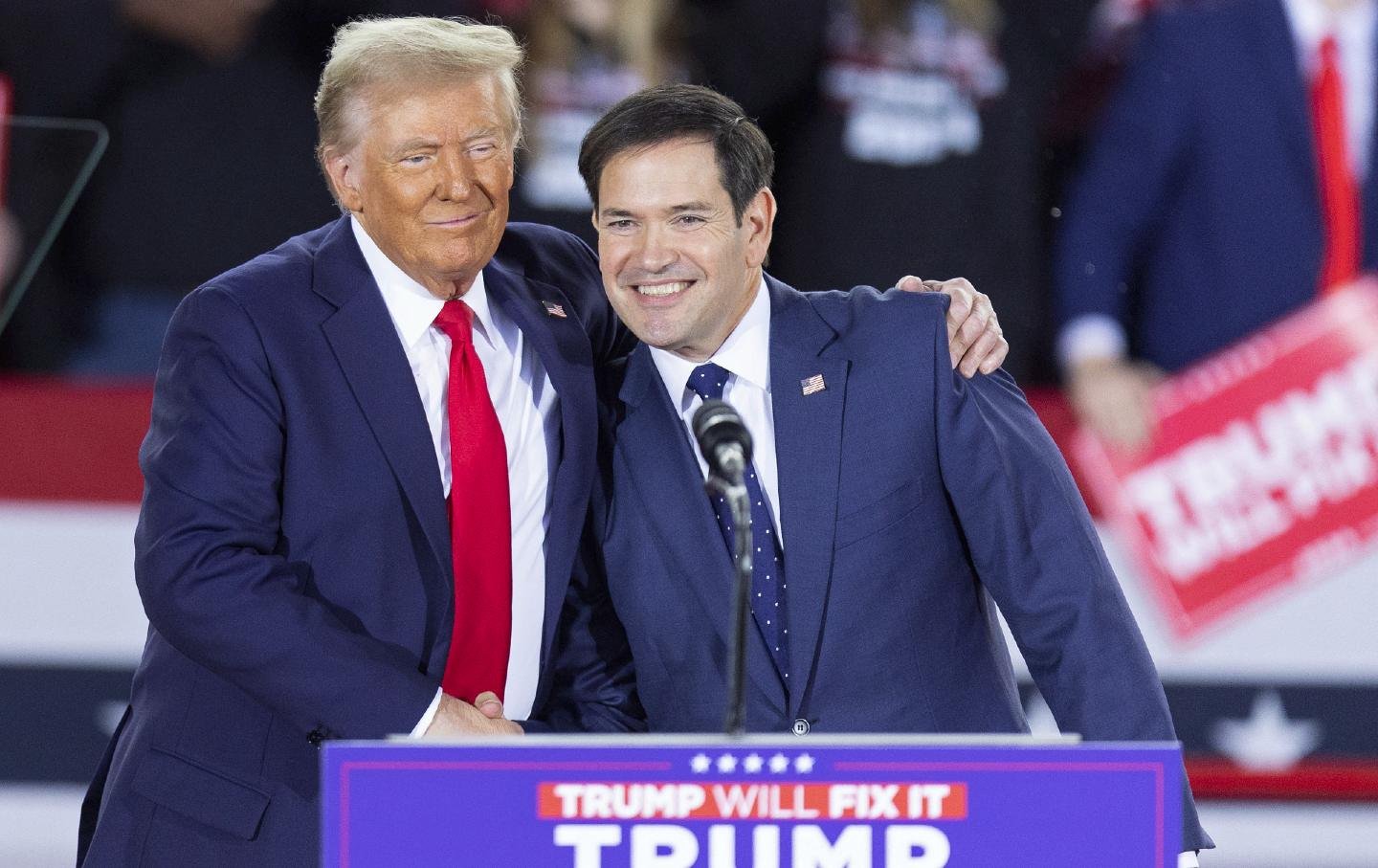
“Once They Were Neocons. Now Trump’s Foreign Policy Picks Are All ‘America First,’” read a New York Times headline published one week after Donald Trump’s victory over Kamala Harris last November. The report focused on three proposed Trump national security team nominees: Representative Michael Waltz for national security adviser, Senator Marco Rubio for secretary of state, and Pete Hegseth for defense secretary. All of whom, the article claimed, have apparently moved away from neoconservatism, which the Times characterized as an “ideology” that promotes “foreign interventions or the prospects of regime change.” This was the ideology that led George W. Bush’s administration to invade Iraq in 2003 in the wake of the 9/11 attacks, but per the Times, in the Trump era it has given way to a focus on “dealmaking.” On issues ranging from Ukraine to Afghanistan to China, Republican foreign policy elites have become less inclined toward grandiose military crusades to remake the world according to American ideals and more toward cold, pragmatic, transactional policies in line with narrow American interests—at least, that’s the story they want told about them.
What kind of foreign policy Trump will actually follow in his second administration remains an open question, and the record from his first administration offers contradictory evidence. As president, Trump often spoke sympathetically of Russian President Vladimir Putin and criticized NATO, but he also expanded arms sales to Ukraine. Trump tripled the pace of bombing in Afghanistan but also negotiated a rapid troop withdrawal; despite his saber-rattling against China, he praised President Xi Jinping’s authoritarian tendencies. His recent gestures toward expansionism within the Western Hemisphere—asserting territorial claims from Canada to Greenland to Panama—hardly suggest dovish instincts, but it’s hard to know how literally to take anything Trump says. He has taken advice in the past from figures whom the Times would call “America First” as well as figures it would call “neocons”—and most likely he will again.
The story of neoconservatism does have a lot to teach us about the current political moment, but “neoconservatism” as a shorthand for hawkish foreign policy—while widespread since the Iraq War—is far removed from what “neoconservatism” meant when it first came into common use during the 1970s. Back then, it served as a term of opprobrium among left-wing intellectuals like Michael Harrington, aimed at a cohort of their peers who, in response to the perceived excesses of the New Left over the previous decade, had mobilized for a reactionary defense of Cold War liberalism.
Some of the figures so described, like Daniel Bell or Daniel Patrick Moynihan, rejected the label even as they vocally expressed their distaste for the New Left, while others, most notably Irving Kristol and Norman Podhoretz, came to embrace it. In a 1976 article in Newsweek, Kristol attempted to define “neoconservatism” and came up with a list of five broad tendencies, the first four of which (a rejection of the Great Society welfare state, but not the New Deal; support for market-oriented policy reforms; reverence for Western high culture; and a preference for equality of opportunity over equality of outcome) had little to do with foreign policy. On foreign policy specifically, Kristol wrote:
Neoconservatism believes that American democracy is not likely to survive for long in a world that is overwhelmingly hostile to American values, if only because our transactions (economic and diplomatic) with other nations are bound eventually to have a profound impact on our own domestic and political system. So neoconservatives are critical of the post-Vietnam isolationism now so popular in Congress, and many are suspicious of “détente” as well. On specific issues of foreign policy, however, the neoconservative consensus is a weak one.
Relying solely on the above, it would be a stretch to extrapolate whatever logic—or wish-fulfillment—toppled Saddam Hussein’s regime and sent hundreds of thousands of US troops to occupy Iraq in an attempt to install Western-style democracy. Still, Kristol’s neoconservatism is capacious enough to include practically everyone working in Republican foreign policy today, regardless of disagreements—except insofar as it suggests more respect for American democracy and vaguely defined “American values” than Trump or some in his orbit have shown. I won’t recount here the long and complicated story of how a second generation of neoconservatives, including Kristol’s own son, came to advocate for a specific set of foreign policies that culminated in the Iraq War. Suffice it to say that since then, neoconservatism has usually meant something closer to the Times’ definition than what Kristol proposed half a century ago.
But there’s some value in considering that older definition—the one that had less to do with foreign policy than with what a group of mid-20th-century intellectuals perceived as a crisis in liberalism itself. The founding generation of neocons cared about foreign policy—mostly in the context of aggressively confronting the Soviet Union during a period when that seemed unfashionable—but they paid far more attention to what they saw as a breakdown in the domestic social order. Most of them had grown up before World War II in working-class, heavily Jewish immigrant milieus, often steeped in Marxist doctrinal debates. But as they came of age after the war they found themselves benefiting from the very liberal institutions they had once attacked from the left. By the mid-1960s, they had become leading national figures in intellectual fields ranging from sociology to literary criticism—just in time to see all those fields come under direct assault from a younger generation of relatively privileged left-wing activists and writers who, as the neocons saw it, outrageously and ungratefully rejected the blessings of American civilization at its height.
Current Issue
This rowdy New Left, the early neoconservatives asserted, heralded the emergence of a New Class of white-collar professionals whose irreverent vulgarity threatened to upend American life, and who would rapidly displace the blue-collar workers who had formed the social base of the Democratic Party’s New Deal coalition. Whether such a development was to be feared or welcomed at the time of this assessment, it’s hard to deny its prescience.
American foreign policy has passed through many phases since then: Vietnam-era domino theory giving way to Kissingerian détente; Ronald Reagan reigniting and then unexpectedly winding down the Cold War; American neoliberal hegemony interrupted by 9/11; and most recently, disillusionment over the War on Terror yielding either to neo-isolationism or a return to great-power confrontation. Among the elite foreign policy community, specific doctrines and personnel have continually shifted in response to particular events and challenges—not always aligning neatly with domestic political views. Meanwhile, the crisis of liberal institutions that set off the original neoconservative reaction has remained virtually constant over the same period, or at least has shown a tendency to recur and rhyme.
The 1968 campus uprising at Columbia University, spurred by generational divisions over civil rights and Vietnam, was a formative moment for the neoconservatives, and last year’s student uprising on the same campus over US support for Israel’s genocidal war on Gaza carried unignorable echoes. The issues at stake may have changed over 56 years, but the overall spectacle was rich with resonance: an Ivy League campus, an administration aligned with an unjust policy status quo, radicalized students seizing control of academic buildings, a brutal police crackdown, and an older cohort of faculty and alumni more appalled by the students’ conduct than by the overseas injustices that provoked it. Both times, campus upheaval was a harbinger of national politics: In 1968—as in 2024—a discredited incumbent Democratic president chose not to run for reelection, his vice president ran instead and lost, and a right-wing demagogue despised by liberals and leftists alike won over a silent majority of the electorate. Then as now, intellectuals split over whom to blame and what liberalism would mean going forward, with some eventually rejecting liberalism altogether.
This is the first edition of a new monthly column for The Nation in which I plan to trace our culture’s response to the pressures of today’s triumphant and proudly illiberal right, as well as to an increasingly disaffected and alienated left. Every institution that once served as a bulwark of elite liberalism—universities, newspapers, magazines, publishing houses, the arts, the legal profession, the entertainment industry, and government bureaucracies at all levels—is presently in a bad way, for reasons long preceding Trump’s victory. Each is divided between an aging old guard trying to protect its accrued status and a young, often radicalized cohort trying to secure a foothold—even as each institution declines in overall influence. Immense new fortunes minted in Silicon Valley have ultimately benefited a small clique of ultra-reactionaries who are openly hostile to the cultural and political power of the once-New Class. With Trump’s return to the White House, these tech oligarchs now have practically direct control over the administrative state, and there is every indication they will wield it against the actual constituencies that make up both the cultural establishment and the Democratic coalition.
This will have wide-ranging implications, including, no doubt, for US foreign policy. But the purview of this column will be the full range of cultural contradictions that so animated the first generation of neoconservatives and that remain unresolved. Right now, it can feel like a whole era is coming to a close, and like Trump represents a final, apocalyptic resolution of the dialectical forces that have divided Americans since the 1960s. It remains to be seen what—if anything—will be left standing.
