
This article is an on-site version of our Moral Money newsletter. Premium subscribers can sign up here to get the newsletter delivered three times a week. Standard subscribers can upgrade to Premium here, or explore all FT newsletters.
Visit our Moral Money hub for all the latest ESG news, opinion and analysis from around the FT
Welcome back.
In a pivotal debate a month before the US general election, Donald Trump’s running mate JD Vance chided sitting vice-president Kamala Harris for the current administration’s energy policy, which he said had encouraged too much reliance on imports of foreign clean tech. “We should be making more of those solar panels in the US,” he said.
In the final months of the Biden White House, Vance appears, at first glance, to be getting his wish. But underneath a surge in panel manufacturing are questions about the US’s ability to bring the industry onshore. For today’s newsletter, I report on the outlook for US solar manufacturing.
Plus, Patrick has the latest on US “woke” wars. — Lee Harris
The impact investing sector has been growing, with fund launches from the biggest private equity firms — but it still accounts for a small portion of the asset management industry. Can it gain much greater scale — and can it achieve competitive returns alongside social and environmental benefits? We explore those questions in our new Moral Money Forum deep-dive report.
Solar energy
Looking behind the US’s impressive solar panel numbers
Since the passage of the US’s landmark green investment law, the Inflation Reduction Act, one crucial test of its political viability — and whether it can survive the Trump administration — has been if it can help the US shed its reliance on imported clean energy technology.
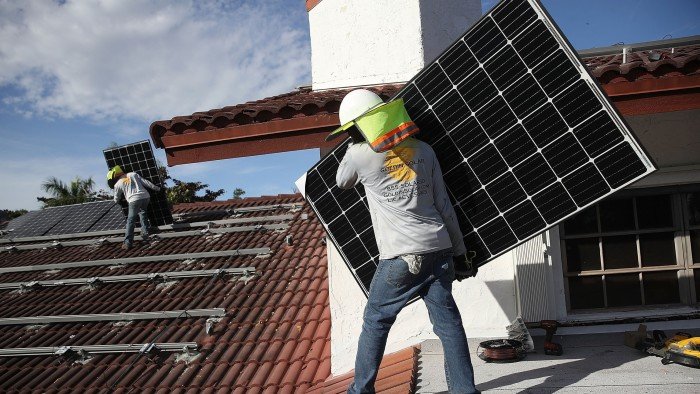
A new report by consultancy Wood Mackenzie and the Solar Energy Industries Association shows steps in that direction. This year, solar manufacturing has hit a critical threshold, with the assembly of panels (known in the industry as modules) closing in on levels that would meet domestic demand.
When run at full capacity, American solar module plants can now produce nearly 40 gigawatts each year, or enough to power the equivalent of about 8mn homes. (BloombergNEF forecast that US solar installation will reach 50GW this year). The industry added 9.3GW of new module manufacturing capacity in the third quarter of 2024 alone, boosted by First Solar’s September opening of a $1.1bn factory in Alabama.

But there is a big difference between building high-tech solar cells — the flat silicon arrays that turn sunlight into power — and assembling them into modules.
Module assembly is “the easiest step in the value chain”, Jenny Chase, lead solar analyst at BloombergNEF, told me. Meanwhile, US plants remain heavily reliant on imports of solar cells from south-east Asia.
The US restarted production of solar cells this year, for the first time since 2019, when Georgia-based Suniva resumed making the products at a factory where it hopes to increase output to 1GW a year. Multiple other suppliers have announced plans to build US solar cell factories to serve domestic module facilities.
However, that could be slow to arrive, SEIA said in the report, since “other manufacturers do not have the advantage of having an existing US factory as Suniva did”. Permitting and construction could take years, SEIA predicted. However, the association forecasts, if current producers can implement their plans, “the US will have over 90GW of cell capacity by 2028”.
Plus, US solar installations are levelling off, due to supply chain issues and delays hooking up to the grid. Over the next five years, the report projected, average annual growth will be essentially flat, at around 2 per cent. All this is before factoring in potential policy changes under Trump and the new Congress. (Lee Harris)
Diversity, equity and inclusion
US companies face mounting attacks over DEI
Simon wrote earlier this week about the stuttering progress around diversity on corporate boards. And the pushback against corporate efforts on diversity, equity and inclusion (DEI) appears to be gaining momentum.
Yesterday, a US judge in northern Texas rejected Boeing’s 737 Max plea deal, over the company’s diversity consideration in selecting a monitor to ensure corporate compliance. Boeing had already moved to disband its DEI department, while another US corporate giant, Walmart, has made a major cull of its own DEI policies.
Trump’s return to the White House is one factor. Another is looming litigation. In February, the Supreme Court is scheduled to hear oral arguments in an employment discrimination case, Ames v Ohio. The case involves a heterosexual woman, Marlean Ames, who alleged she was passed over for promotions in favour of gay people.
Given the conservative leaning at the Supreme Court today, “it is easy to predict how this is going to come out,” said Michael Delikat, a partner at Orrick, who co-founded the law firm’s DEI taskforce.
“This is a very significant legal risk for corporations,” he added. The court’s ruling is likely to “further embolden” people to bring reverse discrimination cases against their employers.
Other DEI attacks have been launched by Republican attorneys-general. In June, the Missouri attorney-general filed a lawsuit against IBM, alleging the computing giant uses unlawful racial and gender quotas. The case is ongoing.
Still, human resources officials at companies were trying to preserve DEI programmes, said Cynthia Soledad, global head of DEI at consultancy Egon Zehnder.
“What companies are trying to avoid is disengagement of their employees,” she said. Headlines about companies rolling back DEI could create cynicism among staff, Soledad added.
“We have definitely seen adjustments in language” on DEI, she said. Still, “companies continue to invest in their talent and cultures”. (Patrick Temple-West)
Smart reads
Rough winds Danish offshore wind group Ørsted’s recent history highlights the evolution of the energy sector — and some of the serious hurdles it faces in that transition.
Coffee crunch A new anti-ESG fund is set to make coffee chain Starbucks its main target.
Looking east Only China can now lead the world on climate, argues Adam Tooze.
Recommended newsletters for you
Full Disclosure — Keeping you up to date with the biggest international legal news, from the courts to law enforcement and the business of law. Sign up here
Energy Source — Essential energy news, analysis and insider intelligence. Sign up here
