
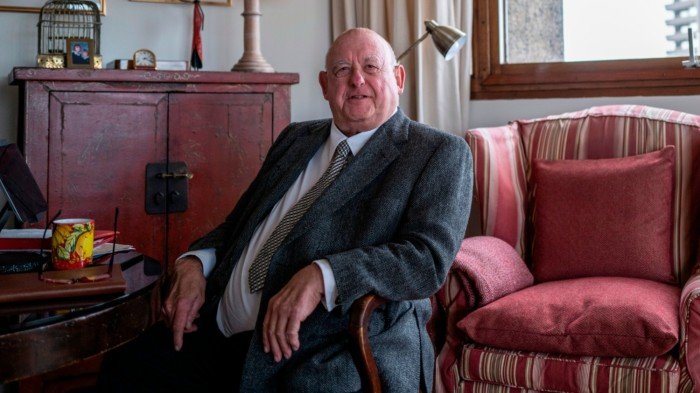
Michael Cassidy looks out from his 20th floor Barbican flat over the City of London, a square mile of prime real estate that bears the imprint of a remarkable 44-year political career.
Cassidy may be little known outside the City, but when he retired this month he was garlanded as a visionary who played a key role in transforming a tired financial district into the global behemoth it is today.
“We rebuilt a third of the City in five years,” said the man who helped lead the Square Mile through Big Bang, the challenge posed by Canary Wharf, IRA bombings and architectural battles with the future king.
Cassidy’s is a story of how the City reinvented itself for the modern age, while operating on a medieval street pattern, in a cramped geographical space defined by its Roman founders.
“It’s a great success story,” said Cassidy, who led the City of London Corporation in the 1990s and from 1986 held the key role as head of planning.
Elected in 1980 to the City of London Corporation — a body with roots in Norman times and where businesses have more votes than residents — Cassidy’s force of personality quickly came to the fore.

By the mid-1980s, then prime minister Margaret Thatcher was on the verge of transforming Britain’s financial services industry with her Big Bang reforms, but Cassidy said the City was woefully unprepared.
“There was a draft City plan that was completely out of touch with what developers and occupiers wanted,” he told the Financial Times. “So we set about demolishing it.”
Instead of Edwardian-style offices, Cassidy realised that Big Bang would require “big trading floors, which we’d never had before”, with clear floors, taller ceilings and cable space under the floors.
Sir Stuart Lipton, one of the UK’s leading property developers, said: “Michael had a real vision. He knew the City was changing. At that time Portland stone was the building material. He wanted quality but he wanted to vary the style.”
Cassidy appointed Peter Rees, a young architect, to assist with the revolution as chief planning officer to change the City’s skyline and push through redevelopments such as the one at Broadgate.

“You know, we gave 4mn square feet of consent in one meeting,” Cassidy chuckled. “I was very keen on bringing about immediate change, otherwise we were going to be too late.”
The City of London was not just facing competition from New York but also from a brash new financial district taking shape a few miles along the Thames at Canary Wharf.
To illustrate the threat, Cassidy invited G Ware Travelstead, the US promoter of Canary Wharf, to a dinner at the ancient Guildhall, home to the City of London Corporation, to address the assembled aldermen and Lord Mayor.
“I’ll never forget what he said to them — in their own dining room,” Cassidy recalled. “I’m going to build Wall Street on the water and steal all the banks off you folk.
“It was a convenient factor for me to bash people over the head who weren’t getting my point. I would threaten them with Canary Wharf, as a sort of tactical move,” he added.
One opponent of Cassidy’s vision was the Prince of Wales — now King Charles III — who railed against modern architecture in a City of London previously noted for its conservatism.
Cassidy claims the heir to the throne wanted to redevelop an old bomb site at Paternoster Square with “French-style boulevards” in an area typified by narrow medieval lanes. “He was not rational,” Cassidy said.
In a bold move, Cassidy invited Charles to speak at Mansion House in an attempt to show “that at least we were prepared to listen to HRH and his very, very particular viewpoint”.
The Prince of Wales did not hold back. “You have to give this much to the Luftwaffe,” he told the City grandees. “When it knocked down our buildings, it didn’t replace them with anything more offensive than rubble.”


But the transformation of the City continued in the face of royal disapproval, aided by the 1992 IRA bombing of the Baltic Exchange, which cleared the way for a future landmark office block: the Gherkin.
“That was transformational,” Cassidy said. “It was a happy coincidence, let’s say, but we don’t want to give the IRA too much credit for it.”
The City’s geography — and a law that protects views of St Paul’s Cathedral — has led to a cluster of tall new buildings grouped to the east of Wren’s masterpiece.
Cassidy, who contracted polio at two years old and spent many of his early years in hospital, applauds the St Paul’s height restriction, but admits that sort of thing would not be so “religiously pursued in New York”.
Tony Blair’s arrival in Downing Street in 1997 created new challenges, notably a plan by Labour to abolish the ancient corporation and make it more recognisably democratic.
Cassidy defends the corporation’s odd structure, saying it helps to provide “a complete commonality between the geographical area and the prime objectives of a major world financial centre”.
He spent five years wooing New Labour and successfully fending off the reform, dispensing money from the Square Mile to neighbouring London boroughs to earn goodwill.
Projects like the Millennium Bridge — briefly known as the “wobbly bridge” because of a design flaw — and affordable housing projects in poorer areas of the capital followed.

It was not until 2000 that London had an elected mayor and, in the absence of citywide government, Cassidy’s City played a role in promoting big projects including the new Wembley Stadium.
He said he also persuaded Gordon Brown, then the new Labour chancellor, to back the Crossrail project that now links the financial district with Heathrow and a vast urban hinterland.
“Gordon Brown could see the huge revenues coming out of the City and he could see Crossrail would help,” he recalled.
Cassidy says the City has grown stronger, developing a tech sector, building on its excellence in law and insurance and riding out Brexit: “We could have done without it but we’ve actually survived.”
He supports a new proposal to close the ancient meat market at Smithfield and to buy out the traders, arguing that “this method of delivering meat to the public was about to become completely defunct”.
From his vantage point at the brutalist Barbican centre he will be able to watch the City skyline evolve again. He argues that even after Covid-19 and the homeworking revolution, the City will continue to thrive.
Doubts have also been raised about London’s strength as a capital market with a sharp decline in listings, but he said the City founded under Emperor Claudius shows no sign of fading away.
“We’re approving one big new building per month,” he said. “They are occupied as soon as they are built. We are seeing the skeleton of a story which is as positive as I can remember.”
