Close Menu
    What's Hot

    Software revenue stemming from activity rather than seat count best defended from AI disruption: KeyBanc

    March 26, 2026

    Uber, Lyft, DoorDash Offer Incentives As Gas Prices Squeeze Drivers

    March 26, 2026

    Fannie Mae Now Accepts Crypto as Mortgage Collateral: But There Is a Catch That Could Cost You Thousands

    March 26, 2026
    Facebook X (Twitter) Instagram
    Hot Paths
    • Home
    • News
    • Politics
    • Money
    • Personal Finance
    • Business
    • Economy
    • Investing
    • Markets
      • Stocks
      • Futures & Commodities
      • Crypto
      • Forex
    • Technology
    Facebook X (Twitter) Instagram
    Hot Paths
    Home»Money»Vintage Photos Show How Different Life Looked 100 Years Ago
    Money

    Vintage Photos Show How Different Life Looked 100 Years Ago

    Press RoomBy Press RoomMarch 30, 2025No Comments18 Mins Read
    Facebook Twitter Pinterest LinkedIn Tumblr Email
    Share
    Facebook Twitter LinkedIn Pinterest Email

    Updated

    2025-03-30T14:12:01Z

    This story is available exclusively to Business Insider
    subscribers. Become an Insider
    and start reading now.

    Have an account? .
    • Life in the 1920s was defined by many cultural, political, and economic developments.
    • Jazz music and flapper fashion defined the era’s sound and look.
    • The Harlem Renaissance brought popularity to art created by Black Americans.

    The Roaring Twenties — now 100 years ago — looked vastly different than our world today.

    Coming after a war-torn decade where military efforts redefined women’s role in society, the 1920s saw a period of cultural and social realignment.

    The decade brought artistic, cultural, and technological advancements in the form of jazz, new voting rights, radio, and more. But while the decade is best known for its glitz and glamour, there’s a darker side to its history, too, that includes many of the same societal issues the world continues to grapple with, like racism, sexism, and wealth disparities.

    Take a look at these vintage photos that show society’s progress, the simple pleasures we all still enjoy, and where we can look to improve in the next century to come.

    Suffragettes rallied for women’s right to vote in America.


    Suffragette Protesting 1920

    A flag and ballot box supporting women’s suffrage.


    Universal History Archive/Universal Images Group via Getty Images

    On August 18, 1920, the 19th Amendment was ratified, granting women the right to vote. However, the law largely applied to white women, as Black women, Indigenous women, and other women of color were prohibited from voting for many decades to come.

    Suffragettes across the US celebrated the moment the 19th Amendment was ratified.


    suffrage 19th amendment

    Women wave American flags to celebrate the ratification of the 19th Amendment.


    Bettmann/Contributor/Getty

    Here, a photographer captured celebrations after the newly ratified 19th Amendment in August 1920.

    Women also broke tradition with short hairstyles, which defined the look of the Roaring Twenties.


    Woman getting her hair cut in the 1920s.

    Many women opted for getting their hair “bobbed” during the decade.


    PhotoQuest/Getty Images

    With the rise in women’s liberation movements came a wave of modernist short hairstyles.

    Luxe fabrics, flapper girl silhouettes, and art-deco style dominated the fashion world.


    1920s fashion

    A woman wearing a fur coat and hat in the ’20s.


    Popperfoto via Getty Images/Getty Images

    In the Roaring Twenties, fashion was characterized by fringe, loose fabrics, and glamorous details. The garments differed immensely from the athleisure and street style-inspired looks that fill clothing racks today. But as fashion historians explain, trends are cyclical — ’20s-inspired clothes could (and will likely) make a comeback into mainstream fashion again.

    Swimwear became more form-fitting.


    Two women at a beach.

    Two women at a beach in the early 1920s.


    Universal History Archive/Universal History Archive/Universal Images Group via Getty Images

    Prior to the 1920s, women’s bathing suits often included stockings and full-length skirts.

    With an increase in popularity in water activities, the decade saw a rise in swimwear fashion styles with less fabric, making it more comfortable for wearers to swim.

    Wedding-dress styles from the ’20s included ornate headpieces.


    wedding dresses 1920

    Brides and grooms gathered in the St. George Church on Christmas Day in 1920.


    Gamma-Keystone via Getty Images

    Brides Magazine reported that beaded headbands were common additions to wedding gowns during the Jazz Age, as were dresses with high necklines and cape- or flutter-style sleeves.

    The decade also marked a new era of automobile advancements.


    chrysler car 1920s style fashion

    A woman with a Chrysler vehicle, circa 1920s.


    Gamma-Keystone via Getty Images

    The 1920s are often looked at as one of the most influential decades of automobile advancements.

    The Model T vehicle defined much of the 1920s — it was sold until 1927.


    model T 1921 tudor san francisco car

    A Ford Model T descending a hill in San Francisco, circa 1921.


    Underwood Archives/Getty Images

    The Model T was sold by the Ford Motor Company 1908 until 1927, per History.com. The vehicle was the earliest effort to make a modern car that was affordable to the masses.

    As explained by the History Channel, the Model T was so affordable that it helped rural Americans connect to other parts of the country, which eventually led to the creation of the numbered highway system that’s known throughout the US today.

    Long before Uber and Lyft, cabs were stylish vehicles.


    woman gets into cab 1920s car

    Cabs looked a tad different than they do now.


    Dick Whittington Studio/Corbis via Getty Images

    Here, a woman was photographed outside a cab vehicle in Los Angeles, circa 1925.

    The shift from rural to urban living was prominent in the 1920s.


    Aerial view of lower Manhattan, New York City, 1923.

    Aerial view of lower Manhattan, New York City, 1923.


    FPG/Staff/Getty Images

    The US Census Bureau reported that the 1920 census marked the first time over 50% of Americans reported living in urban areas compared to rural ones.

    Public transportation advancements gave people new ways to travel around cities.


    london tube entrance 1924 subway station

    A London Underground entrance.


    Topical Press Agency/Getty Images

    Pictured here is a subway entrance in London, circa 1924. Transport for London reported that the city’s Underground was the first subway in the world, having opened in 1863.

    Beyond underground trains, rail trains were also a central part of life in the 1920s.


    train travel 1920s

    Rail trains were a popular mode of transportation in the 1920s.


    JHU Sheridan Libraries/Gado/Getty Images

    Here, a group of employees stand in front of a train in 1920.

    Train travel in the 1920s was often comfortable and glamorous compared to the cramped cars that many commuters know today.


    new york rail commuters 1920s

    Commuters on a train, circa 1920s.


    Historica Graphica Collection/Heritage Images/Getty Images

    Train travel was arguably its most glamorous from 1910 through 1950.

    However, much of public transportation has stayed the same over the decades, like the realities of crowded bus and subway stops.


    1920s chicago group of people bus stop

    Waiting at the bus stop.


    Kirn Vintage Stock/Corbis via Getty Images

    Here, a group of people wait to board a bus in Chicago around 1925.

    Fire engines in the 1920s looked much more ornate than today’s modern, large trucks.


    fire truck pittsburgh

    Firefighters in Pittsburgh, Pennsylvania, circa 1920.


    Underwood Archives/Getty Images

    Here, members of a fire department in Pittsburgh, Pennsylvania, were photographed around 1920.

    Prohibition banned the manufacture, sale, and transportation of alcohol within the US until 1933.


    prohibition 1920s

    People by a Prohibition sign reading, “No booze sold here.”


    Ullstein Bild/Getty Images

    Prohibition went into effect in 1920 with the 18th Amendment. Until it was repealed in 1933, the law greatly impacted American culture and society, giving way to organized crime and speakeasies.

    Prohibition led people to create speakeasies, or secret bars where they could drink in private.


    1920s speakeasy

    A speakeasy cellar, circa 1920.


    Bettmann / Contributor

    Here, people drink at a speakeasy around 1920.

    In the 1920s, drugstores weren’t only places to pick up prescriptions — they were also soda and candy counters.


    drug store chemist

    Frankfurt Pharmacy in Rosemead, California, in 1927.


    Universal History Archive/Universal Images Group via Getty Images

    Drugstores weren’t just places to grab quick convenience items like they are today; they were central gathering spots in the community. At a 1920s-era pharmacy, customers could sit at the counter and enjoy a root beer float or an egg cream.

    These pharmacies of a bygone era were much more ornately decorated — with marble countertops and beautiful light fixtures — than the fluorescent lighting-clad drugstores of today.

    General stores were the go-to spots for workers, food, and household items.


    general store 1920s

    A group of people gathered in a small general store, Utica, Mississippi, circa 1920.


    Underwood Archives/Getty Images

    General stores became less common after the 1920s, but throughout the decade, they were still popular for various goods for farmers and industrial workers, as well as equipment and food.

    Schools for young students around 1920 were typically large classrooms that fit as many pupils as possible.


    kids students classroom 1920s

    Young students in a classroom, circa 1920.


    JHU Sheridan Libraries/Gado/Getty Images

    At the time, classrooms and schoolhouses were designed to hold as many students as possible to maximize space.

    But in the 1920s, more educators and administrators started to support “progressive” schools that were built to house programs that were new at the time, allowing more open-air, light, and access to outdoor activities, per a 2012 report from the National Institute of Building Sciences about school design.

    The `1920s saw the birth of historic figures, such as Queen Elizabeth II, who was born in 1926.


    Queen elizabeth II in 1929

    Queen Elizabeth II (then Princess Elizabeth) with her grandmother in 1929.


    Edward G. Malindine/Topical Press Agency/Getty Images

    Here, the Queen — then known as Princess Elizabeth — was pictured in 1929 at a train station, apparently on the way to the family’s Sandringham Estate for Christmas.

    Prominent civil rights leader Martin Luther King Jr. was also born in the 1920s.


    Martin Luther King Jr. delivering a speech at UC Berkeley's Sproul Plaza in 1967.

    Martin Luther King Jr. delivering a speech at UC Berkeley’s Sproul Plaza in 1967.


    Michael Ochs Archives/Stringer/Getty Images

    He was born on January 15, 1929, in Atlanta and became one of the most important figures in the Civil Rights Movement during the ’50s and ’60s.

    A hundred years ago, the Charleston was the dance of choice.


    charleston dance 1920s man woman

    The iconic Charleston dance move.


    Bettmann / Contributor

    Here, two people photographed around 1926 do the Charleston dance.

    The moves came from a song in the Broadway show “Runnin’ Wild.”


    girls dancing the charleston in harlem 1920

    A group of girls dancing in Harlem, New York City, circa 1920s.


    NY Daily News Archive via Getty Images

    Per the Charleston County Public Library, it became a mainstream dance after the musical’s release in 1923 and defined the rest of the decade.

    Jazz music was the most popular genre of the decade.


    louis armstrong

    American jazz musician Louis Armstrong poses on stage with a band for the WMSB radio station in New Orleans, Louisiana, 1920s.


    Transcendental Graphics/Getty Images

    Jazz music dominated 1920s culture in America thanks to popular musicians like Louis Armstrong.

    The genre was a key feature of the Harlem Renaissance, which encompassed music, literature, and art created by Black Americans.


    Left to right: Honore Dutrey, Baby Dodds, King Oliver, Louis Armstrong, Lil Hardin, Bill Johnson, and Johnny Dodds.

    King Oliver’s Creole Jazz Band in Chicago circa 1923. The band included Honore Dutrey, Baby Dodds, King Oliver, Louis Armstrong, Lil Hardin, Bill Johnson, and Johnny Dodds.


    JP Jazz Archive/Contributor/Redferns

    The National Museum of African American History and Culture reported that after the end of the Civil War, the Great Migration brought over 100,000 Black Americans from a wide variety of backgrounds to Harlem, New York City.

    Throughout the 1920s and ’30s, Black creatives across disciplines shared their art en masse, documenting what it was like to be Black in America during a period known as the Harlem Renaissance.

    Iconic works from the likes of Nella Larsen, W.E.B. Du Bois, Zora Neale Hurston, and more were all produced during this era.

    However, throughout the 1920s, Black people continued to face barriers like segregation, discrimination, and even violence.


    Segregated waiting rooms in Rosslyn, Virginia, circa 1928.

    Segregated waiting rooms in Rosslyn, Virginia, circa 1928.


    Bettmann/Contributor

    In the photo above, the waiting room on the right was designated for “Colored” individuals while that on the left was for white people.

    Segregation was a prominent aspect of life in the US following the Civil War, especially in the South where Jim Crow laws were harshly enforced.

    Other minority groups also faced discrimination. Below are Japanese “picture brides” who immigrated to the US in 1920 to marry American men as a result of exclusionary immigration laws.


    Japanese picture brides having their passports investigated by members of Congress in 1920.

    Japanese picture brides having their passports investigated by members of Congress in 1920.


    Bettmann/Contributor

    Immigration from Japan to the US was largely limited during the 1920s as a result of the 1907 Gentlemen’s Agreement.

    However, it had an exception for Japanese wives of current American residents, which led to the practice of American men choosing Japanese women to be their wives solely based on photos.

    Many of the Japanese “picture brides” faced discrimination, spousal abuse, and poor living conditions upon arrival to the US, Women & the American Story reported.

    Such marriages were made illegal by the 1924 Immigration Act, which barred any immigrant who wouldn’t be eligible for citizenship from coming to the US.

    People of Asian descent were denied full US citizenship until the 1950s.

    The year 1920 also saw the first Olympic Games since before World War I.


    1920 summer olympics antwerp belgium

    Swimmers at the 1920 Olympic Games in Antwerp, Belgium.


    Bob Thomas/Popperfoto via Getty Images/Getty Images

    After the 1916 Olympic Games were canceled due to World War I, the 1920 summer Olympics were set in Antwerp, Belgium, as a way to honor “the suffering that had been inflicted on the Belgian people during the war,” the Olympics reported.

    It was also the first year the Olympic Rings symbol was publicly displayed.

    Back then, sporting equipment like tennis balls, footballs, and other athletic gear was often handmade.


    Tennis sports 1920s

    Workers carried freshly manufactured tennis balls.


    General Photographic Agency/Hulton Archive/Getty Images

    Here, people carry newly manufactured tennis balls.

    In the 1920s, athletic wear was very different from the nylon pants we’re familiar with now.


    sports 1920s

    A football team lined up for a portrait in Winchester, Kentucky, 1921.


    Underwood Archives/Getty Images

    Pictured here, a football team poses in sporting uniforms at Oliver High School in Kentucky in 1921.

    Gym class appeared much more elegant in the ’20s than it is today.


    gym class in 1920s

    People throwing balls in sync in a 1920s gym class.


    Time Life Pictures/Mansell/The LIFE Picture Collection via Getty Images

    This looks way more sophisticated than a sweaty game of kickball.

    Horse races were a ritzy leisure activity that often involved fabulous outfits and hats.


    fashion 1920s

    A woman wearing a voluminous feather hat at a horse race.


    Topical Press Agency/Getty Images

    Here, people attend a horse race at Ascot Racecourse in Ascot, England, around 1920.

    In the 1920s, a trip to the fair became a popular pastime. Fairgoers could go for a spin on the carousel …


    people enjoy a fair ride in 1920

    People enjoying a fair attraction, circa 1920.


    Central Press/Getty Images

    Carnivals and state and county fairs in the US were popular summertime activities during the early 20th century.

    … or make a go-around on bumper cars.


    dodgem bumper cars 1920

    People ride bumper cars, circa 1925.


    Kirn Vintage Stock/Corbis via Getty Images

    USA Today reported that Coney Island’s Luna Park is believed to have had one of the first bumper car attractions.

    Coney Island in Brooklyn represented a new era of entertainment at the turn of the 20th century in America.


    coney island 1920s

    Advertisements at Coney Island, circa 1920s.


    Irving Browning/The New York Historical Society/Getty Images

    Coney Island was an iconic part of the early 20th century that transformed how Americans spent their free time.

    Here, groups of couples competed in a dance contest at the Coney Island boardwalk.


    coney island couples dancing

    People dancing at the Coney Island boardwalk, circa 1928.


    Bettmann / Contributor

    The Brooklyn park gave locals and visitors new ways to stay entertained and spend time with one another in the form of roller coasters and rides, animal exhibits, and a lively boardwalk and beach.

    Here, women competed at a patriotic-looking beauty pageant at Coney Island.


    miss coney island 1920s

    Women at a Miss Coney Island pageant.


    Bettmann / Contributor

    Miss Coney Island 1924 and 1925, respectively, appeared to stand on the Coney Island boardwalk sometime during the mid-1920s.

    Long before the days of Instagram, photographers captured the moment at county fairs.


    people at a fair photographer 1920

    All smiles at a county fair, circa 1920.


    H. Armstrong Roberts/Retrofile/Getty Images

    This snapshot from around 1920 shows fair attendees having their picture taken.

    Spending time at the beach in the ’20s sometimes meant catching shrimp with huge nets, apparently.


    swimming 1920 family

    A family at a beach around 1920.


    The Montifraulo Collection/Getty Images

    Around 1920, a family was photographed at a beach in Germany holding up shrimping nets.

    Silent films dominated the movie industry in the 1920s …


    silent film

    The filming of a German silent film in the 1920s.


    ullstein bild/ullstein bild via Getty Images

    The National Endowment for the Humanities reported that the silent film era began in 1894 and continued through the 1920s. Before there were “talkies,” audiences were dazzled by films starring actors like Charlie Chaplin and Clara Bow.

    … but the decade also saw the transition to the “talkies,” or movies with spoken dialogue.


    the jazz singer scene 1927

    A scene from “The Jazz Singer,” 1927.


    John Springer Collection/CORBIS/Corbis via Getty Images

    In 1927, “The Jazz Singer” became the first feature-length movie to feature dialogue scenes, marking a transition from the silent film era, per the Museum of Modern Art.

    The World reported that the first film (that wasn’t a feature-length movie) with talking scenes was actually created in 1898 by Alice Guy-Blaché.

    As film began to include sound, musical movies captured the hearts of audiences.


    movie filming 1920

    A shot from the filming of a movie with dancers, circa 1920.


    Hulton Archive/Getty Images

    Musical movies produced in the late 1920s, like “Broadway Melody,” continued to push “talkies” into the mainstream.

    Vaudeville, which consisted of short acts of dancers, musicians, magicians, and comedians, was also a popular form of entertainment.


    The Dolly Sisters Vaudeville performance entertainment in 1920s

    The Dolly Sisters were German Vaudeville performers.


    adoc-photos/Corbis via Getty Images

    The Dolly Sisters, pictured here, were famous vaudeville performers in the early 20th century.

    Another iconic vaudeville production during the 1920s was the Ziegfeld Follies, PBS reported, which preceded the modern Broadway musical and helped launch the career of many theatrical stars of the time.

    Leo, the lion that became a symbol of MGM Studios, made his debut in 1927.


    leo lion mgm filming 1920

    The first MGM lion was named Leo.


    Bettmann / Contributor

    MGM’s first lion named Leo was shown on screen in 1927, per The Hollywood Reporter.

    Circus shows also featured animals 100 years ago.


    1920s circus elephant

    A woman is held up by elephants at a circus in 1926.


    ullstein bild/ullstein bild via Getty Images

    In the almost 100 years since this photo was taken, some states in the US have banned the use of animals in circuses, while others have enacted partial bans.

    The famous Ringling Bros. and Barnum & Bailey circus show, “The Greatest Show on Earth,” shut down in May 2017 after 146 years of shocking the nation with its acrobatic and animal performances. It reopened five years later, but without animals.

    In recent years, changing attitudes toward animal rights, as well as high operating costs of shows, and declining attendance rates, have led to the demise of the circus.


    coney island women with pigs

    Women outside of a circus in New York.


    Bettmann / Contributor

    Here, women are photographed holding pigs outside of a circus in New York around 1920. 

    Before modern conveniences like central air conditioning, people found creative ways to stay cool in the summer, like this group of women who appeared to be sitting on a chunk of ice.


    women cool off on ice 1920s

    A group of women on a golf course, circa 1920.


    Library of Congress/Corbis/VCG via Getty Images

    Willis Carrier invented the first air conditioner in 1902, but it wasn’t until 1929 that Frigidaire introduced a unit that was suitable for use in homes, the US Department of Energy reported.

    Any curiosity about what was going on in the world required a look at the daily newspaper.


    newspaper

    Josephine Baker reading a newspaper in 1928.


    Bettmann/Contributor

    People relied on newspapers for local, national, and global updates, as well as advice columns, entertainment, and other stories.

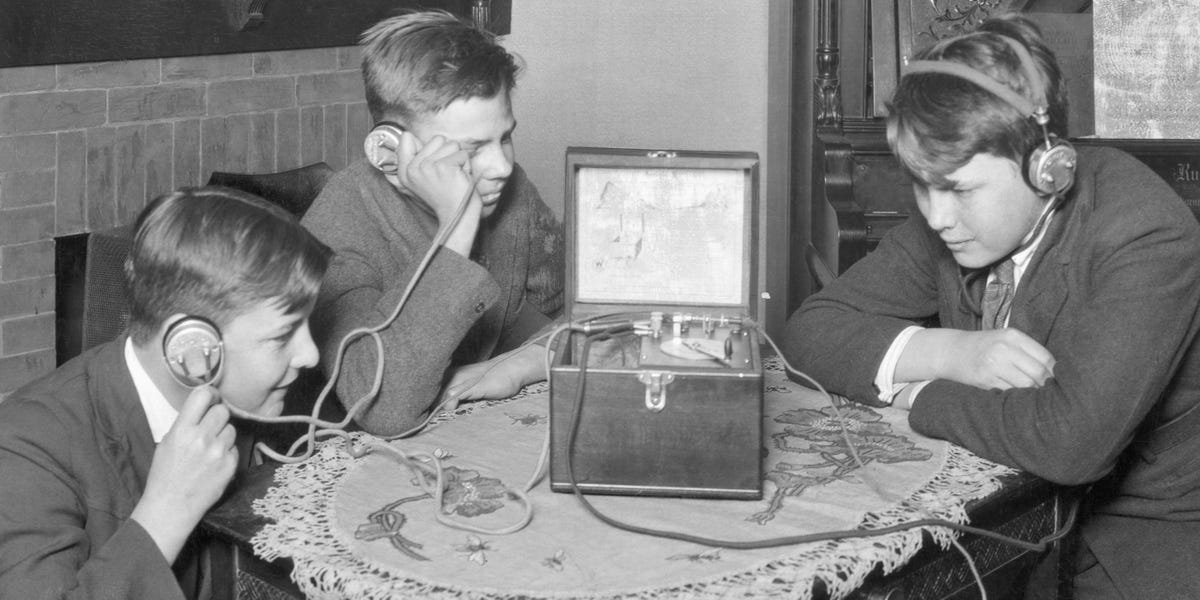
    The world’s first commercial radio broadcast was made in 1920.


    frank conrad radio braodcast kdka

    Frank Conrad, the founder of KDKA radio station.


    Bettmann/Contributor/Getty Images

    The Pennsylvania Center for the Book reported that Pittsburgh radio station KDKA produced the world’s first radio broadcast on November 2, 1920.

    Frank Conrad is known as the “father of radio broadcasting” for inventing the first station, which was located in his garage.

    Throughout the ’20s, radio continued to expand, changing the way people received the news, communicated, and connected with pop culture.


    First Black Radio Station Operator

    Rufus P. Turner was a student at the Armstrong Technical High School.


    Library of Congress/Corbis/VCG via Getty Images

    Per MIT Black History, Rufus P. Turner was the first Black radio station operator. He began operating his station, W3LF, in Washington, DC, in 1928.

    Telephones looked just a tad different from the smartphones we know today.


    woman using telephone 1920s

    A woman uses a mobile-type telephone in London, circa 1920.


    Keystone-France/Gamma-Keystone via Getty Images

    Phones of the 1920s and ’30s were characterized by their rotary dials and “spit cup” receivers.

    Being a switchboard operator was a common job for many women in the early 1920s.


    1920s telephone switchboard operators

    Telephone switchboard operators, circa 1920.


    GraphicaArtis/Getty Images

    Being a switchboard operator often required saying the phrase “number please” hundreds of times per hour for eight hours a day, according to a 1922 op-ed in The New York Times, as cited by Time.

    Kitchen appliances were much different than they are now.


    cooking school 1920s kitchen

    Women at the Soho School of Cookery in London in the 1920s.


    FPG/Getty Images

    The beginning of the 20th century brought many advancements to the home — from gas ranges to the advent of refrigerators, which became commonplace in homes by the 1920s — but kitchens certainly didn’t have the multi-functional, high-tech gadgets many homes are equipped with today.

    While much has changed in the past century, from cars and technology to pastimes, many of the simple pleasures of life have remained constant, like getting ice cream from a snack stand …


    kids ice cream soda stand paris 1920

    A summer day in Paris.


    Harlingue/Roger Viollet via Getty Images

    Here, kids were photographed at a soda stand on a street in Paris around 1920.

    The only thing that would make this sweeter was if Coca Cola still cost a nickel.

    … and catching up with good company at a café.


    cafe paris circa 1920

    Women at a café in Paris, circa 1920.


    Branger/Roger Viollet via Getty Images

    Here’s to all the changes and all the lasting pleasures of the next 100 years.

    Share. Facebook Twitter Pinterest LinkedIn Tumblr Email
    Press Room

    Related Posts

    Uber, Lyft, DoorDash Offer Incentives As Gas Prices Squeeze Drivers

    March 26, 2026

    Judge Offers Clearest Look yet at Stakes in Anthropic Vs Pentagon

    March 26, 2026

    US Needs a ‘Whole New Workforce’ to Win AI Race, Meta’s President Says

    March 26, 2026
    Leave A Reply Cancel Reply

    LATEST NEWS

    Software revenue stemming from activity rather than seat count best defended from AI disruption: KeyBanc

    March 26, 2026

    Uber, Lyft, DoorDash Offer Incentives As Gas Prices Squeeze Drivers

    March 26, 2026

    Fannie Mae Now Accepts Crypto as Mortgage Collateral: But There Is a Catch That Could Cost You Thousands

    March 26, 2026

    U.S. natural gas inventory net change of -54 Bcf for week ended March 20 – EIA

    March 26, 2026
    POPULAR
    Business

    The Business of Formula One

    May 27, 2023
    Business

    Weddings and divorce: the scourge of investment returns

    May 27, 2023
    Business

    How F1 found a secret fuel to accelerate media rights growth

    May 27, 2023
    Advertisement
    Load WordPress Sites in as fast as 37ms!

    Archives

    • March 2026
    • February 2026
    • January 2026
    • December 2025
    • November 2025
    • October 2025
    • September 2025
    • August 2025
    • July 2025
    • June 2025
    • May 2025
    • April 2025
    • March 2025
    • February 2025
    • January 2025
    • December 2024
    • November 2024
    • April 2024
    • March 2024
    • February 2024
    • January 2024
    • December 2023
    • November 2023
    • October 2023
    • September 2023
    • May 2023

    Categories

    • Business
    • Crypto
    • Economy
    • Forex
    • Futures & Commodities
    • Investing
    • Market Data
    • Money
    • News
    • Personal Finance
    • Politics
    • Stocks
    • Technology

    Your source for the serious news. This demo is crafted specifically to exhibit the use of the theme as a news site. Visit our main page for more demos.

    We're social. Connect with us:

    Facebook X (Twitter) Instagram Pinterest YouTube

    Subscribe to Updates

    Get the latest creative news from FooBar about art, design and business.

    Facebook X (Twitter) Instagram Pinterest
    • Home
    • Buy Now
    © 2026 ThemeSphere. Designed by ThemeSphere.

    Type above and press Enter to search. Press Esc to cancel.